On the Trail: A Walk into the Unknown

adventureblog.nationalgeographic.com

adventureblog.nationalgeographic.com

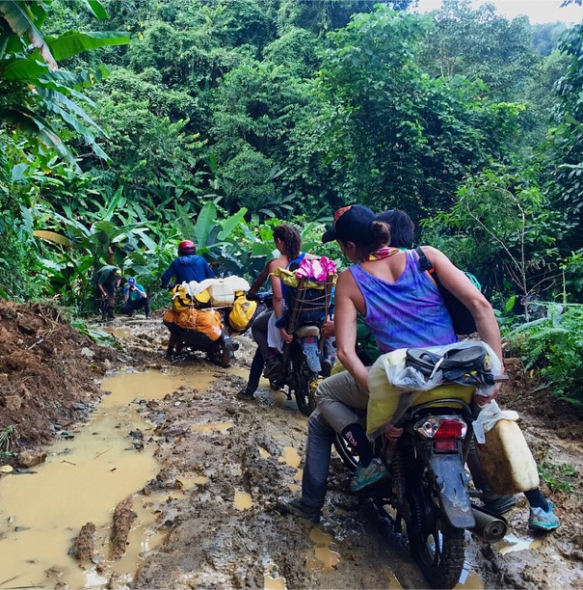
National Geographic together with The North Face are on an expedition to find the highest peak in southeast Asia. A group of six seasoned adventurers are traveling primarily on foot with some boat and motorcycle assistance deep into the jungle on a trip that will require two weeks of unsupported hiking and travel in each direction. The group is so off the grid they are carrying their own stash of anti venom to treat a possible, or even likely, poisonous snake bite by any one of a kaleidoscope of colorful and lethal vipers, cobras and kraits. Mark Jenkins, a seasoned writer of adventure non-fiction is documenting the group’s trip with regular posts at adventureblog.nationalgeographic.com

This expedition has all the hallmarks of real exploration and is reminiscent of expeditions of  the 19th and early 20th centuries. The objective is vague, the route is potentially deadly and what the outcome will be is far from clear.

adventureblog.nationalgeographic.com

adventureblog.nationalgeographic.com

Below is a link to the first post, including a very closeup picture of Trimeresurus albolabris, the lethal white lipped pit viper, which expedition member Hilaree O’Neill nearly stepped on.

Myanmar Climb: Welcome to the Jungle – Dispatch #1 – Beyond the Edge.

Off the Trail: Marking time.

This weekend Jewish congregations around the globe will once again resume the weekly out-loud public readings of the Torah (Five Books of Moses, aka Old Testament)  from the beginning, Genesis. “In the beginning, God created the heavens and the earth” the Torah opens. The statement is simple but jarring. Every year at this time we are confronted with our humblest of beginnings. Not our personal beginnings but the earliest explosive cataclysmic beginnings of a universe so vast as to be incomprehensible.

Geologists estimate the age of our planet Earth as 4.6 billion years old. Yet multicellular life did not make its appearance for almost 4 billion years. John McPhee, pulitzer prize winning non-fiction author of Annals of a Former World, a 660 page collection of five books published under one title for the first time in 1998, writes succinctly: From an interstellar gas cloud, evidently, the solar system began to form about 4.56 billion years ago. The first eleven verses of Genesis cover more than 4 billion of those years – the entire Precambrian and the first one hundred and fifty million years of Phanerozoic time (p. 630).

jpegIn his five separate books written over about 20 years, McPhee accompanies leading geologists along as they explore and explain the geology of the United States. McPhee’s plum line is Interstate 80, which starts near the basaltic columns lining the Hudson River just north of New Jersey’s George Washington bridge and following it as it crosses the mid-portion of the country )what he refers to as “the craton” and continuing from East to West ending in or about the San Andreas fault which runs right through San Francisco. McPhee queried one geologist and asked him how he reconciled his professional work that dealt in hundreds of millions and billions of years with his daily life which operates on minutes and hours, days and weeks. The rock scientist explained that his was indeed a schizophrenic existence.

We focus on the now, because, after all, that is where we live our lives. The present. Our sense of history spans decades, and in some cases, centuries and once in a while, a millenium or two. “Classic rock” music goes back only fifty or so year, making a mockery of the word “classic”. But, rock music is not that old. The rocks that are the actual foundations of our cities, the bedrocks under the dirt holding our homes up, are, however, beyond ancient. I don’t think we have a word to capture the span of ‘billions of years ago’. “Ancient” is lacking. “Old” is not even a consideration.

The woods are an antidote to the “now-ness” of mundane living. In the forest, or mountains, or wadi, whether hiking or running, you travel among the extraordinarily ancient rocks, some sculpted by water running intermittently over thousands of year, between boulders carried and left behind by advancing than retreating glaciers, and summit mountain tops rounded by tens of thousands of years of erosion, shaping the land bit by bit. Out there is where we are confronted with our planet’s unfathomable past. And at least once a year, Judaism reminds us all that our lives area a fleeting nanosecond in God’s intergalactic time scale. But soon enough, within minutes of the opening of Genesis,  we will begin reading about the exploits of Man and Woman, as they begin to build their lives, in the slow motion that sometimes seems so real. In fact, we make our appearance just 16 sentences later, and mankind remains the focus from then on.

Our challenge is to synthesize these two schizophrenic realities, and make some sense of the now.

Off the Trail: California – Paradise Burning – The New Yorker

This is my second re-post from The New Yorker in one month, a practice I hope  not to rely on. But, the following video, by Sky Dylan-Robbins of The New Yorker illustrating a piece written by Dana Goodyear in the current issue, about the effect of the severe drought on California’s food basket farm lands, delivers a real jolt, especially if you live in a verdant part of the world, shielded from dire water scarcity. For United States citizens who consume a lot of food from California, this drought will likely have real implications: food prices going up is the best case scenario. Food scarcity is the other real possible outcome.

It’s interesting to hear the seasoned California sheepherder Martin Etchamendy who is interviewed, an older man with sunburned chiseled facial features, the lines in his face shaded just a bit by his large straw cowboy hat. “Water, we need water. Water, water, water,” he says gesturing emphatically toward the opening of the 7 minute long video. “Sometimes,”, he continues later in the piece, ” it is easy to forget who produces the food”.

As the Jewish people gather to mark the new year this week, may “Who Produces the Food” shower His countenance favorably upon us and the entire world.

California: Paradise Burning – The New Yorker.

On the Trail: ‘Shelter’ outside

West Mountain Shelter, Eric Koppel

West Mountain Shelter, Eric Koppel

“Shelter” is not a word commonly invoked to describe the vagaries of our modern 21st century day to day lives. We don’t say “I am going into my shelter now”. Rather, we say “I am going inside”, meaning, of course, we are returning into the safety and security of our homes. In fact, “shelter” evokes images not of home and hearth but of a bomb or air raid shelter, remnants of the 1950s cold war. If you live in Israel, a “shelter” is part of your normal vocabulary as all new construction must include a shelter or “safe room” to protect from missile attacks, or worse. And, a little over a year ago the word “shelter” was repeated frequently as Boston police warned residents to “shelter inside” while they searched for the Boston marathon bomber.

In all recent examples, “shelter” has a negative connotation: a place to retreat from mortal danger.

And so, the notion of a 3-sided low ceilinged stone structure built on the side of mountain, miles from a road,  town or city being called a “shelter” is anachronistic. Afterall, this primitive structure could only protect from rain and snow, and that only if they are not blowing in sideways. These shelters are no protection from wild animals, big or small, and offer only partial protection from cold or heat. Yet, these structures found along most long distance hiking trails are in fact referred to as “shelters” for they do offer a hiker  a modicum of protection from the weather. A “primitive shelter” is a more apt name.

As I set my backpack down last Sunday on the stout wooden floor boards of the West Mountain shelter in Harriman State Park, about a half mile from the Appalachian Trail, I felt indebted to the men who, in about 1928-29, went to great effort to build this structure in the woods. In their prescience, they sited the West Mountain shelter on pre-Cambrian granite bedrock,  to face an unobstructed view of the Hudson River and off in the distance, the Manhattan skyline, a skyline that was only just getting started at the end of the roaring twenties.

This shelter, like so many shelters on hiking trails in the northeast, is a substantial structure consisting of three walls built from bowling ball sized boulders of different colors and shapes, held together with no mortar noticeable, yet impermeable to wind and rain blowing through the walls. The ceiling consists of shingles on top of wooden beams and slats. The West Mountain shelter even includes two built in fireplaces on either side of the broad open front entrance. It does not have a water source nearby but I can not fault the nameless men who built this edifice 85 years ago. They were clearly taken with the beautiful view, water or not.

Volunteers continue to maintain and build hiking trails all over and even refurbish shelters when needed. But I do not hear of many cases of shelters being built at new locations, although it probably happens. As I ‘sheltered inside’ the West Mountain lean-to, protected from nothing in particular on that sunny, balmy, picture perfect day, I wished I could have offered a personal thanks to the people who chose this location, gathered the boulders and wood needed to build this old fashioned trail shelter so many years ago, rock by rock, beam by beam.

Howard E. Friedman

-30-

Off the trail: A fresh look at dirt.

I have hiked or run on dirt trails for a number of years now so it is odd to look at dirt in a new way. But now, I am careful where I tread on the dirt, lest I stomp on and kill a seedling.

A few weeks ago I was assigned a community garden plot. I did not receive the news until almost the end of June so it was a real race to find seeds to purchase, till the soil and plant my garden. By the middle of July, late one night after work, after dark, my garden was fully planted. I opened the spigot and jiggled my thumb over the end of the hose to create an arcing spray. By the light of my headlamp,  globules of water looked like pearls in the beam of light, disappearing silently into the dirt. With a great deal of good fortune I might just get a crop of corn, lettuce, carrots and zucchini in the early fall.

Now on summer evenings I am drawn to my garden like I used to be drawn to the dirt on the trail. But now I am not interested in how much ground I can cover and what I might see along the way. Rather, I am interested in how much I can grow out of this plot of earth.

Surprising as it might seem, gardening in any organized way, and certainly modern corporate farming, is relatively new to the human race. What with homo sapiens dating back almost 200,000 years ago, anthropologists believe that we humans only began to actually plant seeds to grow food sometime around ten thousand years ago. We gathered plants, fruits and nuts to eat prior to that. But cultivating an understanding of gardening took many, many years.

Indeed, scientists explain that at first human ancestors practiced not agriculture, the planting of seeds in cleared plots of lands, but rather vegeculture, that is planting a seed or two outside of the cave entrance in an available clearing. Only after years of experience with vegeculture did humans develop the ideas and concepts which ultimately led to modern gardening and farming: clearing tracts of land, mass planting of seeds and watering and fertilizing the crops.

When hiking along the dirt trail in the forest I pass through the land. Now I  myself am rooted to the soil, fingers deep into the dirt, like tendrils of a seedling. I tread lightly, checking each step again and again so as not to stray onto the tiny emerging sprouts.  And though I stay by my hundred square foot space, the experience is immersive, expansive, not claustrophobic or limiting. And I leave with a similar sense of calm I get from time spent deep in the woods.

The dirt is common to both the trail and garden.   It is an alluvial silty outwash from rocky sediment, mixed in with composted lichen and forest litter, serving as a home to thousands of microbes, yielding a magic carpet that bedizens our forests and farms and helps nourish a planet. And we should respect this life giving resource. Now well into the summer of 2014 we are inundated with painful news of planes falling from the sky killing all aboard, school girls gone missing, teenage boys abducted and murdered, conflicts around the globe, in Ukraine and Israel and Gaza. Body counts of killed and wounded climb.Mourners’ tears water cemetery grass. One response to ongoing conflict will ultimately come from the soil, which will outlast all combatants and go on in the fullness of time to hide the remnants of the warfare we wage. American poet Carl Sandburg (1878-1967) recognized the power of the soil to hide the horrible in his poem Grass. For Sandburg, the grass hid the memories. Perhaps we the citizens of the earth can learn to till hope from the soil, instead:

Grass

BY CARL SANDBURG

Pile the bodies high at Austerlitz and Waterloo.
Shovel them under and let me work—
                                          I am the grass; I cover all.
And pile them high at Gettysburg
And pile them high at Ypres and Verdun.
Shovel them under and let me work.
Two years, ten years, and passengers ask the conductor:
                                          What place is this?
                                          Where are we now?
                                          I am the grass.
                                          Let me work.
Howard E. Friedman


On the Trail: Peer into the Shade


Shade on the Escarpment Trail in the Catskills (http://www.nature-photography-in-the-rough.com/)

Shade on the Escarpment Trail in the Catskills (http://www.nature-photography-in-the-rough.com/)

Summer has begun and in the northern hemisphere that usually means hot and sunny especially if trails are above tree line. But in the northeastern United States we are lucky that miles and miles of hiking trails remain well shaded as they traverse forests under a canopy of millions of maple. birch, hickory, oak and beech leaves, among others. The shade is a balm on a hot and sunny day.

Striped Maple, an understory tree (http://njurbanforest.com/about-nj-urban-forest/)

Striped Maple, an understory tree (http://njurbanforest.com/about-nj-urban-forest/)

Running through a shady trail last week, I thought about the challenges of life in the shadows. For plant and tree life dependent on sunlight for photosynthesis, shade would seem to a be a punishment, like half rations for a prisoner, or no rations at all. Yet, the understory of forests, the part that is mostly in the shade, does teem with verdant greenery. Indeed, some trees, notably the striped maple, inhabit only the understory and do not ever breech the forest canopy. Other trees, however, are shade tolerant. That is, they can survive in the shade, for years if needed, until they have an opportunity to leave the understory and poke their tallest limbs into sunlight, perhaps after a nearby taller tree topples over, clearing a space in the forest canopy. And, many plants, even in our own gardens, flourish only in the shade.

How does life tolerate the dimness of the daytime darkness, the absence of direct sunlight, especially when that light is a currency of life for most plants and trees? There is no one answer. Instead, plants in the shade use a cornucopia of adaptations for their survival.

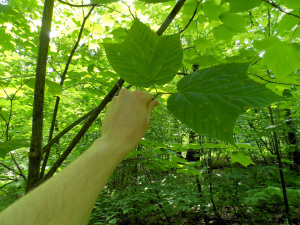
Think of common shade plant in many home gardens, Hostas. Notice that they have large leaves, an adaptation to collect as much sunlight as possible. In addition, the chloroplasts in the leaves of shade dwelling plants and trees are larger than in trees and plants that live in full light and their epidermal cells are better designed to maximize light. Also, shade trees and plants have no waxy layer on their leaves, something that trees in full light use to help reflect away unneeded light. And, in addition, shaded plants can change the angle of their leaves to maximize any available light during the day.

Shade is not only sunlight blocked, but rather potential not yet realized, growth untapped, waiting for opportunity. Shade tolerant plants, though, have it figured out. Do not wither during lean times. Adapt and be patient. If you find yourself struggling out on your trail, peer into the shade for inspiration, then continue on your way.

The sunlight, it is a coming.

Howard E. Friedman


(for more information about shade apaptations, visit : http://plantsinaction.science.uq.edu.au)


On the Trail: One Dose of The Escarpment Trail

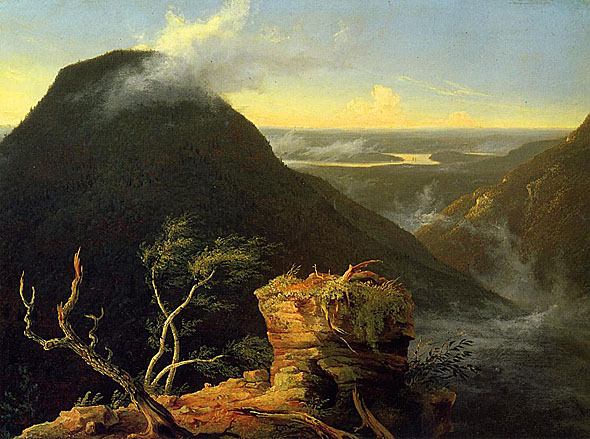
Sunny Morning on the Hudson, Thomas Cole, c. 1820 (explorethomascole.org)

On the last Sunday and Monday of May I was fortunate to backpack 19 miles of the Escarpment Trail, a footpath dating back in parts to the early 1800s, which climbs up, and down, and up and down as it traverses the eastern most ridge of the Catskill mountains, providing a commanding view towering 2,000 feet above the Hudson River valley and the self-same river seven miles in the distance. The escarpment, a rocky buttress which extends for more than 30 miles in all, inspired many American painters in the nineteenth century who carried their easels from the southern section of the trail up onto the rocks overlooking nearby North-South Lake and river and valley below, garnering the name for themselves, Hudson River School painters.

Our path began in the town of Windham, NY with a three mile climb to Windham peak at just over 3,500 feet elevation. Our trail followed due south, cresting Blackhead Mountain, 3,950 feet elevation before dipping back to lower elevations. We camped along the ridge top after completing 11 miles, setting out early the next morning to continue our journey, stopping to refill water at a piped spring gushing water from a sandstone massif. The trail transects several types of flora along its course, from Northern hardwood forests of birch, beech, maple and pine trees to Alpine type forests of primarily Balsalm Fir, which fill the air with the smell of Spring itself. The forest than changes to large stands of primarily birch trees along the way. Splashing the trail with colors on either side of the single track footpath were abundant amounts of Purple Trillium flowers (also called Wake Robin) along with Canada Violet, Spring Beauty and Wild Columbine.

Purple Trillium, photo by Jim Salge (www.vftt.org)

Purple Trillium, photo by Jim Salge (www.vftt.org)

My mind was still playing back scenes from the Escarpment Trail days later when I read about new research that found that modest exercise in senior citizens can help them maintain their mobility. These findings were reported on May 27th, 2014 at the annual American College of Sports Medicine conference and published in the recent Journal of the American Medical Association . Researchers found that a daily walk of only 400 meters, or once around a high school running track, was sufficient to keep older, primarily sedentary people mobile. Of course, everyone knows that exercise is good for you. But, we don’t really know how much is needed to get results.  This study establishes that for this group of 1,635 sedentary people, ages 70-89, walking only four hundred meters could be considered one “dose” of exercise. And according to Wendy Kort Ph.d. from the University of Colorado, who reviewed the study, this research begins to refine the notion of what is an appropriate “dose” of exercise.

Our backpacking trip was necessarily short to accommodate work and family responsibilities. We left at 8:30 Sunday morning and returned home around 5 p.m. Monday but, with travel, our time on the trail really extended for just a bit over 24 hours to cover the 19 steep, rocky miles and allow time for eating and sleeping.

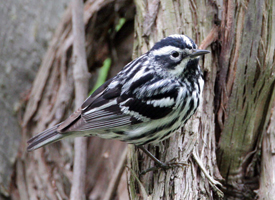
Black-and-white warbler, photo by John McKean (www.allaboutbirds.org)

While the trip was short we did manage to traverse most of a well established hiking path, packed with beauty on the trail including not only wildflowers and shifting forest types, but vistas of the horizon, including the Hudson River, views of other Catskill peaks and even an unexpected close-up view of a black and white warbler only several feet away, perched on a spruce branch. The trail does include one macabre reminder of the power of windy downdrafts along a 2,000 foot escarpment: the well preserved fuselage of a Cessna plane that rests feet from the trail, exactly where it crashed in this mountainous area decades ago, killing its pilot.

This trek into the woods I would say, was one dose, or perhaps a double dose, of immersion into nature untamed. Time will tell how long it will last before I will needs prescribe myself another dose.

Howard E. Friedman
On the trail: A virtual backpacking trip thru Yosemite…

from Project Yosemite by Sheldon Neill and Colin Delehanty

from Project Yosemite by Sheldon Neill and Colin Delehanty

With warmer weather, thoughts turn to epic hiking and backpacking trips, many of which, unfortunately, will not materialize, at least not this season. While I do not profess that technology can replace a true outdoors experience, I would be foolish not to at least acknowledge that the increasing marvels of technology are bringing the outdoors closer and closer to our fingertips.

I would love to spend some time backpacking through Yoesmite Valley. But, it won’t happen this summer. In the meanwhile, my eyes and even my soul can feast on the magnificent time lapse video footage capturing the movements of land and sky filmed over 10 months with sophisticated equipment to create a pretty darned good simulation of sights and sound of a hike throughYosemite National Park.

Colin Delehanty and Sheldon Neill hiked 200 miles carrying 70 lbs. of camera equipment on their backs to make the following five minute outstanding video. Visit www.projectyose.com to see this video (a Vimeo editor’s choice), nourish your soul, learn more about their project and see links to others they met along the way who have also captured on film the beauty that is Yosemite National Park.

Howard E. Friedman

“A Window on Eternity”, in Gorongosa and Chernobyl

Destruction of our natural habitat comes in many many different forms. Edward O. Wilson writes about destruction and rebirth in one such place, Gorongosa National Park in Mozambique. And Timothy Mousseau, professor of Biology at University of South Carolina, studies destruction and its impact on rebirth in another location, Chernobyl, Ukraine.

A Window on EternityIn A Window on Eternity, A biologist’s walk through Gorongosa National Park (Simon & Schuster 2014), Wilson briefly recounts the history of Mozambique’s 16 year civil war ending in 1994 which resulted in nearly a million people killed and the creation of several million refugees. A collateral effect of the war was near extinction of what Wilson describes as “the megafauna” of Gorongosa National Park, a wildlife refuge located in Mozambique, but too close to the fighting. Large edible and/or valuable animals were killed for food or profit. Elephants decreased by 80-90% in number. Cape buffalos went from 13,000 in 1972 to 15 in 2001, Wilson writes. Wildebeest went from 6,400 to one and zebras from 3,300 to just 12 he adds.

Thanks to the great efforts of U.S. businessman and philanthropist Gregory Carr who began over seeing the reintroduction of large animlas back into the park, Gorongosa is staging a slow resurrection.

“Another several decades may be needed for Gorongosa to return to its old preeminence, but given the persistence of its undergirding of plants and invertebrates which largely survived the war intact, I believe this  will surely come to pass,” Wilson concludes in the chapter called ‘War and Redemption’. In the chapters that follow Dr. Wilson describes findings from his and his colleague’s expeditions to Gorongosa as he shares their ground-eye view of ants, katydids, praying mantises and others. “None to me is a bug,” he writes, “Each instead is one kind of insect, the ancient legatee of an ancient history adapted to the natural world in its own special way. I wish I had a hundred lifetimes to study them all,”  he writes in the beginning of chapter eight, ‘The Clash of Insect Civilizations’.

But while E.O.Wilson is sanguine about ‘The Conservation of Eternity’ (title of chapter eleven) in nature’s ability to recover from war in Gorongosa park, fellow biologist   Timothy Mousseau, professor at University of South Carolina is less optimistic about the resilience of various phyla of the animal kingdom to survive nuclear fallout. Dr. Mousseau has been studying how various species of birds, spiders and insects have fared in and around the Chernobyl nuclear reactor which exploded 25 years ago, releasing large amounts of radioactivity into the atmosphere. His work was featured on Newyorktimes.com.

Dr. Mousseau in Red Forest, Chernobyl (http://cricket.biol.sc.edu/Mousseau/Mousseau.html)

Dr. Mousseau in Red Forest, Chernobyl (http://cricket.biol.sc.edu/Mousseau/Mousseau.html)

Still a hot zone, the area around the old plant has been off limits to humans, making it an interesting living laboratory to study flora and fauna without the day to day interference of human life (though one could make an easy argument that after contaminating an entire region with radioactive waste, day to day human activity is kind of negligible). Since 1999 Mousseau and Dr. Pape Moeller have been documenting aberrations in spider webs, bird beaks,  insects and rodents, all of which they say reflect genetic mutations in animals living in the most radioactive zones around Chernobyl. And, while some researchers take issue with Mousseau and  have pointed to the fact that any wildlife that persists around Chernobyl is proof of the resilience of  various species, Dr. Mousseau cautions that if you look more carefully, life has persisted but not robustly and not in good health.

Neither scenario is appealing. Dr. Wilson documents a resurgence of wildlife in an area that witnessed almost a million human deaths, thousands of animal deaths and which required importing ‘megafauna’ species to help repopulate the area. Dr. Mousseau documents the persistence of weakened and wounded life which, however, has been able to survive a near direct nuclear explosion but which has little hope of ever returning to full health. Perhaps for either scenario, Edward O.Wilson was prescient in selecting the opening quote in his latest book: “I have set before you life and death, blessing and cursing: therefore choose life, that both thou and thy seed may live . – Moses at Mount Nebo, Deuteronomy 30:19.”

Howard E. Friedman

On the trail: Retreat and the edge effect

Tenafly Nature Center at Rt. 9 (H. Friedman)

Tenafly Nature Center at Rt. 9 (H. Friedman)

I finally turned back.

Perhaps my plan was ill advised from the start. To run and hike in two feet of snow without the aid of snow shoes or skis. Or even boots. Just La Sportive Wildcat trail shoes and a plastic bag I had slipped over each of my feet before I put my shoes on. But I really thought the snow would have been tamped down already by other hikers with their snow shoes or cross country skis or boots.

Apparently very few people had been out and the trail was covered with thick pillowy snow, softening in the warming temperatures. But on I ran, counting on my Kahtoola Microspikes to grab the ice and hard packed snow and prevent slipping. They were no match for today’s conditions. In some cases I crashed through the top layer of hard packed snow. But in other spots I post holed, my foot slipping into a cauldron of cold. After thirty minutes I finally accepted that I was neither trail running nor hiking, but rather slowly and inefficiently slogging my way uncomfortably through a forest blanketed in snow.

It was time to retreat, that moment when hope collides with reality.

Mountaineers must deal with the quandary of retreat. If a mountaineer advances to a summit when the odds are against her, she risks her life. Yet if she retreats she will have spent thousand of dollars and weeks or months on an unsuccessful expedition. Successful climbers, however, succeed in part because they know when to advance and when to retreat.

photo by Jake Norton/adventure.nationalgeographic.com

photo by Jake Norton/adventure.nationalgeographic.com

American mountaineer Ed Visteurs, the first U.S. climber to ascend all of the world’s 14 peaks over 8,000 meters (and without the use of supplemental oxygen), offered realistic advice about success in mountain climbing. “Getting to the top is optional. Getting down is mandatory”, he said. Each person who sets out on an adventure, be it large or small, must respect his own limits, his own edge of ability.

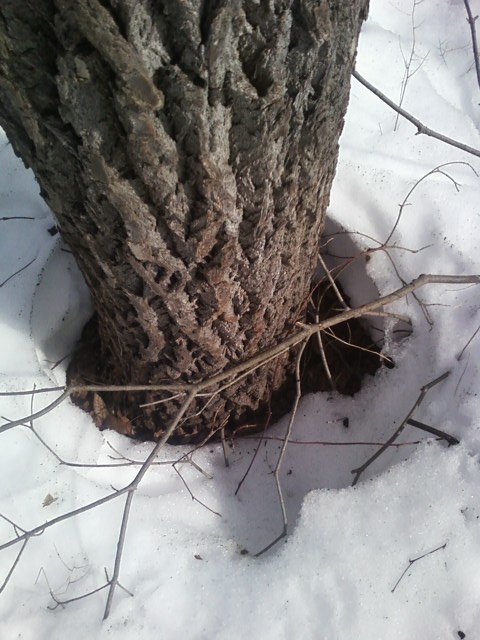
During my retreat I noticed that snow that had settled around the edge of the base of the trees was now melting away from those same trunks, leaving a ring of snow. And that ring forms a thin edge. The snow was disappearing gradually from around the trunks. The edge where the two had coexisted was the first spot to melt away.

Tenafly Nature Center 2014 (H. Friedman)

Tenafly Nature Center 2014 (H. Friedman)

Snow always begins its retreat at the edges, where it abuts a fencepost, or sidewalk or stone wall. The edge is a fragile place. Retreat for humans also occurs at the edge, the edge of ability or mental discipline. And when retreat comes, it starts with just one foot step, one step back. But that one step may be the difference between adventure and misadventure.  When you are standing on the edge, knowing whether to walk forward or back is one of life’s great challenges. But do not mistake turning back for defeat. Retreat is simply an opportunity to try another day.

Howard E. Friedman