On the Trail: Winter and the Big Bang

(Forestwander.com via Wikimedia Commons)

(Forestwander.com via Wikimedia Commons)

In a week riddled with more senseless and barbaric killings around the globe one small item of astrophysical import did not  garner much attention, even though it addressed the fundamental question of how the universe began.

The mercury began this morning in the teens when I awoke.  Dressed in layers I ran  to the nearby woods to see what I would see. In winter, all is hidden yet all is revealed. I saw no animals running about but only remnants of their activity from the day or night before. Squirrel tracks galore, raccoon and opossum prints, the occasional deer tracks and even the footprints of a family of mallards on the ice covered portion of the slow moving creek, webbed toes pointed toward open water. Two red tailed hawks and a great blue heron took off from their hidden perches, quickly, silently, vanishing like actors disappearing into the wings.

I ran a familiar route on snow and ice and came to the small pond, now frozen solid, a rare opportunity to walk out on the ice. The water is never deep here so the only risk would be wet and frigid feet if the ice cracked below. But it held.

The harsh frozen landscape seems ancient, as if it could exist for eternity, in contrast to Spring where flowers and their petals seem so fragile, even at the peak of their beauty. Winter conjures images of frozen planets in our solar system, or the frozen dark side of the moon, dry, seemingly lifeless. And thus winter makes me ponder the origins of our universe and the earth itself.

Professor Brian Koberrlein expanded on an article explaining how our universe did not necessarily begin with one defined singular moment, the ‘Big Bang’. Rather, the professor at Rochester Institute of Technology wrote in Physics Letters B, citing research from the University of Benha in Egypt and Letherbridge University in Alberta, Canada this month, the universe always existed and will always exist. A ‘big bang’ happened along the way, but that moment, referred to as “singularity” by astrophysicists, does not have to have been the first moment.

“Singularity”, one point from which all else emanates, is a comforting idea, and, we each can identify defining moments in our lives that marked a new beginning. But, outdoors in nature, peering down the snow covered trail that fades into a sun filled patina of white and ice, the infinite seems more real than the finite.

And I am glad to welcome “infinity” back into the model of how the universe began. The concept of timelessness helps frame our own travails and challenges. Whatever will be, the universe always was and always will be and we are a part of that timelessness. And while winter on the trail evinces a natural timeless quality, you can follow that same path in the Fall, or Summer, or Spring, and it will still take you to forever.

Howard E. Friedman

-30-
On the Trail: Hiking alongside evolution

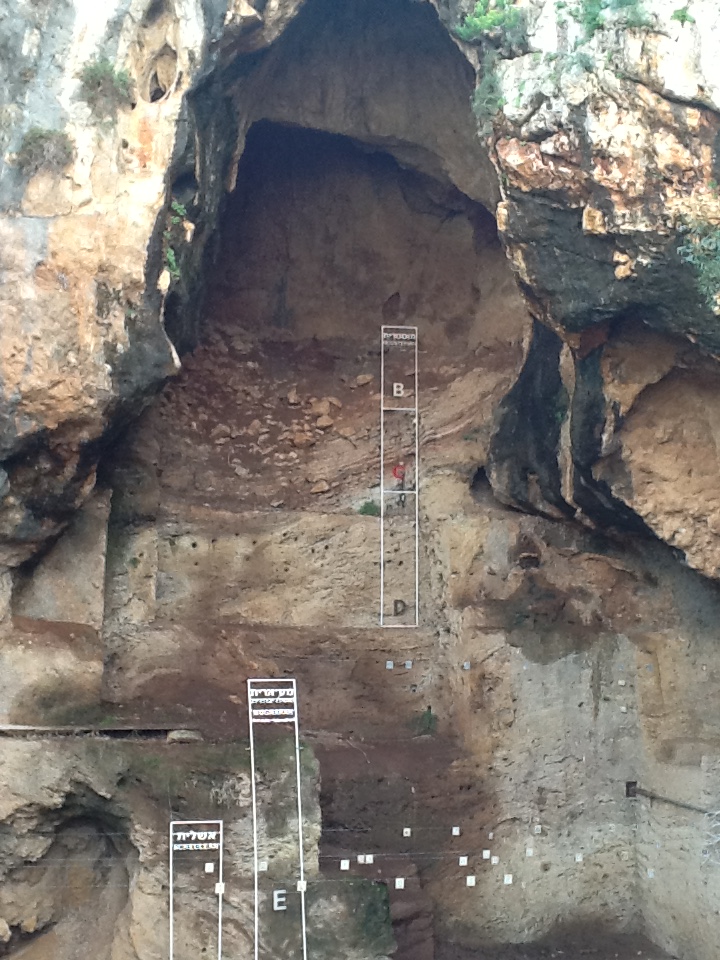
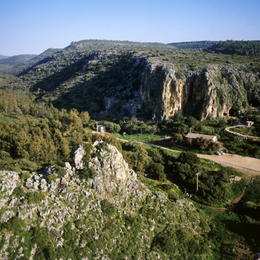
Tabun Cave, site of pre-historic human activity,  lies next to the Israel National Trail (phto: Albatross Aerial Photography)

Tabun Cave, site of pre-historic human activity, lies next to the Israel National Trail (phto: Albatross Aerial Photography)

Israel is in the news for the recently announced discovery of the Manot 1 pre-historic modern human partial skull, carefully dated to 55,000 years ago. The skull was found in a limestone cave in the Galilee region of northern Israel in 2008 and carefully researched for the past 6 years by Professor Israel Hershkovitz and a team of anthropologists from Tel Aviv University. The find was published in the respected journal Nature and reported widely across the world. The skull has features of modern humans but also some Neanderthal features, again focusing attention on the question: did ancient Homo sapiens interbreed with Neanderthals?

About one month ago I was fortunate to have an opportunity (thanks, Mom and Dad) to visit the Carmel region of Israel and hike a bit of the Israel National Trail, a hiking trail which extends the length of the country, 1000 km, from north to south.

Blue, white and orange triple color blaze of the Israel National Trail

Blue, white and orange triple color blaze of the Israel National Trail

The section of trail I visited is literally a stone’s throw from another important anthropology site, the location of Tabun, Skhul and El-Wad caves, also limestone massifs, with a commanding view of the Mediterranean Sea and Israeli coastline just 5-6 miles due west.

View of the Mediterranean from Nachal Meorot

View of the Mediterranean from Nachal Meorot

These caves were discovered and excavated beginning in the late 1920s by British paleontologist Dorothy Garrod,a pioneer and rare female in her field. The site continued to be excavated into the 1960s and was recently named a UNESCO World Heritage Site. This collection of caves demonstrates more than 200,000 years of human existence including Neanderthal and early Homo sapien remains, living in the same location, even if not at the same time.

Looking into Tabun cave. Neanderthal remains were found in the middle layers and ancient hominid remains above and below.

Looking into Tabun cave. Neandratal remains were found in the middle layers and ancient hominid remains above and below.

Moreover, one of the adjacent caves presents a clear example of Natufian culture, humans who began to settle in one location and live a more agrarian lifestyle, no longer living a nomadic ‘hunter-gatherer’ existence. Just outside this cave system were multiple buried human skeletal remains, more than 10,000 years old, decorated with various ornaments. These may represent one of the earliest burial sites in the world.

And now, just dozens of miles away, we now have evidence of human remains which indeed represent another example of ancient humans in transition. Just exactly what that transition was from and where it was going to remains to be proven more definitively.

Manot-1 partial skull with features of ancient hominid and Neandratal (photo: Prof. I. Hershkovitz, in Nature, on-line Jan. 2015)

Manot-1 partial skull with features of ancient hominid and Neanderthal (photo: Prof. I. Hershkovitz, in Nature, on-line Jan. 2015)

It is rare these days to see “Israel” in a newspaper headline without some human tragedy or geopolitical tragedy following close behind. For the story from Manot Cave, at least, the only controversy would be of a scientific nature. And on that point, remarkably, most scientists interviewed have praised the Tel Aviv University researchers for their careful, deliberate study, analysis and conclusions.

While most tourists who travel to Israel do so to visit and bask in the holy religious sites of the past couple of thousand years, be they Jewish or Christian or Muslim, very few people travel to Israel to see where ancient Neanderthals once lived. I myself have traveled to Israel on multiple occasions, and only recently even knew such a site existed in Israel (thank you Professor John Hawks and for your Coursera course on Human Evolution).

Perhaps after visiting all the holy sites, tourists and locals alike should visit these most ancient sites of human habitation, to underscore our common heritage and to know that what joins us all into the family of ‘Man’ is so much more ancient than what divides us.

Howard E. Friedman

-30-

On the trail: Walking and newness

“Are you getting tired of walking?”, Steve Inskeep, host of NPR’s Morning Edition asked National Geographic adventurer Paul Salopek after he had completed the first year of his planned seven year walk retracing human migration from Ethiopia, through the Middle East, Asia, North and South America and ending at Tierra del Fuego, the southern tip of Chile. Salopek is wintering in Turkey for a few months, to rest, catch up on documenting his trip and plan the next section of his walk.

Salopek did not hesitate to answer.

Myriad reasons attract people to walk the open road or trail. Many are motivated by the need to exercise. Some are seduced onto the rocky trail by the siren call of rustling leaves, or a cascading creek, or the birdsongs which are so prominent a part of nature’s soundtrack.

And if you are fortunate, you returned from your hike or run or walk in the woods feeling emotionally recharged, even if physically tired. You may have seen an animal or flower that quickened your heart beat. Worries dissipated, at least for a time, and where to place your next footstep was your most pressing concern.

But how does it happen? How can running along a brook, hiking in a meadow or walking through the park be so therapeutic?

Today at twilight I ran along a creek, a small river, actually. And I was surprised by what I did not see. No birds. No herons, or egrets or cormorants. No swallows diving toward the water than soaring toward the sky. And I saw precious little animal life. One cottontail, not the dozen I usually see. And one doe, large eyes staring straight at me, but all alone.

The branches were bare save for the pine and spruce boughs. And no trefoils or clover were in bloom. All was quiet, nature bereft.

As I contemplated the stillness I thought of the answer Salopek gave at the end of his interview.

Salopek interacts with villagers (photo by Paul Salopek) http://www.nationalgeographic.com/explorers/bios/paul-salopek/

Salopek interacts with villagers (photo by Paul Salopek) http://www.nationalgeographic.com/explorers/bios/paul-salopek/

“Are you tired of walking?”, Inskeep asked.

“No”, he answered immediately. “I think, on the contrary, that’s what this walk does. This walk has the power I never imagined, to make the whole world seem new again”, Paul Salopek concluded.

How than does the trail recharge the soul? When you engage the world at a slow human pace, and remain in contact with the ground, you have the opportunity to see the world anew.

Around the globe, many people will soon mark a new calendar year. But make no mistake. What makes the year, or month or day new, is not the date on the calendar. Rather, the ability to look at the day with open eyes, and take the time to contemplate that experience, that is what endows sameness with newness.

I do not have Salopek’s seven years to walk. But I can wander into a nearby forest or field, and when I do and whatever the season, even on a barren winter eve, all seems new, again.

Howard E. Friedman

-30-

On the Trail: Boots on the ground

"Wild" from Fox Searchlight Pictures, featuring Reese Witherspoon, and Danner boots,

“Wild” from Fox Searchlight Pictures, featuring Reese Witherspoon, and Danner boots,

The movie “Wild” is coming to a theater near you, the screen adaptation of the eponymous book about Cheryl ‘Strayed’, a newbie hiker who set off and thru-hiked the 2,600 mile Pacific Crest Trail on a journey of self discovery and emotional healing.

When you see a trailer for the movie, you will see Cheryl’s boots, the camera pointing straight down toward her heavy backpacking boots. Big, solid leather boots with prominent red laces and metal lacing hooks. For the movie at least, the actress Reese Witherspoon wore Danner boots, made by the long-time boot manufacturer in Portland, OR. I know this because I ordered a pair of Danner Station boots which I wear to work and therefore I am on their email list. They proudly sent me an email newsletter with a short film about the making of Reese’s boots, including footage of the Danner manufacturing plant and interviews with the employees, craftsmen, really, who assemble this old-fashioned bespoke footwear. (See Danner’s well done promo about their Mountain Light Cascade boot worn in the movie here).

Danner;s Mountain Light Cascade

Danner’s Mountain Light Cascade

Over the past several years, hikers, backpackers, runners and anyone who takes more than a passing interest in walking or running, shoe wear and design knows that the trend toward lighter weight foot wear has taken over much of the industry, at least for the shoe cognoscenti. Hikers are routinely thru-hiking the country’s longest trails, the Appalachian, Pacific Crest and Continental Divide trails, in running shoes or low cut hiking shoes.  And the reasons are simple. Researchers have established incontrovertibly that every 100 gram decrease in shoe weight results in about 1% less oxygen consumption required during activity. Basically, lighter weight shoes are simply easier to wear over long distances.

But, is there a hidden cost to our light weight foot wear?

Cam Honan who Backpacker magazine says “trekked 50,000 miles” on foot is reported in the March 2014 issue to have worn through 28 pairs of shoes on a 15,000 mile hike of all of the longest trails in the US including the AT, PCT and CDT. He switched out shoes on average every 535 miles. His experience is not unique. Long distance hikers often literally wear out multiple pairs of shoes. Old shoes, if we are conservation minded, get donated to a charity, if they are in any kind of wearable condition. Otherwise, they get added to the growing pile of the world’s refuse heaps.

So while boots like Danner’s Mountain Light boots are very heavy (probably approaching 2 pounds each), they are resoleable, what Danner calls “recraftable”. Perhaps Cam Honan could have covered 15,000 miles in two boots, the one he was wearing and the one that was being resoled. Who knows? But as we embrace lighter weight footwear, we should think about the issue of durability and having to throw more junk into our landfills.

The hiking and trail running shoe manufacturers should start to take a cue from rock climbing shoes, which take a beating, getting scraped and brushed against all manner of hard rock surfaces, yet, can be resoled and more than once. I have been wearing a pair of Five Ten Guide Tennies for a number of years and have had them resoled. Why can’t hiking shoes be light weight and resoleable?

I challenge hiking and trail running shoe manufacturers to design technical footwear that is both lightweight and ‘recraftable’. That way we can be both good to our feet and good to the planet.

Howard E. Friedman

-30-

On the Trail: An Ode to Old Shoes

Fare thee well, old running and hiking shoes,

companion for oh, about 15 moons.

Time has run out on thee, though I am fond of you,

like the day I first spied thee in thine box.


Do not be angry upon me my Italian Wildcats

You have served me well, o’er hill and dale

La Sportiva Wildcat

La Sportiva Wildcat

and along the Escarpment Trail.

And through puddles and snow, and in day and in night.


But you show your wear, though thee be but one year and some months old.

Your midsole is full of lines, creases, that cannot be ignored.

It is beaten down, and you feel hard beneath my soft feet.

Though, to be kind,  overall you still look so youthful.


But oh thy tread, thy tread, it is too worn, flattened smooth in areas

And gives me great fear on slick wet rock or damp tree roots

lest I go glissading, skittering into the air,

only to land and break a vital bone or tear a sinew.


We have indeed had joyous times,

running here, walking there

or sitting in quiet contemplation. But time moves on

And moreover, my fickle self also seeks a lighter model with a lower heel.


Lest you think me cruel, I will not totally abandon you.

Nay, I shall not drop you in the Salvation Army donation box

Or, send you to Soles 4 Souls, though that be wise and kind and useful

No, I will keep you in my closet, to don once a fortnight or so to run an errant errand.

(Until such time as I will decide to donate you at last.)


And no Wildcats, I will not make you meet your heir to my feet.

La Sportiva Helios

La Sportiva Helios

But know they too hail from your same Italian villa, and, probably are a close cousin,

But a full year younger, and lighter, and, oh, their tread, it is just fine.

No, Wildcats, you need not meet Helios now.


Rather, you will meet them in the closet, in, oh, about a year or so.


H.F.

-30-

On the Trail: Great Blue and You

Great Blue Heron, by Marie Read, allaboutbirds.org

Great Blue Heron, by Marie Read, allaboutbirds.org

Twenty minutes watching a great blue heron from fifteen feet away can teach you a few things.

I sideled up  to the waters edge of Overpeck Creek recently after running in the large urban park, to see what I would see. Usually not much. A distant cormorant or a snowy egret on the far side in the phragmites. But this morning would be one I would remember. A great blue heron stood motionless on the kayak dock just a few feet off shore. Completely motionless. Statuesque. Immaculately attired actually.

And there it stood. I  sat on a nearby granite rock and noted the time. It did not move, fixed in its gaze toward the water. Five minutes passed. Ten minutes. Than in balletic form it turned 180 degrees. And again stood still, now gazing at the water in the opposite direction. Another five minutes. No movement, until slowly the heron stepped off the dock and into the water, clearly a more strategic position. It lowered its head to within inches of the water, than looked up and moved away,  crouching under the sloped gangplank of the dock, compressing its neck into a perfect S shape, its dagger like beak pointed, poised, primed to strike.

Then in one explosive action the bird uncoiled its neck, and in so doing buried its beak full into the water with nary a splash.

Great Blue Heron, by Greg Bishop, flickr.com/photos/gregbishop160/2928315528/

Great Blue Heron, by Greg Bishop, flickr.com/photos/gregbishop160/2928315528/

What happened below the surface, though, remains a mystery for it raised its head high, its beak empty. Had it caught something small and quickly ingested? Whether because of its success or its failure, the great blue than strode away.

I took away some lessons from watching the heron, lessons of patience, perseverance. Lessons of focus, stillness and, that solitude is often essential.

But I also learned that clear, cool autumn morning by the shore of the wide slow moving river that if you plan to survive hunting small aquatic wildlife near the water’s edge, you should arm yourself with a very long, flexible neck and a beak as lethal as a bayonet.

Howard E. Friedman

-30-

On the Trail: A Walk into the Unknown

adventureblog.nationalgeographic.com

adventureblog.nationalgeographic.com

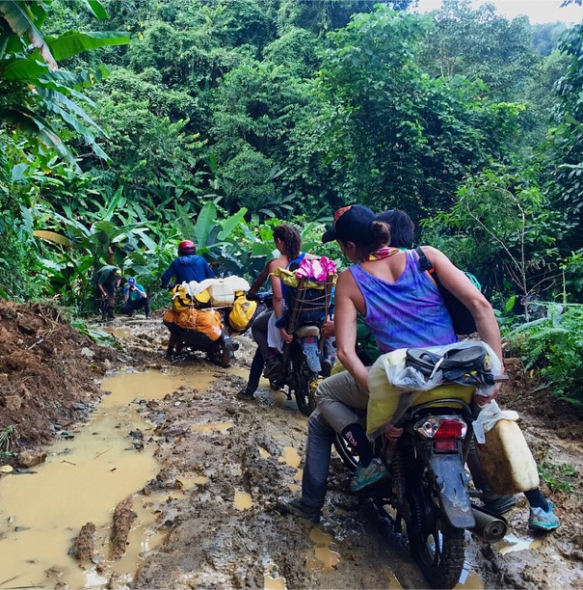
National Geographic together with The North Face are on an expedition to find the highest peak in southeast Asia. A group of six seasoned adventurers are traveling primarily on foot with some boat and motorcycle assistance deep into the jungle on a trip that will require two weeks of unsupported hiking and travel in each direction. The group is so off the grid they are carrying their own stash of anti venom to treat a possible, or even likely, poisonous snake bite by any one of a kaleidoscope of colorful and lethal vipers, cobras and kraits. Mark Jenkins, a seasoned writer of adventure non-fiction is documenting the group’s trip with regular posts at adventureblog.nationalgeographic.com

This expedition has all the hallmarks of real exploration and is reminiscent of expeditions of  the 19th and early 20th centuries. The objective is vague, the route is potentially deadly and what the outcome will be is far from clear.

adventureblog.nationalgeographic.com

adventureblog.nationalgeographic.com

Below is a link to the first post, including a very closeup picture of Trimeresurus albolabris, the lethal white lipped pit viper, which expedition member Hilaree O’Neill nearly stepped on.

Myanmar Climb: Welcome to the Jungle – Dispatch #1 – Beyond the Edge.

Off the Trail: Marking time.

This weekend Jewish congregations around the globe will once again resume the weekly out-loud public readings of the Torah (Five Books of Moses, aka Old Testament)  from the beginning, Genesis. “In the beginning, God created the heavens and the earth” the Torah opens. The statement is simple but jarring. Every year at this time we are confronted with our humblest of beginnings. Not our personal beginnings but the earliest explosive cataclysmic beginnings of a universe so vast as to be incomprehensible.

Geologists estimate the age of our planet Earth as 4.6 billion years old. Yet multicellular life did not make its appearance for almost 4 billion years. John McPhee, pulitzer prize winning non-fiction author of Annals of a Former World, a 660 page collection of five books published under one title for the first time in 1998, writes succinctly: From an interstellar gas cloud, evidently, the solar system began to form about 4.56 billion years ago. The first eleven verses of Genesis cover more than 4 billion of those years – the entire Precambrian and the first one hundred and fifty million years of Phanerozoic time (p. 630).

jpegIn his five separate books written over about 20 years, McPhee accompanies leading geologists along as they explore and explain the geology of the United States. McPhee’s plum line is Interstate 80, which starts near the basaltic columns lining the Hudson River just north of New Jersey’s George Washington bridge and following it as it crosses the mid-portion of the country )what he refers to as “the craton” and continuing from East to West ending in or about the San Andreas fault which runs right through San Francisco. McPhee queried one geologist and asked him how he reconciled his professional work that dealt in hundreds of millions and billions of years with his daily life which operates on minutes and hours, days and weeks. The rock scientist explained that his was indeed a schizophrenic existence.

We focus on the now, because, after all, that is where we live our lives. The present. Our sense of history spans decades, and in some cases, centuries and once in a while, a millenium or two. “Classic rock” music goes back only fifty or so year, making a mockery of the word “classic”. But, rock music is not that old. The rocks that are the actual foundations of our cities, the bedrocks under the dirt holding our homes up, are, however, beyond ancient. I don’t think we have a word to capture the span of ‘billions of years ago’. “Ancient” is lacking. “Old” is not even a consideration.

The woods are an antidote to the “now-ness” of mundane living. In the forest, or mountains, or wadi, whether hiking or running, you travel among the extraordinarily ancient rocks, some sculpted by water running intermittently over thousands of year, between boulders carried and left behind by advancing than retreating glaciers, and summit mountain tops rounded by tens of thousands of years of erosion, shaping the land bit by bit. Out there is where we are confronted with our planet’s unfathomable past. And at least once a year, Judaism reminds us all that our lives area a fleeting nanosecond in God’s intergalactic time scale. But soon enough, within minutes of the opening of Genesis,  we will begin reading about the exploits of Man and Woman, as they begin to build their lives, in the slow motion that sometimes seems so real. In fact, we make our appearance just 16 sentences later, and mankind remains the focus from then on.

Our challenge is to synthesize these two schizophrenic realities, and make some sense of the now.

On the trail: the fast keep getting faster

Much has been written recently about the widening income disparity in the United States. The rich continue to get richer while the poor stay poor and the income of the middle class slowly erodes.

This phenomenon is not limited to the economy alone. The fast get faster, too, while the slow, well, let’s just say they don’t get too much faster.

AP Photo/Andrew A. Nelles, from http://espn.go.com/sports/endurance/index

AP Photo/Andrew A. Nelles, from http://espn.go.com/sports/endurance/index

This past week in the 2014 Berlin Marathon, Kenyan Dennis Kimetto set a new world record for the 26.2 mile road race, completing the run in less than two hours and three minutes, beating the previous record by over 20 seconds, which is a significant improvement. Even the second place winner, Emmanuel Muthai, also broke the previous world record. Both runners are still a long way from crashing through the psychological and likely physical barrier of running a sub-two-hour marathon, though.

Kimetto, Muthai and the two top female finishers all had one thing in common. They wore the same type of shoes, the adidas Boost series “made up of thousands of energy capsules that store and return energy in every step”. I would be interested in running in these shoes to experience the sensation addidas promises.

adidas Adizero Boost

adidas Adizero Boost

I was initially excited about Mr. Kimetto’s finish, foolishly thinking somehow that it augured well for me personally, raising the bar of the possible, dangling a new aspiration. I am similarly excited to read about lightening fast speed records set hiking the entire Appalachian or Pacific Crest trails. Maybe I should buy the same shoes those record setters wore. Or, eat the same pre race meal.

But I have no illusion that Kimetto’s shoes will make me run appreciably faster, just as I have no illusion that driving the “luxury sedan” I see advertised on TV or wearing the very expensive watch mountaineer Ed Viesturs wore on Mt. Everest will appreciably enhance my life.

Most likely, or, shall I say, most definitely, mimicry of the elite is just mimicry, and will not result in significant change. So each year the Kenyans get faster while the middle of the pack runners continue to own the middle. And, the five-plus hour marathon finishers, well, they are happy just to finish.

One reason we humans focus on time and speed is because the discrete numbers are easy to measure and easy to understand.  But we should appreciate that, for the non-elite among us, watching those elite athletes push themselves to run and hike faster and faster, breaking record after record, is really, just entertainment. What happened in Berlin last week says lots about Dennis Kimetto and Emmanuel Muthai as runners, their training regimens and their ability to endure pain, and yes, perhaps something about their lung and heart capacities too. Their accomplishments do reveal something about the potential of the most fit members of our species. But, the new world marathon record, most regrettably, says practically nothing about me as an individual.

But hey, that’s entertainment.

Howard E. Friedman

-30-

Off the Trail: California – Paradise Burning – The New Yorker

This is my second re-post from The New Yorker in one month, a practice I hope  not to rely on. But, the following video, by Sky Dylan-Robbins of The New Yorker illustrating a piece written by Dana Goodyear in the current issue, about the effect of the severe drought on California’s food basket farm lands, delivers a real jolt, especially if you live in a verdant part of the world, shielded from dire water scarcity. For United States citizens who consume a lot of food from California, this drought will likely have real implications: food prices going up is the best case scenario. Food scarcity is the other real possible outcome.

It’s interesting to hear the seasoned California sheepherder Martin Etchamendy who is interviewed, an older man with sunburned chiseled facial features, the lines in his face shaded just a bit by his large straw cowboy hat. “Water, we need water. Water, water, water,” he says gesturing emphatically toward the opening of the 7 minute long video. “Sometimes,”, he continues later in the piece, ” it is easy to forget who produces the food”.

As the Jewish people gather to mark the new year this week, may “Who Produces the Food” shower His countenance favorably upon us and the entire world.

California: Paradise Burning – The New Yorker.