Unknown's avatar

Posts by thewalkahead.com

observer, thinker and occasional writer

Walking as a Way of Life

Vagabond never had a positive connotation. Someone who walked from place to place, perhaps aimlessly, perhaps with purpose, but not really accomplishing much beyond survival.
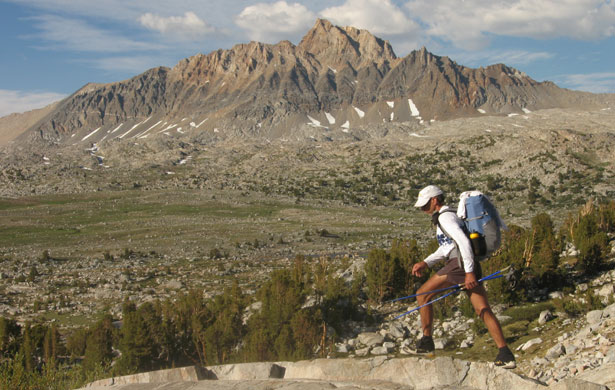
Andrew Skurka on the Sierra High Route

Andrew Skurka on the Sierra High Route

Today some of the best and brightest are professional walkers. Hikers really. Actually backpackers. They walk with purpose and determination. They walk after planning their route carefully. Sending food by mail in advance to be picked up at a later date. Or have calculated where they can resupply food. Water sources have also been identified well in advance. And these modern vagabonds walk with one thing no vagabond of old could ever have imagined. They walk with sponsors. Gear supplied by this company. Clothes by another. Trip reports are beamed by satellite to a blog for armchair adventurers to follow. And sometimes they walk in the company of paying travelers who are happy to benefit from the company and experience of a professional hiker to lead the way.

And they walk for months at a time. Sometimes in a circle, around Mont Blanc or Alaska and the Yukon Territories. They walk from point to point, usually starting with the Appalachian Trail to gain experience than heading for the Pacific Crest Trail, or the Continental Divide Trail or Vermont’s Long Trail, or trails in Europe or Asia, like hiking from Kathmandu to Everest base camp.      Blue-Ridge-Hiking-Logo

But unlike vagabonds of yore today’s modern incarnation have rehabilitated walking for survival to walking to thrive. And we who can not or do not take a long walk can see some of the world through their eyes. Two individuals who have elevated wandering to skillful art form are Andrew Skurka and Jennifer Pharr Davis. Both of these individuals have been named as National Geographic Adventurers of the Year, and not for skydiving from the stratosphere or hang-gliding from the top of Mt. Everest. But for walking.
Walking to Remember

Shelley Lisbona died three and half years ago at the age of 17 from a condition called pulmonary hypertension. She had been on the high school fencing team and sang with her school chorale group. She was an average teenager, or, perhaps it is safe to say, she was an above average teenager. Her health had been complicated by what had been diagnosed as asthma and later vocal chord dysfunction. Subsequent  fainting led to her diagnosis of pulmonary hypertension at age 16. She died four months later. PHA Fun Walks

Shelley was remembered by family and friends this past week with a walk sponsored to raise money for the Pulmonary Hypertension Association and to remember this young woman. The length of the walk was not important, or even advertised. The route was not arduous. In fact, the walk was simply around the track at her high school in Wanaque, New Jersey.

People turned out and walked and raised around $3000 in Shelley’s memory. The group was not large. But people showed up. To walk, to remember, to do good in the world. And to continue to heal.

Walking is our most basic form of locomotion and transportation, getting from here to there. Going toward and than arriving at a destination. But walking with intent  in its simplicity can also be a powerful form of communication: You are not forgotten.

Why We Watch Walkers

June is a month of gathering to watch people walk, in graduations, weddings and parades.    parade march

This coming Sunday is the Puerto Rican Day Parade, one of the largest in New York City. Last week was the Israel Day Parade, also traveling up Manhattan’s Fifth Avenue. On Memorial Day small towns across America had parades and this will be repeated on the Fourth of July.

Why we do we gather in large numbers to watch other people walk with flags and banners? Would we gather in the same numbers to watch people stand with flags and banners? People do not gather in large numbers to watch other people standing in protest. Yet we gather to watch a parade.

Arguably, a parade has music and festive ‘floats’ which is enjoyable to see. But we also gather to watch our children march down the graduation aisle. And no doubt we would go to their graduation even if they did not march in to Pomp and Circumstance. And the same for weddings. We would definitely attend even if there was no ‘marching’, really walking, down the aisle. Yet intrinsic to the graduation and weddings is the walk down the aisle.

graduationWe gather to watch people walk, to move, to transition from one stage of life to another. We gather to watch people walk en masse, in an organized manner that is a culmination, that required dedication and planning, that marks an accomplishment or a declaration of allegiance to a cause or an identity. We stand and observe  while the people we care about move forward. Walking is after all the choreographed  movement of temporarily losing than regaining one’s balance. We the observers stand and bear witness that people we care about or identify with  have imposed balance and order in their lives in what at times is a world fast paced and often off-kilter.

Walking as a tonic…

Why do people turn to walking as the activity that will soothe their roiling souls?

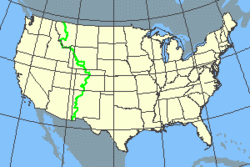
A 33 year old recently divorced, long time overweight man who suffers from Crohn’s Disease decided to radically change his life by taking an unpaid leave from work to spend six months on a personal odyssey and hike the Continental Divide Trail, raising awareness about Crohn’s as well. The trail begins in the Big Hatchets Wilderness area in Mexico and ends 3,100 miles north in Glacier National Park on the Montana-Canada border.

Route of the Continental Divide Trail

Route of the Continental Divide Trail

Unlike the Appalachian Trail which originated around 1925 and is well blazed and fairly close to civilization, the CDT was only designated as a National Scenic Trail by Congress in 1978 and meanders far from city lights. Moreover only 72% of the trail is considered to be in its final location. Once entering the United States the trail traverses New Mexico, Colorado, Wyoming, Idaho and Montana.

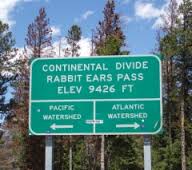
The Continental Divide is a line of mountain ranges that begins in Alaska and continue into South America. The Divide divides rainfall: rain on the west wends its way to the Pacific Ocean; rainfall on the east runs into the Mississippi River system and Atlantic Ocean. The CDT could rightly be considered the ‘spine’ of the continental United States.

The trail goes north and south. Water flows east and west.

The trail goes north and south. Water flows east and west.

In couchtocdt.wordpress.com, blogger Pete decided to hike the CDT after looking in the mirror in 2011 and “seeing a sad fat and depressed person staring back”, he writes in an early blog post.  The trail would be a challenge he could embrace, help cure him of his laziness and procrastination, help him lose weight and make him into someone people could look up to, he writes. And now the hike is underway. Pete posts regularly from the trail, tweets more frequently and posts his breadcrumbs on a Delorme map, techno trekking modes that are becoming commonplace among wilderness adventurers.

Is walking more of a tonic than writing? More than learning to paint? Volunteering in a soup kitchen? When the spirit is roiling, moving seems to be the preferred elixir, and moving through the grandeur of open space among mountains and valleys subject to the vagaries of mountain and valley weather seems to be the specific prescription. After more than 580 miles Pete is already sounding a more positive confident tone, especially as he offers support to others who suffer from Crohn’s. In a recent post he wrote: “I can’t imagine not being out here and I know that making it this far is a privilege that many other suffers can’t do”. Read more at: www.couchtocdt.wordpress.com

Everest and the end of terrestrial exploration…

1963 Everest expedition

1963 Everest expedition

May 1 marked the 50th anniversary of the American summit of Mt. Everest by James W. Whittaker along with Sherpa Nawang Gombu in 1963. This summit success was ten years after Sir Edmund Hillary and Sherpa Tenzing Norgay were the first ones to successfully summit the peak in May 1953. But Whittaker’s summit of Everest was important for America at the time and his success together with the subsequent success of Tom Hornbein and Willi Unsoeld who reached the summit on May 22nd, 1963 helped kindle a fascination with mountaineering and outdoors pursuits in this country.

But 50 years later Everest is not the same place it was when Whittaker climbed, when one could not pay a guide tens of thousands of dollars to lead him or her to the summit. And no one could have virtually traversed the route up Everest via Google Earth or, even have imagined doing so.

National Geographic together with the American Alpine Club have posted a video just under six minutes listening to the views of Whittaker, other principals in that historic climb and other mountaineers and adventurers on what we gained that May 1963, what we have lost since then and what we still have.

Here is a short sample of the thoughts of mountaineer Conrad Anker who went to look for George Mallory’s remains on Everest in 1999:

“Terrestrial exploration in the way Livingston and Lewis and Clark and the great explorers of the past 200 years, thousands of years explored is no longer there. You can open your tablet or your smartphone and you can explore anywhere on the world. But what’s left is that internal exploration, that journey of exploration. That is worth celebrating.”

Walking Home – a short review

walking-homeWalking Home by British poet and writer Simon Armitage is gaining popularity with current reviews in the New York Times (positive) and the Wall Street Journal (trending negative). And now here too.

The author, a well known writer in England, walks the Pennine Way, a 270 mile north-south hike across the spine of England, following the valleys and (small) peaks of the land as it travels across moorlands and cuts in and out and around small towns. Mr. Armitage, married and 47 years old, sets out to walk alone after having arranged  nightly lodging from well wishers and a series of poetry readings along the way as well. He made these arrangements while publicizing his trip via the internet. And at each poetry reading he passed the hat, or in his case a sock to collect funds to help supplement his expenses.

Mr. Armitage writes directly about his experiences, injects some humor, describes his surroundings and the people he meets, stays with and walks together with as well. I found his writing style pleasant if not always engaging and some of his observations thought-provoking. In one paragraph he reflects on the experience of staying each night in someone else’s house, usually in a spare bedroom of a child long since grown yet still decorated with awards and books and other memorabilia from years ago. These rooms are memory chambers he writes, just not his.

For hikers and backpackers the thought of a thru-hike of the Pennine’s is enticing. Not too long. Food and lodging are nearby. Not too steep, with the tallest peaks less than the 3,000 foot high peaks of the Catskills. Yet with the fog and rain, one can get lost in the Pennines, making this walk not a ‘walk in the park’. Whether you are enamored with Armitage’s writing style or not, give him credit for introducing us to this 2-3 week walk, over hills and dales, across boggy moorland yet passing touchstones of Wordsworth and the Bronte sisters along the way.

Walking through the Rift Valley…

We walk for utility- to get from here to there. We walk for exercise, for fun, to explore our surroundings. Journalist Paul Salopek documents the poorest of Ethiopia’s

poor who set out to walk across a barren desert, leaving their country for neighboring poor countries in search of an existence minimally less bad than their current one. The following post by Salopek is part of his 21,000 mile continuous walk across the land masses of our planet: The Things They Leave Behind – Out Of Eden Walk.

The Iditarod 2013 is underway.

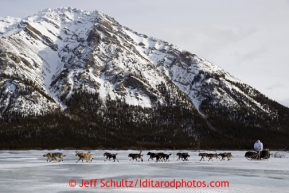
The true heroes of the Iditarod, a more than 1000 mile race across the frozen landscape of Alaska are the teams of 16 huskie dogs working together to pull their driver and sled.

thumbs_130305-2D3143

The dogs wear special booties on their paws to protect them from the ice, snow and rough frozen terrain along the way. But let’s give the musher her due as well. As anyone who has a standing job knows standing all day and much of the night takes a toll on the feet. And when temperatures are below freezing even more so. Indeed, this race taxes every part of the body, physical and mental. Of course the greatest toll is on the dogs. The race lasts 11-12 days for the fastest teams with breaks as needed to rest the dogs.

thumbs_130303-1D1949

The official Iditarod web site has terrific information about the race. The best daily video clips from each day of racing are saved for paid subscribers with funds going to help support this unique race. A short video about the history of the race can be seen here.


That’s using your feet!

Walking around the world I would say is the ultimate way to use one’s feet. Walk through desert. Walk over mountain ranges. Walk through war zones. Walk through history, geography, geopolitics, anthropology, sociology. Walk through humankind.

1302_dispatch2_001_0667-768x466

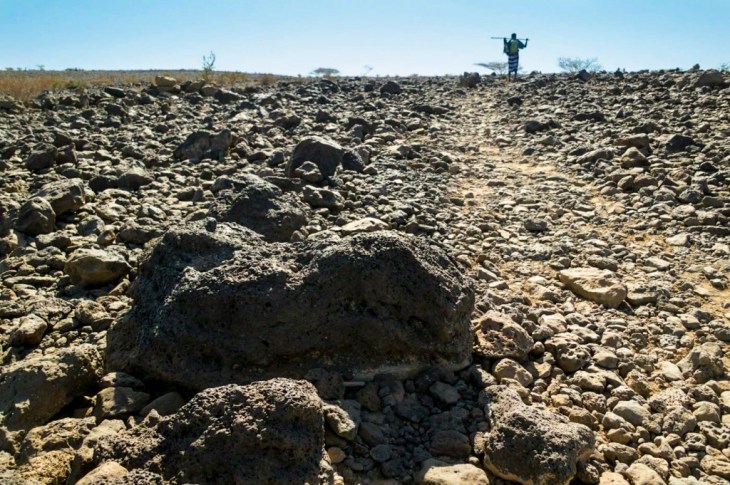
Paul Salopek, a Pulitzer Prize winning journalist has begun his trek Out of Eden, the name of his project by walking from his starting part along the great rift valley in Ethiopa. He is headed across Africa, the Middle East, Asia, across the Bearing Strait into Alaska and down the west coast of the United States to his ultimate destination, the southern tip of Chile. But Mr. Salopek’s destination is not ultimately one of mileage. Rather it is one of understanding human history, as it was and as it is today.

Salopek is posting a ‘milestone’ on-line every 100 miles which consists of photos of the ground, sky and people and an audio recording of where he stands along with a blog post. His seven year journey will cover about 21,000 miles on this journey sponsored in part by National Geographic as well as news organizations including The Pulitzer Center on Crisis Reporting and the Nieman Foundation at Harvard.

The journalist adventurer can be followed by reading blog and twitter posts, receiving emails or visiting the Outofedenwalk.com web site. On a recent twitter post Mr. Salopek wrote: “On walking and concentration: We were not meant to sit still.”

Stanmeyer-Gun1-768x466