Walking in a fog…

Fog obscures.

The “fog of war” explains how otherwise  civil men can be driven to act so uncivil. Fog is the rationale. Not only soldiers but poets too have turned their eyes toward the “fog”. For them it is a comfortable literary trope. “Fear death – to feel the fog in my throat and the mist in my face” wrote Sir Robert Browning (1812-1889). And when people look out their window and see the fog, they sigh as if only sunlight can bring happiness.

Last Sunday I hiked a route with which I am quite familiar, a 4 mile trail through boulder fields, along and over brooks, past a cascading waterfall and around fallen trees in an east coast maple-beech-birch forest in northern New Jersey. The trail includes over 1000 feet in elevation change and half of that is a 500 foot ascent up a section with several vistas along the way. From each viewpoint the panorama gets better and better until at the top one can see 30 miles and easily make out the skyline of New York City.

On a clear day.

Fog on Carris Hill Oct. 2013

Fog on Carris Hill Oct. 2013

On a clear day people make their way up the strenuous section which is almost two miles from the trail head. On a clear day a hiker will see others along the way and at the top,  in small groups or large or alone with their dog.

On a foggy, damp day you see no one at the top and just one or two souls  who have turned around complaining about the absent views.

But I for one saw value that day in not seeing. I took comfort in my obstructed view of that which I knew was there yet could not see. And for the first time in my life I made no effort to look past the slate gray cloud which enveloped the summit, which colored the nearby lime green leaves into a drab olive hue and totally hid the canopy only a few dozen feet beyond. No skyline was to be seen no how.

I surrendered any attempt to see beyond my veiled misty curtain for I began to understand that the nature of nature is that it is always beautiful if not always comfortable. We are guests in a vast abode about which we have no say. Yes, I could have waited for a sunny day. But Sunday last the fog at my fingertips was my panorama, and it was good.

The still, small, voice…

When I finally stopped gasping for air I realized what I had done.

After plodding along for the past few years with no attention to speed I decided to see if I could run faster. I looked around and found many recommendations and decided to try interval training: Run a lap at normal speed than run the same lap faster. Repeat. And repeat again and again.

After panting I realized I was able to increase my speed by 20%, if only for a short period of time. I did not know what I had accomplished while I was running, only after I stopped.

The Jewish high holidays have concluded. The liturgy for the Jewish New Year, Rosh Hashanah, is filled with images of the majesterial as we proclaim God the Master of the Universe. We listen to the primal sound of a ram’s horn, the shofar, to punctuate the day. And in one stirring paragraph we describe the power of that sound upon our hearts. But that sentence is mysteriously juxtaposed to the most enigmatic phrase of the day. The sound of the shofar will be sounded, the prayer states, and a “still, thin sound will be heard”.

That phrase comes from the book of Kings 1, chapter 19 and concludes a section about Elijah the prophet who had reestablished God’s honor before crowds of idol worshippers, including Israelites who had strayed from their belief in God. Tired from his battle for truth Elijah beseeched God to end his life. God responded by sending an angel who led Elijah on a 40 day journey to a cave from where he witnessed a sound so loud it crushed rock, caused a devastating earthquake and a great fire.

“God is not there” we are told after each cataclysmic event. Elijah did not find God in the maelstrom. But than a “still, small voice” appeared and there is where Elijah reconnected to his Maker. Immediately afterward we read Elijah leaves his cave and re-enters the world, appointing a king for this nation and for that one. He begins to re-build the world. 19th and 20th century naturalist writers have borrowed this phrase as well and often refer to the “still, small voice” they hear in the forests and the fields.

And I thought of this scene finally standing upright after bracing myself on my knees doubled over, oxygen deprived, the lactic acid burn starting to ebb. We don’t know what we have accomplished in the midst of the thing, in the middle of a run, or long hike. Or in the midst of raising our children. Indeed, physiologists believe that endurance is increased not during the quickened pace while running but rather in the moments right afterward when the the cardiovascular system adjusts to the new challenge.

It is only in the calm moments that follow our accomplishments that we, like Elijah, can realize the truth of our lives, and the work we have done and the work we have yet to accomplish.

The Power of New Shoes?

Of course new shoes can make your feet feel better. But can they really help your soul?

I ran a trail yesterday I have run many times before. I did not see the Great Blue Heron I once saw there feeding not 15 feet away. Nor did I see the Northern Oriole building its dangling hollowed ball  shaped nest I’ve seen before nor the spring irises lining the trail here and there. Yet I felt newly exhilarated despite the sameness of the scenery. What was different?

Not much. Just my shoes.

New shoes.

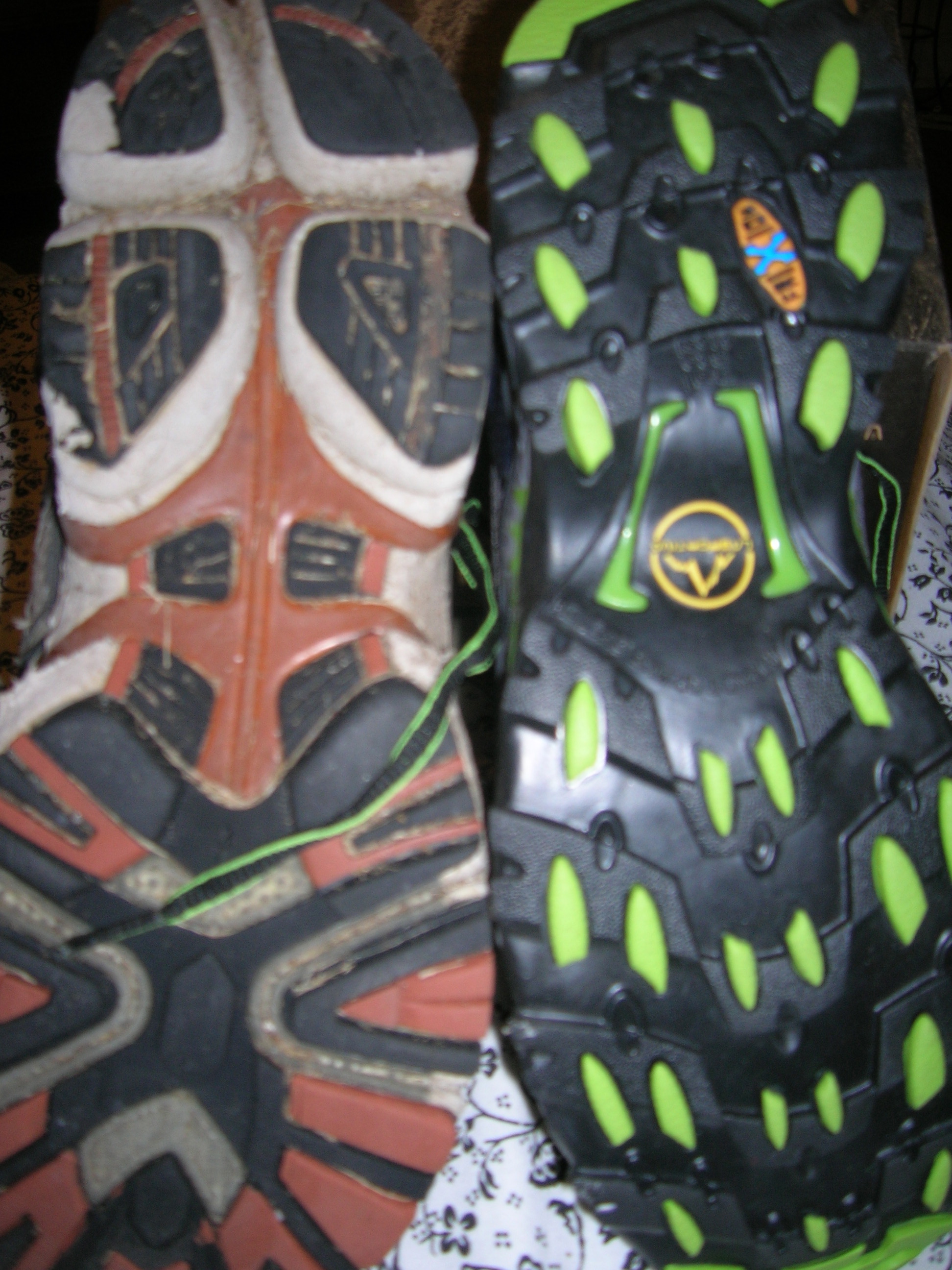
The old (Asics Trail Sensor circa 2009) and the new (La Sportiva Wildcat circa 2013)

The old (Asics Trail Sensor circa 2009) and the new (La Sportiva Wildcat circa 2013)

New shoes I had researched and pondered, read reviews about and weighed pros and cons before arriving at my decision. I looked for them in stores and ultimately ordered on the web. Even guessed right on the European size.

I am loyal to my shoes. Not the brand specifically but actually to the shoes. I do not part ways with them easily. I wear them until they are frayed. Until chunks of rubber are missing from the sole. Until I am pretty sure the mid sole layer has lost its cushioning. Yet, I have seen pictures of the poorest of the poor running around or carrying water in tattered shoes, or no shoes and I know even at their worst my old shoes are quite adequate.  And so I relinquish them reluctantly and don new shoes undeservedly.

But I am attached to old shoes for quite another reason too. We have traveled together for so long. The rubber rand covering the front of the shoes is peeling. The lining around the heel has worn completely away after thousands and thousands of steps on streets and sidewalks and grassy fields and trails criss crossing county and state parks, as my shoes and I have hiked our way together across rocks in a fast flowing brook or run across a wooden bridge while looking upstream at  riffles of frothy white water. They were with me when I ran a trail race and badly sprained my ankle and they were with me the following year when I redeemed myself on the same course.

Old sole, new sole.

Old sole, new sole.

I look at the worn sole but don’t see shoes worn out. Rather I see miles walked, hiked, run.

Yet the trail does seem more fresh and alive and spirited with my new shoes, a feeling which I attribute to more than better cushioning and less fraying. I am inspired by the possibilities of the new, real or imagined. The shiny sole of my new shoes with their special features to provide traction on uneven terrain beckons the deep forest trail. And I will even take inspiration from the picture on the shoe box, of men I know not, running toward towering mountains I know not where in a place I will likely never be.

Photo on the cover of the La Sportiva Wildcat shoes

Photo on the cover of the La Sportiva Wildcat shoes

(Old shoes: Asics Trail Sensor. New shoes: La Sportiva Wildcat)

Walking with the wisdom of the crowd…

My son and I set out to explore a rock climbing crag nearby, recently approved by the municipal land owners and sanctioned for climbing. The area is an otherwise unused strip of land, long with several undulations of granite cliffs no more than 100 feet tall with several smaller rock formations at its base. The most prominent feature of this wooded land however is a series of towering power lines. The land is actually a power company right of way for high capacity electrical lines. Indeed, if you listen carefully it is possible to hear a faint crackling of electricity traveling through the lines at the top of the steel super structures which stand guard on otherwise undeveloped woodlands.  images

No formal trails lead to the rocks but faint foot paths have stomped down tall grasses. In some areas a dirt path has emerged but no blazes mark the trail. Leave the parking lot, look for a faint trail and walk. Look for a stream and cross by a  fallen log the instructions explain. Pick up a trail on the other side, faint as it is. Finally crossing a dirt road one sees an official sign at the informal entrance to this newly opened rock climbing area.

514744213_1c0dcc8046

Neither my son nor I are real climbers. We have climbed in indoor climbing gyms which simulate some of the athletic moves needed for outdoor climbing on real rock slabs. And we have climbed once in the famous Shawungunk climbing area in New Paltz, NY under the supervision of a watchful and well trained guide. So we were just scoping out this new venue to see if we and the rocks made a good match.

By the time we started hiking into the woods we did not have too much time to explore but did have enough time enough to spot a flock of goldfinches dressed in their bright summery ellow and black plumage flying in and around some low brush.

imgresOn the way back we lost the trail, with no supplies, lights or even water. We were never more than half mile or so from the car but with dusk approaching the thought of stumbling around in the dark in an unfamiliar woods was unappealing. While we lost the main trail, faint as it was, we picked up several other ‘herd’ paths – that is, trails going this way and that left by the footfalls of previous hikers. On some summits a herd path usually leads to a great view, or short cut to the trail’s continuation. The herd path deviates from the main blazed path, placed purposefully by the trail maintainer. White rectangles 2 inches wide and 3 inches long mark the entire 2,160 miles of the Appalachian Trail.

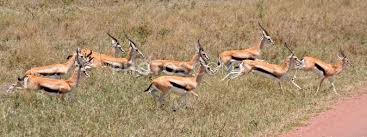
Herd wisdom, or the wisdom of the crowd, has been around for eons. Thompson’s Gazelle‘s use the wisdom of the crowd to turn tail and bolt in the opposite directions from a prowling lion. Schools of fish do the same. And now a days humans ‘crowd source’ using the collective information gathering skills of hundreds to pull resources together to yield new information hitherto not easily knowable.

But walking in the woods in the waning light, pushing away boughs of thorn bushes obstructing the faint herd paths we had little choice but to follow the foot steps of walkers before us, and hope that their intentions in walking this ground were our intentions, that they were going, or coming, from the direction we sought. It felt comforting to embrace the wisdom of the footsteps of the crowd which indeed led us back to where we started.

Austrolapithicus on Breakneck Ridge

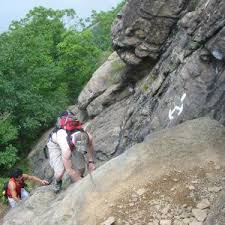
My son and I hiked what is commonly referred to as one of the more strenuous day hikes in the greater metropolitan New York region, noted for its steep ascent requiring both hands to navigate several steep rock scrambles. The route begins on the eastern shore of the Hudson River, separated by the Metro-North Hudson line train tracks. The route ascends promptly and continues to do so for seven tenths of a mile, climbing 1,260 feet to the summit.

Ascending Breakneck Ridge

Ascending Breakneck Ridge (photo credit Daniel Chazin, NY/NJ Trail Conference)

While clinging to the precambrian granite gneiss and searching by feel for a toe hold to provide a slender ledge from which to push myself higher I thought for a moment of the footsteps upon which I stood 48 hours earlier. Two days prior I had visited the Museum of Natural History in Manhattan and spent a few moments in the Hall of Human Origins. Near the beginning of the exhibit stand two short hairy human-like people, holding hands, one male and one female. Their gaze is straight ahead and has an air of contented surprise.

Austrolapithicus

Austrolapithicus

The curators have placed in front of this couple a casting of Austrolapithicus footprints, discovered by anthropologists Mary Leakey and Paul Abell in 1978 and taken from a dig in Laetoli, Tanzania, not far from the Olduvai Gorge. About 3.5 million years ago dozens of footprints were fossilized in volcanic ash. The footprints appear human. The great toe is not simian –not angling wildly away from the foot. Rather it is parallel to the other toes and the footprints also reflect an arch, another human characteristic.

These prints are significant because they are among the earliest signs of bipedalism in human ancestors and scientists believe they are proof of when our ancestors mastered walking on two feet, which they also conclude was long before our ancestral brain increased in size.

Visitors of the exhibit are invited to place their feet on the fossilized prints. That I do. My size 10.5 foot dwarfs these uber-ancient footprints. I stand there face to face. This moment of staring in their eyes while also standing in their footsteps came back to me while on Breakneck Ridge, as I searched for a toehold on metamorphosed granite, hardened deep in the earth’s crust eons before man took his first step.

Austrolapiths’ footprints are recorded for all time, a record of a straight-ahead walk across a muddy flat. My toehold on the granite gneiss will leave no mark, no impression on the earth. Yet at that very moment for the first time I contemplated a  connection between myself and the most early walkers: a relationship between those early humans we know by their footprints for whom walking upright was a seminal event in human history and me and my fellow humans for whom a good toehold on the rock is just another day well spent.

Why We Watch Walkers

June is a month of gathering to watch people walk, in graduations, weddings and parades.    parade march

This coming Sunday is the Puerto Rican Day Parade, one of the largest in New York City. Last week was the Israel Day Parade, also traveling up Manhattan’s Fifth Avenue. On Memorial Day small towns across America had parades and this will be repeated on the Fourth of July.

Why we do we gather in large numbers to watch other people walk with flags and banners? Would we gather in the same numbers to watch people stand with flags and banners? People do not gather in large numbers to watch other people standing in protest. Yet we gather to watch a parade.

Arguably, a parade has music and festive ‘floats’ which is enjoyable to see. But we also gather to watch our children march down the graduation aisle. And no doubt we would go to their graduation even if they did not march in to Pomp and Circumstance. And the same for weddings. We would definitely attend even if there was no ‘marching’, really walking, down the aisle. Yet intrinsic to the graduation and weddings is the walk down the aisle.

graduationWe gather to watch people walk, to move, to transition from one stage of life to another. We gather to watch people walk en masse, in an organized manner that is a culmination, that required dedication and planning, that marks an accomplishment or a declaration of allegiance to a cause or an identity. We stand and observe  while the people we care about move forward. Walking is after all the choreographed  movement of temporarily losing than regaining one’s balance. We the observers stand and bear witness that people we care about or identify with  have imposed balance and order in their lives in what at times is a world fast paced and often off-kilter.

Walking Home – a short review

walking-homeWalking Home by British poet and writer Simon Armitage is gaining popularity with current reviews in the New York Times (positive) and the Wall Street Journal (trending negative). And now here too.

The author, a well known writer in England, walks the Pennine Way, a 270 mile north-south hike across the spine of England, following the valleys and (small) peaks of the land as it travels across moorlands and cuts in and out and around small towns. Mr. Armitage, married and 47 years old, sets out to walk alone after having arranged  nightly lodging from well wishers and a series of poetry readings along the way as well. He made these arrangements while publicizing his trip via the internet. And at each poetry reading he passed the hat, or in his case a sock to collect funds to help supplement his expenses.

Mr. Armitage writes directly about his experiences, injects some humor, describes his surroundings and the people he meets, stays with and walks together with as well. I found his writing style pleasant if not always engaging and some of his observations thought-provoking. In one paragraph he reflects on the experience of staying each night in someone else’s house, usually in a spare bedroom of a child long since grown yet still decorated with awards and books and other memorabilia from years ago. These rooms are memory chambers he writes, just not his.

For hikers and backpackers the thought of a thru-hike of the Pennine’s is enticing. Not too long. Food and lodging are nearby. Not too steep, with the tallest peaks less than the 3,000 foot high peaks of the Catskills. Yet with the fog and rain, one can get lost in the Pennines, making this walk not a ‘walk in the park’. Whether you are enamored with Armitage’s writing style or not, give him credit for introducing us to this 2-3 week walk, over hills and dales, across boggy moorland yet passing touchstones of Wordsworth and the Bronte sisters along the way.