Trailer for Run Free – The Story of Caballo Blanco

Born to Run, the best selling book by Christopher McDougall, published in 2009, introduced readers to the enigmatic Caballo Blanco (the White Horse),

 Caballo Blanco in the CopperCanyon. Photo by Leslie Gaines.

aka Micah True who lived and ran in Mexico’s Copper Canyon. He was inspired by the native Tarahumara people who lived there and ran long distances just for fun. Micah True went on to host races in the Copper Canyon to bring revenue and support to these indigenous people. He died in 2012, while running in the Gila Wilderness of New Mexico.

A documentary is making its way across the festival circuit this year about this inspiring person who required little for himself all the while working to make the world better for others. The trailer has been released.

Trailer | Run Free – The Story of Caballo Blanco.

Off the Trail: The Anthropocene is here to stay.

The term Anthropocene is starting to appear more and more frequently. The “cene” ending of the word is familiar from any number of geologic epochs such as Holocene or Pleistocene. But in the case of Anthropocene we humans are the subjects, not dinosaurs, or glaciers or seismic events of unimaginable proportion.

Scientists continue to try and understand how we humans, the “anthro” in Anthropocene, are impacting our planet. Are we causing irreversible changes with development? Or over-population? Or did we start to irrevocably alter the planet when we began agriculture more than 10,000 years ago, deforesting and tilling the earth?  And anthropology professor Dr. John Hawks has written about some anthropologists who wonder if we should capitalize the word at all or refer to our epoch with a little ‘a’ just to signal that this time period is currently unfolding and its full details can not yet be known.

Read below for two scientists thoughts on this topic after convening an expert panel to think and write about our current geologic era and try to determine where we can go from here in understanding the “Anthropocene” and the impact we are having on what is for now, at least, our solar system’s only known habitable planet.

Below is the beginning of the article which was published in theconversation.com and which I saw re-posted on earthsky.org. I encourage you to read the entire piece, written by Professors Ben A. Minteer and Stephen Pyne, both of Arizona State University.

HF

What does it mean to preserve nature in the Age of Humans

“Is the Earth now spinning through the “Age of Humans?” More than a few scientists think so. They’ve suggested, in fact, that we modify the name of the current geological epoch (the Holocene, which began roughly 12,000 years ago) to the “Anthropocene.” It’s a term first put into wide circulation by Nobel-Prize winning atmospheric chemist Paul Crutzen in an article published in Nature in 2002. And it’s stirring up a good deal of debate, not only among geologists.

The idea is that we needed a new planetary marker to account for the scale of human changes to the Earth: extensive land transformation, mass extinctions, control of the nitrogen cycle, large-scale water diversion, and especially change of the atmosphere through the emission of greenhouse gases. Although naming geological epochs isn’t usually a controversial act, the Anthropocene proposal is radical because it means that what had been an environmental fixture against which people acted, the geological record, is now just another expression of the human presence.

It seems to be a particularly bitter pill to swallow for nature preservationists, heirs to the American tradition led by writers, scientists and activists such as John Muir, Aldo Leopold, David Brower, Rachel Carson and Edward Abbey. That’s because some have argued the traditional focus on the goal of wilderness protection rests on a view of “pristine” nature that is simply no longer viable on a planet hurtling toward nine billion human inhabitants.

Given this situation, we felt the time was ripe to explore the impact of the Anthropocene on the idea and practice of nature preservation. Our plan was to create a salon, a kind of literary summit. But we wanted to cut to the chase: What does it mean to “save American nature” in the age of humans?”

(the rest of the article can be accessed here)

Mt. Everest: Man vs. Mountain vs. Tectonic Plates

from nytimes.com (04/25/15) The base camp at Mount Everest after an avalanche on Saturday. Credit Azim Afif/via Associated Press

from nytimes.com (04/25/15) The base camp at Mount Everest after an avalanche on Saturday. Credit Azim Afif/via Associated Press

For hikers, trekkers, trail runners, and armchair adventurers, Mt. Everest has to loom large as an ultimate destination. Unfortunately, over the past 20 years, so much high altitude catastrophic loss of life has occurred there. As of 10 p.m. EST on April 24, 2015, the New York Times is reporting another 17 people have perished on the mountain after an avalanche swept through base camp, killing climbers in their tents at base camp, and cutting off those camped above the avalanche beyond the Khumbu icefall section of the route. This avalanche is attributed to the magnitude 7.8 earthquake with its epicenter near Kathmandu which struck today and the subsequent aftershocks.  That event has reportedly claimed well more than 1,800 lives with that number surely to be revised upwards. In a chilling coincidence, with respect to Mt. Everest, this past week marks one year since 16 Sherpas died in an avalanche in the Khumbu Icefall area between base camp and camp one on the mountain’s southeastern ridge.

Writer Mark Synott posted a thoughtful piece about guided climbs on Mt. Everest on adventureblog.nationalgeographic.com just days before this most recent catastrophe and loss of human life occurred. In his piece, titled ‘Everest-a moral dilemma’, which now seems very dated, reading it through the prism of the current unfolding maelstrom of even more human suffering,  Synott  questions some of the brazen trends developing among guiding companies working to put more and more eager people on the summit of the world’s highest mountain, whether those paying clients are qualified high altitude climbers or not. But Synott also looks back to a simpler time, at some of the great victories on Everest when the struggle was really man vs. mountain, a time when only the most prepared and daring would deign to make that climb.

In an eerie bit of foreshadowing, Synott concluded his  thoughts on Everest by writing that “there is high drama to be found on the world’s highest mountain…”. He surely did not anticipate another tragic climbing season with the loss of life reported so far only paling in comparison to the loss of life, human suffering and tremendous devastation ongoing in Nepal’s capital, Kathmandu, and the surrounding region.

Man versus mountain may succeed once in a while. Men versus moving tectonic plates, however, will never win. We watch helplessly from afar but hope and pray that swift relief will come to all affected, on Everest and throughout Nepal.

Howard E. Friedman

-30-

On the Trail: Another New Trail Shoe Trend

(originally appeared in Trail Walker, quarterly publication of the NY/NJ Trail Conference Spring 2015)

Extra thick soled hiking and trail running shoes are being promoted this Spring and hikers will even see extra thick hiking boots heavily advertised soon, as well. Some of these shoes, referred to as “maximalist” shoes, have soles that are more than three times as thick as even standard hiking and trail running shoes. While ‘maximalist’ shoes have been around for a few years, they were mostly a niche product available from the manufacturers on line or in independent outdoor gear stores. Now, national and regional retailers like REI and Campmor are even selling this unique type of shoes.

The maximalist trail shoes stand out primarily for one feature – mid-sole material almost 1.25 inches thick, often made of a proprietary mix of ethyl vinyl acetate (EVA) foam blended with rubber to create increased cushioning.

Hoka One One boot. Photo by Brian Metzler, from running.competitor.com

Hoka One One boot. Photo by Brian Metzler, from running.competitor.com

, like the famous Western States 100 mile race  (Karl Meltzer) and posting speed records on the Pacific Crest Trail (Heather “Anish Anderson”) and John Muir Trails (Liz Thomas).

Hikers, backpackers and ultra-marathoners have embraced these re-designed shoes for three reasons. First, the generous cushioning through the mid-sole layer of the shoes provides shock absorption whether running or hiking on the trail or on the road. Second, the shoes have either minimal “drop”, (the height difference between the heel and the forefoot), or, no ‘drop’ at all. Proponents of shoes with minimal or zero “drop” claim that they promote a natural gait with a less forceful impact and allow for a more efficient functioning of the achilles tendon. Third, the maximalist shoes, which now include mainstream brands such as Vasque, Brooks and Skechers, in addition to the two most popular brands, Hoka One One and Altra, generally have a wider and more anatomically shaped toe box. Altras have zero drop while Hoka Ones have a minimal drop.

A few years ago when shoe manufacturers promoted “barefoot” running and trail shoes, like Vibram Five Fingers, they cited research and quoted biomechanics experts supporting the shoes’ benefits. And, they maintained that their shoes hearkened back to our ancient hominid roots as barefoot walkers. Now, very few ‘maximalist’ companies are citing any research backing their claims and the thick soled shoes in no way mimic human ancient foot wear or ambulation. Yet, the shoes are catching on with elite and recreational trail runners and hikers. And some weekend hikers claim that these cushioned, low drop shoes with a lot of room for their toes, helped resolve nagging problems like heel pain and shin splints. One note of caution, thogh.  Theelevated  platform design of these shoes may prove unstable to anyone prone to ankle sprains. And, if you are getting good results with your current hiking shoes, than, no need to switch.

-30-

On the trail: the grass survives, again.

The grass survived.

The snow has melted, finally, and you can once again run, walk or hike through the grass. After months under a foot or more of snow, the grass is still green, and alive, mostly.

How does grass survive the freezing cold, the darkness, buried under the snow?Humans can not survive being buried in an avalanche for more than a few minutes. Yet grass survives the cold, the weight, the desiccation. How do its cells resist rupturing, imploding and becoming a protoplasmic organic slime? How do its fragile roots maintain their grasp on a soil which has itself frozen and is no longer nurturing.

This week marks the beginning of the holiday of Passover, commemorating the exodus of the Children of Israel from slavery in Egypt. The holiday has many themes, revisited each year by parents and children and grandparents and grandchildren in a performance art like meal called the ‘seder’ where the story of the exodus is retold, using food as symbolic props.

But one idea often gets lost in all the preparation and the re-telling. The name of the holiday, Passover in English and ‘Pesach’ (pronounced peh-sakh) in hebrew, conveys a most basic but critical thematic idea. The name of the holiday references God’s sending an angel to visit death upon the first born males in pharonic Egypt as a punishment. God instructed the angel of death to spare the Jewish children. The name, then, focuses on a celebration of survival and an acknowledgement of God as both the taker and sustainer of life in a world filled with Divine intervention in the matters of mankind.

It is by design that Passover always occurs near beginning of springtime, a period of rebirth. And the blades of grass are the first signs of that renewal. They persist through a winter that really should have killed them. But at winter’s end the grasses stand up with no flowery announcement of their arrival. Unannounced and unadorned, they unfurl themselves and reach for the warmth of the nourishing sun.

The springtime holiday of Passover marks not only re-birth but also the birth of a nation that survived its own long winter of oppression, deprivation and servitude. Not every blade of grass survives the winter and neither did every member of the nation survive to leave Egypt 3,000 or so years ago. Which is why seeing the grass again in the springtime is the perfect time to truly celebrate life.

Walk in alone. Walk out together.

March is the unofficial start to the hiking season, at least for people setting out to hike a long trail, like the 2,100 mile Appalachian trail. Setting out in March avoids the coldest, snowiest part of winter and provides a long enough time to walk until the cold settles in again in the fall. More times than not, hikers start out on a solo journey, hoping to challenge themselves.  But along the way, even the most solo of solo hikers will find comfort in commiserating, camping, hiking, with others he or she meets along the way. And while the time spent in the company of others may be brief, that joining together can lift the spirits of even the most aching, blistered and tired soul.

We have many journeys in life that we must embark on alone. But ‘alone’ does not mean abandoned. My nieces and nephews just lost their mother, my brother lost his wife, who passed away at the age of 55. The end arrived as they sat by her side for long days and nights over several weeks. They are a close and united family, but naturally still face this challenge each on his and her own terms. The husband and the children entered the hospice room as individuals but they emerged from that space and a week of mourning together, bereaved, yet even closer.

The Appalachian Trail is often referred to as ‘the long green tunnel’. The trail is a single-track which passes through mostly forest, a long tunnel amidst maple, birch, oak and hickory leaves, verdant green in the spring and summer. Walking  along you can feel isolated, traveling alone with the burden of your gear on your back,  rays of light squeezing between the dense canopy of leaf filled branches, illuminating the ground with occasional spots of light here and there. But as you make your way and meet others who share your journey, your steps feel lighter as you share your burden. And despite your physical and emotional exhaustion, the journey through the long green tunnel does eventually come to an end. When you emerge, no matter how alone your sojourn felt, at journey’s end, know that you did not walk it completely alone.

Howard E. Friedman

-30-

On the Trail: Personal challenges and personal agency.

(Forestwander.com via Wikimedia Commons)

(Forestwander.com via Wikimedia Commons)

Six wild turkeys emerged from the wooded shadows into a clearing,  single file, variously walking on and sinking in to the foot of snow on the ground. Than another six than another dozen emerged, walking, sinking, moving slowly and circumspectly, stopping to forage among twigs branches and fallen tree trunks.

I had just finished running and walking among the same trails as these wild, ungainly birds. I knew a bit about the challenges they faced moving over uncertain and unwelcoming terrain, having sunk through the snow myself. Moving overland in the winter woods was laborious.

Today’s temperature was 20F, much warmer than last week’s low teens. But there was still a sense of accomplishment in managing the environment, wearing three layers instead of 4, one pair of gloves instead of two.

‘Manage the environment, don’t let the environment manage you’, an intrepid outdoors friend commented.

Humans have been struggling, and mostly succeeding, to manage their environment for thousands of years. And there is a satisfaction that comes with surviving frigid temperatures, avoiding hypothermia and frostbite and yet enjoying the out of doors, with its rich palette of colours, shapes and textures. It is the pleasure of matching personal agency against the challenges of the environment.

And we have largely mastered our environment, be it climbing tectonic uplifts soaring five miles into the hypoxic frigid sky, like Everest, or submerging to study thermal vents miles below the surface of the ocean, like the Marianas Trench, or, of course, the ultimate mastery by man- space exploration.

Yet assuming our personal agency always results in ‘mastery’ is a fallacy. It is a fallacy in the outdoors as witnessed by the many fatalities- Rob Lowe, dying on the cold shoulder of Everest moments after calling his wife in New Zealand to say ‘I love you’, Chris McCandless whose death by starvation trapped in the Alaskan back country was famously chronicled in the book ‘Into the Wild’, to name only two of hundreds, if not more.

And personal agency as ‘mastery’ is a fallacy in our day to day lives, as it only takes us so far. This is truest especially when faced with overwhelming challenges against which no one can prevail, not the smartest, the prettiest, not the wealthiest or the most accomplished, not the most important. No one.

In the test of man against nature, the latter always prevails. As for our personal agency, we can manage, or try to manage, our responses especially in the face of impending loss.  We can take small comfort that we have, at the least, participated in the process. The winter trail will test your ability to survive the inhospitable, the uninviting, the unnatural for us warm blooded, furless mammals. And it is that mere survival that makes the successful days on the hard packed snow among the barren trees and frozen ponds so gratifying, even as it gives a fleeting, albeit false, sense of invincibility.

Howard E. Friedman

-30-

On the Trail: Winter and the Big Bang

(Forestwander.com via Wikimedia Commons)

(Forestwander.com via Wikimedia Commons)

In a week riddled with more senseless and barbaric killings around the globe one small item of astrophysical import did not  garner much attention, even though it addressed the fundamental question of how the universe began.

The mercury began this morning in the teens when I awoke.  Dressed in layers I ran  to the nearby woods to see what I would see. In winter, all is hidden yet all is revealed. I saw no animals running about but only remnants of their activity from the day or night before. Squirrel tracks galore, raccoon and opossum prints, the occasional deer tracks and even the footprints of a family of mallards on the ice covered portion of the slow moving creek, webbed toes pointed toward open water. Two red tailed hawks and a great blue heron took off from their hidden perches, quickly, silently, vanishing like actors disappearing into the wings.

I ran a familiar route on snow and ice and came to the small pond, now frozen solid, a rare opportunity to walk out on the ice. The water is never deep here so the only risk would be wet and frigid feet if the ice cracked below. But it held.

The harsh frozen landscape seems ancient, as if it could exist for eternity, in contrast to Spring where flowers and their petals seem so fragile, even at the peak of their beauty. Winter conjures images of frozen planets in our solar system, or the frozen dark side of the moon, dry, seemingly lifeless. And thus winter makes me ponder the origins of our universe and the earth itself.

Professor Brian Koberrlein expanded on an article explaining how our universe did not necessarily begin with one defined singular moment, the ‘Big Bang’. Rather, the professor at Rochester Institute of Technology wrote in Physics Letters B, citing research from the University of Benha in Egypt and Letherbridge University in Alberta, Canada this month, the universe always existed and will always exist. A ‘big bang’ happened along the way, but that moment, referred to as “singularity” by astrophysicists, does not have to have been the first moment.

“Singularity”, one point from which all else emanates, is a comforting idea, and, we each can identify defining moments in our lives that marked a new beginning. But, outdoors in nature, peering down the snow covered trail that fades into a sun filled patina of white and ice, the infinite seems more real than the finite.

And I am glad to welcome “infinity” back into the model of how the universe began. The concept of timelessness helps frame our own travails and challenges. Whatever will be, the universe always was and always will be and we are a part of that timelessness. And while winter on the trail evinces a natural timeless quality, you can follow that same path in the Fall, or Summer, or Spring, and it will still take you to forever.

Howard E. Friedman

-30-

On the Trail: Hiking alongside evolution

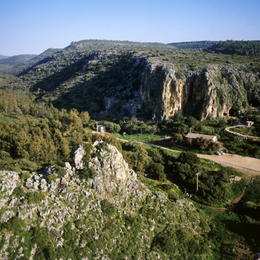
Tabun Cave, site of pre-historic human activity,  lies next to the Israel National Trail (phto: Albatross Aerial Photography)

Tabun Cave, site of pre-historic human activity, lies next to the Israel National Trail (phto: Albatross Aerial Photography)

Israel is in the news for the recently announced discovery of the Manot 1 pre-historic modern human partial skull, carefully dated to 55,000 years ago. The skull was found in a limestone cave in the Galilee region of northern Israel in 2008 and carefully researched for the past 6 years by Professor Israel Hershkovitz and a team of anthropologists from Tel Aviv University. The find was published in the respected journal Nature and reported widely across the world. The skull has features of modern humans but also some Neanderthal features, again focusing attention on the question: did ancient Homo sapiens interbreed with Neanderthals?

About one month ago I was fortunate to have an opportunity (thanks, Mom and Dad) to visit the Carmel region of Israel and hike a bit of the Israel National Trail, a hiking trail which extends the length of the country, 1000 km, from north to south.

Blue, white and orange triple color blaze of the Israel National Trail

Blue, white and orange triple color blaze of the Israel National Trail

The section of trail I visited is literally a stone’s throw from another important anthropology site, the location of Tabun, Skhul and El-Wad caves, also limestone massifs, with a commanding view of the Mediterranean Sea and Israeli coastline just 5-6 miles due west.

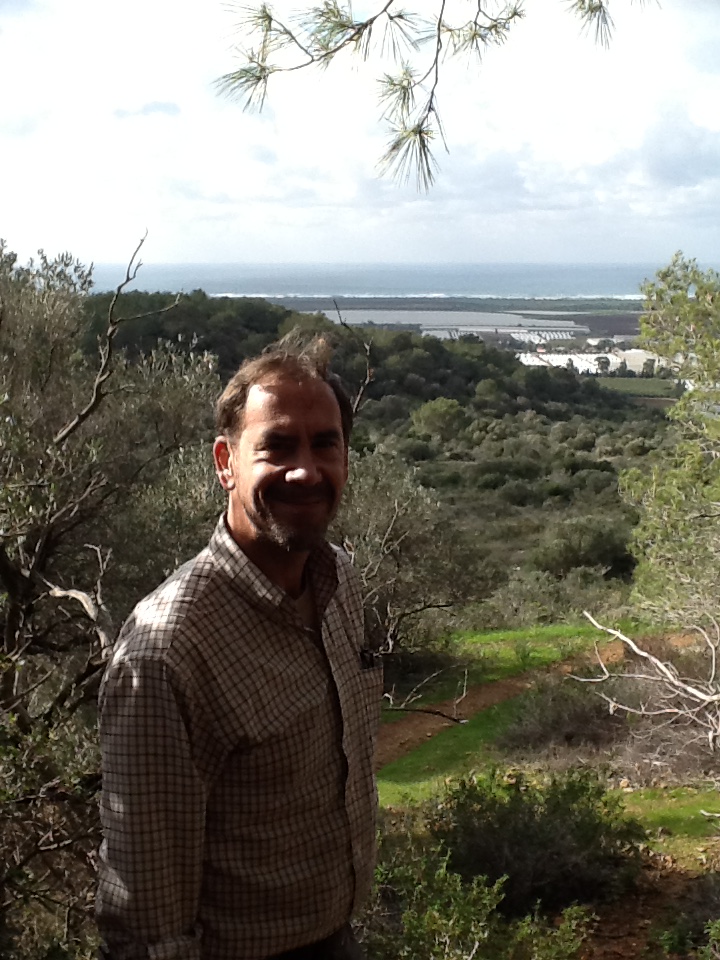
View of the Mediterranean from Nachal Meorot

View of the Mediterranean from Nachal Meorot

These caves were discovered and excavated beginning in the late 1920s by British paleontologist Dorothy Garrod,a pioneer and rare female in her field. The site continued to be excavated into the 1960s and was recently named a UNESCO World Heritage Site. This collection of caves demonstrates more than 200,000 years of human existence including Neanderthal and early Homo sapien remains, living in the same location, even if not at the same time.

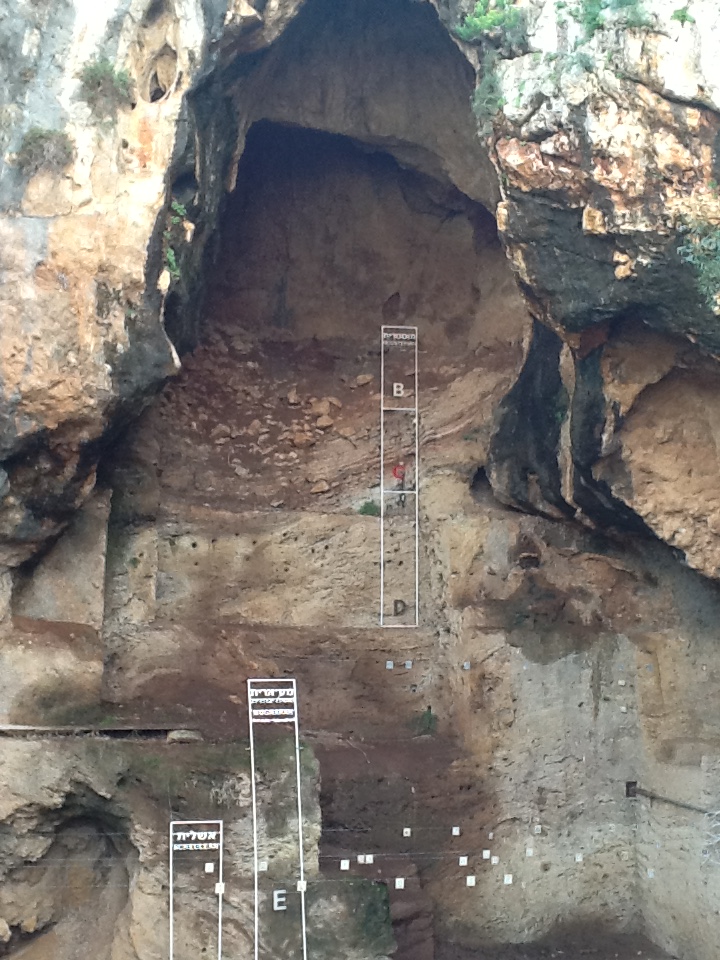
Looking into Tabun cave. Neanderthal remains were found in the middle layers and ancient hominid remains above and below.

Looking into Tabun cave. Neandratal remains were found in the middle layers and ancient hominid remains above and below.

Moreover, one of the adjacent caves presents a clear example of Natufian culture, humans who began to settle in one location and live a more agrarian lifestyle, no longer living a nomadic ‘hunter-gatherer’ existence. Just outside this cave system were multiple buried human skeletal remains, more than 10,000 years old, decorated with various ornaments. These may represent one of the earliest burial sites in the world.

And now, just dozens of miles away, we now have evidence of human remains which indeed represent another example of ancient humans in transition. Just exactly what that transition was from and where it was going to remains to be proven more definitively.

Manot-1 partial skull with features of ancient hominid and Neandratal (photo: Prof. I. Hershkovitz, in Nature, on-line Jan. 2015)

Manot-1 partial skull with features of ancient hominid and Neanderthal (photo: Prof. I. Hershkovitz, in Nature, on-line Jan. 2015)

It is rare these days to see “Israel” in a newspaper headline without some human tragedy or geopolitical tragedy following close behind. For the story from Manot Cave, at least, the only controversy would be of a scientific nature. And on that point, remarkably, most scientists interviewed have praised the Tel Aviv University researchers for their careful, deliberate study, analysis and conclusions.

While most tourists who travel to Israel do so to visit and bask in the holy religious sites of the past couple of thousand years, be they Jewish or Christian or Muslim, very few people travel to Israel to see where ancient Neanderthals once lived. I myself have traveled to Israel on multiple occasions, and only recently even knew such a site existed in Israel (thank you Professor John Hawks and for your Coursera course on Human Evolution).

Perhaps after visiting all the holy sites, tourists and locals alike should visit these most ancient sites of human habitation, to underscore our common heritage and to know that what joins us all into the family of ‘Man’ is so much more ancient than what divides us.

Howard E. Friedman

-30-

On the Trail: Ski shoeing, a mix of cross country and snow shoeing.

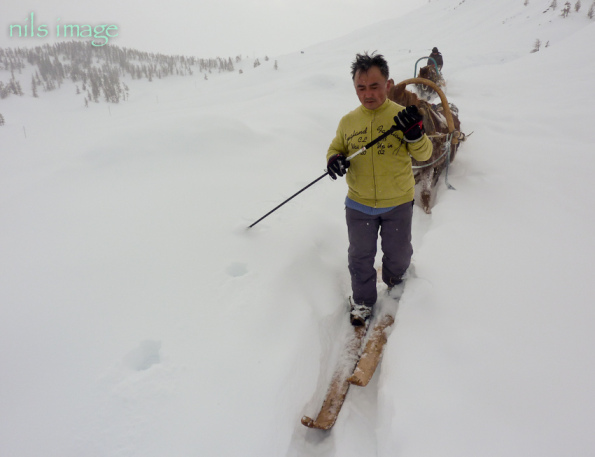
Ski-shoeing In the Altai Mountains (https://altaiskis.wordpress.com/, Nils Image)

Ski-shoeing In the Altai Mountains (https://altaiskis.wordpress.com/, Nils Image)

Thanks to ancestors of Mongolian horsemen and warriors who trace their lineage to Genghis Kahn, winter hikers do not have to choose between either cross country skiing or snow shoeing. Rather, they can benefit from the centuries of experience of the Altai people, the indigenous Chinese citizens of the Altai mountain range, bordering China, Mongolia, Kazakhstan and Russia, who have mastered a hybrid form of winter snow travel, best described as “ski-shoeing”. This technique uses short and wide skis designed to enable walking up snowy hills as with snowshoes, but allows skiing downhill like with cross country skis yet enables sliding across level snow covered ground. And, ski-shoes, which are about 70-75% the length of traditional skis and weigh about 5-6 lbs. per pair, can break trail too.

The ski shoes, called Hoks, which means “skis” in the native Tuwa language of the Altai people, includes a fabric climbing ‘skin’ built in to the undersurface of the skis, as well as metal edges, commonly found on backcountry skis. The Altai Hok skis were designed to be more efficient than snow shoeing yet easy to learn even for non-skiers, Nils Larsen, president of Altai Skis, interviewed by phone from Curlew, WA, said. In fact, hikers can use their existing hiking or backpacking boot with the ski’s universal binding, or, use a cross-country ski boot with a different binding for increased control.

Altai Hok skis, front, and back, showing climbing skin (http://altaiskis.com/)

Altai Hok skis, front, and back, showing climbing skin (http://altaiskis.com/)

The Altai people have been using similar type skis for centuries or longer. They use horsehide, however, as the climbing skin, with the stiff hairs facing downhill to provide traction when climbing. The Hok skis use a similarly stiff but synthetic fabric. Unlike traditional cross country and down hill skis, the Altai people use only one pole, made of larch or birch wood, not two poles. Called a ‘tiak’ this one pole is held by both hands and dragged behind the skier to provide balance when skiing downhill. Larsen explained that using the one pole in this manner really improves stability. The pole is not used to propel the skier forward.

The Hoks could be used on as little as several inches of snow, Mr. Larsen said, and can be used to climb most hiking trails with the exception of thinly covered icy trails. They excel, though, in deeper snow. The Hoks can traverse exposed rocks but the skier has to walk over them like with snow-shoes. Compared to cross country skis, the Hoks are slower both on flat terrain and downhill, and they do not fit into groomed cross country tracks, Mr. Larsen said. But, he maintained, they are more efficient than snow shoes since the user can slide his foot forward each step instead of lifting it up. And, the shorter ski length makes the Hoks more maneuverable than longer skis when navigating around trees in wooded areas, he added.

The Altai people use their ski shoes for daily travel around their villages as well as tracking of Elk in their nearby forests. An Altai Elk hunt on ski shoes was well documented by National Geographic in their December 2013 issue (including some video footage of the Altai skiers nationalgeographic.com). Researchers suggest that short, wide skis lined with animal hair could date back thousands of years and may represent some of the earliest skis ever. Winter hikers may find that this simple design could enhance their winter adventures by making snow travel on the trail more efficient than with snow shoes and more versatile than with cross country skis.

Howard E. Friedman

-30-