On the Trail: Really Smart Socks

published in Trail Walker Spring 2014, official publication of New York/New Jersey Trail Conference, nynjtc.org

By Howard E. Friedman DPM  Image

High tech companies keep trying to push their products onto the trail either in your backpack or on your wrist. Mapping apps for smart phones and ipads. Solar powered recharging stations so you can recharge your ipad and smart phone. But many hikers, backpackers and trail runners continue to eschew the idea of letting technology get between them and the trail. But this spring the newest high tech product for hikers will actually come between you and the trail – as long as you are wearing socks. Really smart socks.

 This spring a new high-tech sock will be available to runners and hikers that will record and project an image of exactly how your feet are striking the ground. Are you a heel striker, forefoot striker or mid-foot striker? Do you put all your pressure under your great toe but no pressure under your smallest toe? Understanding how the foot strikes the ground can be an important distinction especially for runners since many researchers suggest that mid-foot and forefoot strikers are less prone to injuries than heel strikers. (Walkers and hikers are normally heel strikers). The socks can also detect if the wearer’s gait has changed during a hike or run.

ImageCalled Sensoria, these socks will also record distance traveled, cadence (number of foot strikes per minute), number of steps taken, calories burned, as well as other metrics. A number of existing products can also tell you similar information, such as the Nike+Sportswatch. But no other device on the market geared for the athletic consumer can generate data and images of the pressure generated under your feet.

The Sensoria sock made of a washable, synthetic wicking fabric will be available this spring from Heapsylon LLC, a  Redmond, WA based technology company, Ceo Davide Vigiano said in a telephone interview. The company also manufactures a shirt and sports bra that use a sensor to record heart rate.

The sock incorporates three sensors, one each under the heel, near the big toe and near the small toe, which are less than 1 mm thick. To activate the sensors, the hiker or runner attaches an anklet to the sock via snaps. The  battery powered anklet contains an accelerometer and other technology which allow it to capture data from the sensors in the sock. The user can then see the data as it is being collected on his or her smart  phone or even Google glasses, with pressure reflected as either green, the lowest reading, or yellow or red, a high reading. Or the user could download the data from the anklet via Blue Tooth technology  or using a USB connection, after the hike to see a video strip of their foot strike history and other data, like distance traveled. Harvard evolutionary biologist Daniel Lieberman Ph.D, who has authored many studies on barefoot running and is the author of The Story of the Human Body (2013 Pantheon) is collaborating on the mobile application, according to Mr. Vigiano. The sock sensors do not have a GPS but can be paired with existing GPS units, Vigiano said.

Image

These smart socks are ideal for trail or road runners who not only want to know how far and fast they have traveled but also want to modify their gait, be notified if they have started suddenly pronating or supinating and want to try and minimize injury. Moreover, the sock could give a before and after look at exactly how an arch support or foot orthotic changes the pressure under the foot.

Howard E. Friedman

On the trail: Retreat and the edge effect

Tenafly Nature Center at Rt. 9 (H. Friedman)

Tenafly Nature Center at Rt. 9 (H. Friedman)

I finally turned back.

Perhaps my plan was ill advised from the start. To run and hike in two feet of snow without the aid of snow shoes or skis. Or even boots. Just La Sportive Wildcat trail shoes and a plastic bag I had slipped over each of my feet before I put my shoes on. But I really thought the snow would have been tamped down already by other hikers with their snow shoes or cross country skis or boots.

Apparently very few people had been out and the trail was covered with thick pillowy snow, softening in the warming temperatures. But on I ran, counting on my Kahtoola Microspikes to grab the ice and hard packed snow and prevent slipping. They were no match for today’s conditions. In some cases I crashed through the top layer of hard packed snow. But in other spots I post holed, my foot slipping into a cauldron of cold. After thirty minutes I finally accepted that I was neither trail running nor hiking, but rather slowly and inefficiently slogging my way uncomfortably through a forest blanketed in snow.

It was time to retreat, that moment when hope collides with reality.

Mountaineers must deal with the quandary of retreat. If a mountaineer advances to a summit when the odds are against her, she risks her life. Yet if she retreats she will have spent thousand of dollars and weeks or months on an unsuccessful expedition. Successful climbers, however, succeed in part because they know when to advance and when to retreat.

photo by Jake Norton/adventure.nationalgeographic.com

photo by Jake Norton/adventure.nationalgeographic.com

American mountaineer Ed Visteurs, the first U.S. climber to ascend all of the world’s 14 peaks over 8,000 meters (and without the use of supplemental oxygen), offered realistic advice about success in mountain climbing. “Getting to the top is optional. Getting down is mandatory”, he said. Each person who sets out on an adventure, be it large or small, must respect his own limits, his own edge of ability.

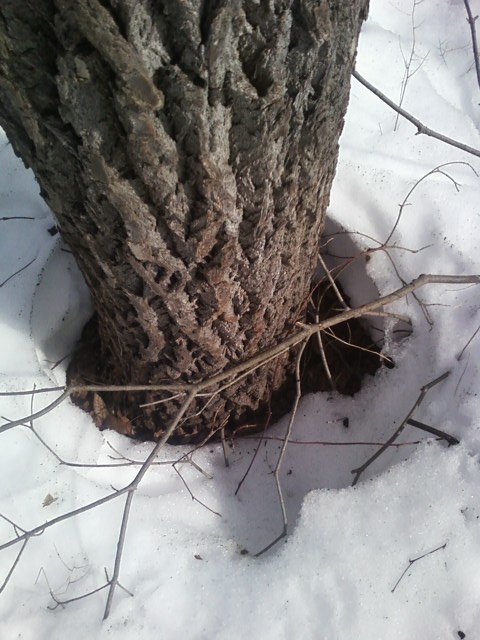
During my retreat I noticed that snow that had settled around the edge of the base of the trees was now melting away from those same trunks, leaving a ring of snow. And that ring forms a thin edge. The snow was disappearing gradually from around the trunks. The edge where the two had coexisted was the first spot to melt away.

Tenafly Nature Center 2014 (H. Friedman)

Tenafly Nature Center 2014 (H. Friedman)

Snow always begins its retreat at the edges, where it abuts a fencepost, or sidewalk or stone wall. The edge is a fragile place. Retreat for humans also occurs at the edge, the edge of ability or mental discipline. And when retreat comes, it starts with just one foot step, one step back. But that one step may be the difference between adventure and misadventure.  When you are standing on the edge, knowing whether to walk forward or back is one of life’s great challenges. But do not mistake turning back for defeat. Retreat is simply an opportunity to try another day.

Howard E. Friedman

Losing and finding the trail: an Olympic lesson

Outdoors educators advise lost hikers to stay put, make a shelter, and wait for help, instead of striking out in a new direction and risk getting even more lost. If you stay put you might be safe and not get more lost. But staying put will only help if someone comes to find you and leads you home. There are no guarantees you will be found. Sometimes you have no choice but to walk yourself back to where you began, or at least to where you lost your way.

A series of television commercials from the 2014 Sochi Olympics consider the value of looking back, or more precisely, walking, running, jumping, skiing –  backward, and back to your earliest beginnings.

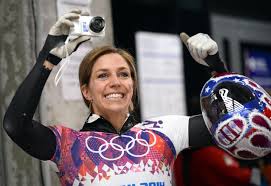
Noelle Pikus Pace (Photo: Kevin Jairaj, USA TODAY Sports)

Noelle Pikus Pace
(Photo: Kevin Jairaj, USA TODAY Sports)

TD Ameritrade presents a series of ads that begin with images of an olympian on the podium in gold medal position. Than, we see a montage of that athlete’s life in reverse, with video, in one example, of olympian skeleton slider Noelle Pikus-Pace sliding backward, running backward, sliding backward up a water slide, with additional images of of Noelle as a child, than as a toddler and finally sliding backward up a sliding board as an infant. The screen goes black with a tagline that says: Behind every big moment there are lots of small ones.

Of course, we are the sum or our total experiences, as this commercial emphasizes. But those life experiences are rooted in our childhood. William Wordsworth (1770-1850) made that point in seven words in his poem, The Rainbow:

The Rainbow

by William Wordsworth

William Wordsworth. (c) The Wordsworth Trust; Supplied by The Public Catalogue Foundation

William Wordsworth.
(c) The Wordsworth Trust; Supplied by The Public Catalogue Foundation

My heart leaps up when I behold

A rainbow in the sky:

So was it when my life began:

So is it now I am a man;

So be it when I shall grow old,

or let me die!

The Child is father of the Man;

I could wish my days to be

Bound each to each by natural piety.

“The child is father of the man” is a frequent theme among people hoping to make sense of their lives. Where did the happy child go? What happened to hopes, dreams and aspirations?Psychologists walk patients back to their childhood to try and help then understand who they were and in so doing help them understand who, what and why they are what they are now.

Teachers understand the importance of rallying around a child’s natural talents and ambitions. The wise King Solomon wrote in his Book of Proverbs: Educate the child according to his ways. So when he is old he will not depart from it (Proverbs 22:6). And this advice has become a mantra for educators  who need to teach different children differently, whether a child is a visual or auditory learner, to cite just two examples.

But the TD Ameritrade commercials portray not only the importance of rallying around our children to help them make their dreams come true. The television spots capture other qualities that are rare yet necessary for an olympic caliber athlete: passion. And not even the most supportive of parents can create passion in a child. Yet, since passion breeds perseverance, it is an important prerequisite for success.

Pikus-Pace wins silver at Sochi 2014 (NBCnews.com)

Pikus-Pace wins silver at Sochi 2014 (NBCnews.com)

Even the non-olympians among us should note the path to greatness these athletes exhibit and we could learn a lesson from these vignettes. To walk ahead with determination and resolve starts by knowing one’s self at the start of the journey. True, not everyone has the passion of an olympian, nor the skill. But everyone is on a journey, and, if you lose the path, than what?

Noelle Pikus-Pace left her sport after the 2010 Olympics. But after a miscarriage last year left her feeling lost she walked herself back to where she started and with the support of her husband returned to the skeleton track. I would suggest that when lost in the forest, real or metaphorical, you at least attempt to find that point where you lost your way. Then, if nothing in the woods seems familiar, stay put and wait for help. But in your mind continue to walk yourself backward.  Try and understand  how and where you became so lost. Once you answer those questions, you can start to find your way back home again.

Tenacity on the Trail

Catskill Waterfall, John Frederick Kensett (1816-1872), at Yale Museum of Art

Catskill Waterfall, John Frederick Kensett (1816-1872), at Yale Museum of Art

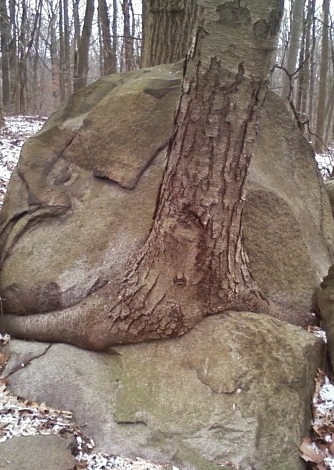
Humans aim to thrive.  Yet nature is oft satisfied with merely surviving. And at times, merely surviving is good enough. For example, some trees survive rooted only in a thin crevice of rock. And hikers and trail runners pushing through their day should take inspiration.

Gardeners strive to plant seeds and plants in the most fertile soil, and may even enrich the earth with compost or other fertilizer. And maple trees drop their seeds on the forest floor, rich with years of accumulated soil and decomposed leaf litter. Both gardener and maple tree aim to plant in a nutrient dense environment. Soil is the accumulation of lichens, mosses, fungi, animal and insect waste, decomposed leaves, twigs and fallen branches, a rich mix of nutrients ready to nourish the next seed that settles in its midst.

So it is shocking then to see that some trees are able to sprout from a rock without the benefit of a rich bed of soil. As the seed degrades and germinates, it must leach any and all available nourishment trapped alongside it in its rocky lair. And it must soak up precious drops of rainwater that find their way down the sides of the cold rock walls. Furthermore it must sprout with only the minimal amount of sunlight that makes its way deep into the dark crevasse.

Surprisingly, the sight of a tree emerging from a rock entombment is not so unusual in the forest. ‘Catskill Waterfall’, by Hudson River landscape painter John Frederick Kensett (1816-1872), seen above hanging in the Yale Art Museum, depicts a white birch seemingly emanating from a granite block, at the far right of his painting. And even today when driving through rocky terrain, one can often see saplings and trees growing almost magically right out of the crags that line our highways.

treeinrockTo a hiker or trail runner struggling on a hike or run, seeing a sapling or even a full grown tree swaying above its rocky foundation should give encouragement: to see life that has grown and persevered in adverse conditions. True, the tree growing out from a crack in a granite boulder may not be the tallest tree in the forest, but the tree has survived, and can help propagate its species. The tree can be a home to birds’ nests and provide refuge to insects galore which can burrow under its bark. But the tallest or the biggest tree it likely will never be.

The act of survival in the outdoors plays itself out again and again. Witness any of the birds resident through the winter. On a recent winter walk I was surprised to find myself within feet of a golden crowned kinglet, feeding among fir branches. This species, weighing less than a third of an ounce, is known to be able to survive even at temperatures of -40 F. The kinglet need not thrive on the coldest winter days, merely survive, to live so it can breed again in the spring. And so it is with the song sparrows, chickadees, nuthatches, titmice, cardinals, bluejays and downy woodpeckers one sees foraging, relentlessly, for their day’s nourishment throughout the winter.

Survive another day.

Such a lesson, while extreme for a recreational hiker or trail runner, is nevertheless a good one. The next mile which might seem to be insurmountable need not be covered in style. Breathlessness is okay. Sore muscles are okay. Walking and stopping are okay. Even thirst, at least for a short while, is okay. Know your limits, but persevere if possible.

The life force to survive is tenacious.

Thriving, however, may have to wait for another day.

Howard E. Friedman

Winter Ghosts on the Trail

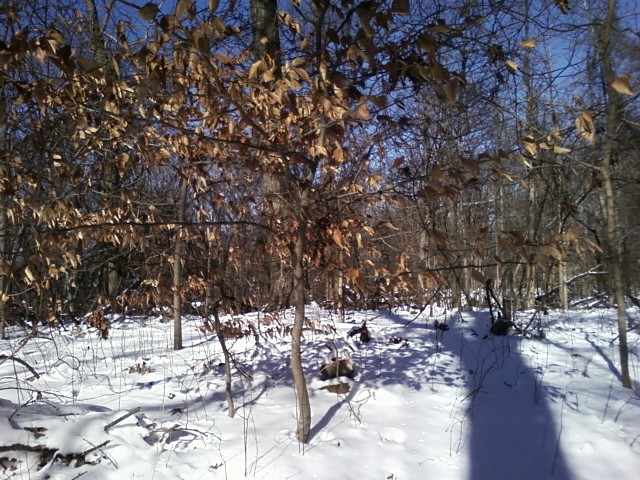
Beech tree in January

Beech tree in January

Wisps of last year linger even at the end of January. Almost all leaves dropped off  their branches months ago but the beech tree clings to last season. Even as it stands in a carpet of snow, its leaves rustle in a wind, one of the few sounds in the forest now. Though the leaves have lost their green color and are now only a ghost of their former selves, they summon up the images of the new leaves that will replace them and the millions of leaves that will appear on the trees that now stand bare in the dry winter air.

Needle bearing trees, pines, spruces, firs, hemlocks are covered in green year around, though even they lose needles from time to time. But they do not lose them all at once. And maples and birch trees lose their leaves in a continuous rain of colorful but dead and dying leaves in late autumn. Yet some beech trees hold on to their leaves throughout the winter in a process botanists call ‘marcescence’, a trait shared with oak trees. The tan wispy leaves that last throughout the winter  no longer participate in photosynthesis. Yet some scientists have postulated that these marcescent leaves serve to protect the new yet-to-bud leaves. And some have suggested that oaks and beeches are an intermediate type of tree on the evolutionary spectrum; occupying a space between the coniferous trees and the maples and birches. (Losing leaves in the fall can be a help to trees by limiting water loss and limit damage from severe cold, while holding on to needles year round may maximize photosynthesis).

Running through the snow-covered trails at Flat Rock Brook park in New Jersey, the leaves on the beech tree seemed incongruous viewed against a snow-filled backdrop. A leaf, after all, represents growth and fertility and hope and springtime. Yet the snow cover bespeaks a winter dormancy, a time of inactivity for forests and gardens. But seeing the ground covered with snow does not mean we cannot see what it hides.

My route took me over a brook crossing, one I had done many times before, rock hopping my way across. I knew the rocks were there but they were under a pile of snow and some hidden in thin ice. I looked down, but saw only mounds of snow and despite the snow cover, intuited my path.

Beech leaves have finally fallen.

Beech leaves have finally fallen.

Yet staring at the translucent leaves both on the trees and the ones that finally succumbed to their fate, I saw re-birth. Springtime. Looking at the snow covered trail and the snow on the ground to my right and left I saw, or at least wanted to see, spring wildflowers and grasses, buds on trees and nesting birds. I did see those things I think.

What can we see when we can’t see the real thing?

Educators, psychologists and others have written about the effects of watching television on developing minds.  What happens when everything is revealed? Do we dull our imagination? The advertising industry has certainly settled on ‘selling the sizzle and not the steak’. Leave something to the imagination.

And many researchers have written about our ability to imagine and fill in the visual gaps when we read. I did not find a study comparing our brain function while watching versus our brain activity when reading. But in ‘Your Brain on Fiction‘, a 2012 article in the New York Times, writer Anne Murphy Paul cites findings of neuroscientists who used MRIs to evaluate brain activity in people while they were  reading.The research shows that the written word on the page stimulates even non verbal areas of our brain. A word like “cinnamon” stimulates the olfactory portion of our brains. Fiction, it turns out, is good for our brains.

And last Sunday, running through the snow seeing ghost leaves dangling on the tree and no Joe Pye weed where it is supposed to grow, I would add: experiencing the naked forest in winter has the power to stimulate the springtime portion of our brains even while we enjoy the winter landscape.

0126141223

Winter light. What does your shadow say?

By by simonwakefield [CC-BY-2.0 (http://creativecommons.org/licenses/by/2.0)], via Wikimedia Commons

By by simonwakefield [CC-BY-2.0 (http://creativecommons.org/licenses/by/2.0)%5D, via Wikimedia Commons

Overland foot travel in winter requires extra care, like warm clothing. But there is one element even more critical,  that, unlike clothing, can not be added or subtracted easily at will.

Sunlight.

By liz west (Sundial) [CC-BY-2.0 (http://creativecommons.org/licenses/by/2.0)], via Wikimedia Commons

By liz west (Sundial) [CC-BY-2.0 (http://creativecommons.org/licenses/by/2.0)%5D, via Wikimedia Commons

True enough that hiking in the dark could be augmented with a bright headlamp. But there is no substitute for pervasive sunlight, the way it illuminates earth and sky. Regrettably, in the Winter, natural light is in short supply. Even on sunny Winter days, the radiance of the sun seems dim and insufficient. The sun can not bathe us in an intense bright  light from its low wintry perch no matter how much we strain to see.

Sundials have been in use for thousands of years, marking the sun’s transit across the sky. Once ancient people realized that our shadows shorten from morning until noon and than lengthen again toward evening, they could use that information to build reliable sun clocks, using a shadow to mark time. Sundials date back to ancient Egypt about 3,500 years ago and a reference to a sundial exists in the Book of Isaiah (38:8): “Behold, I will cause the shadow of the dial, which is gone down on the sun-dial of Ahaz, to return backward ten degrees.’ So the sun returned ten degrees, by which degrees it was gone down.”

Even Stonehenge is thought to be an ancient sun dial of sorts, not marking the hours of the day but marking rather the annual interconnected cycle of the sun and the earth, identifying both the shortest and longest days. And Stonehenge scholars believe that the midwinter solstice was more important to its worshippers than the summer solstice. Perhaps the reaffirmation of the sun’s travel across the sky was most appreciated in the depths of the dark winter days.

Sundials mark the passing of daylight, not by the sun’s light but by its shadow when the light hits the dial’s ‘gnomon’, the element that obstructs the light and casts the shadow.  Winter hikers are quite familiar with their shadow since the leaf cover that often shades the trail is absent, allowing light to filter its way down through the naked branches. Walk east in the early parts of the day and your shadow follows you, urging you along the way. Walk west and your shadow leads the way, pulling you along the trail,  the absence of light your personal guide.

You are your gnomon.

Photo source: Wikipedia, by Willy Leenders

Photo source: Wikipedia, by Willy Leenders

We know shadows from our early childhood. Shadow plays on the wall in nursery school. Picture books about frightened children cowering from their giant shadow. We know about shadows from language and literature. To Cast a Giant Shadow comes to mind. “Yeah though I walk through the valley of the shadow of death” is a more somber example from the book of Psalms.

Yet light is what we crave in the winter and even though sun beams reach the forest floor those rays of golden light still seem without their full luster. And it is our shadow that reminds us of both the presence of the sun and the absence of its light.

Now slowly approaching winter’s mid point the sun rises earlier and sets later and later if only by a few minutes at a time, increasing daylight by an additional two minutes each day by the end of January. While the sunlight has not yet fully awoken buds and bulbs from their sleep, we can see our way on wintry walks in the woods for longer and longer each passing day.  Just follow you shadow toward the light.

Springtime in the Winter, But No Promises

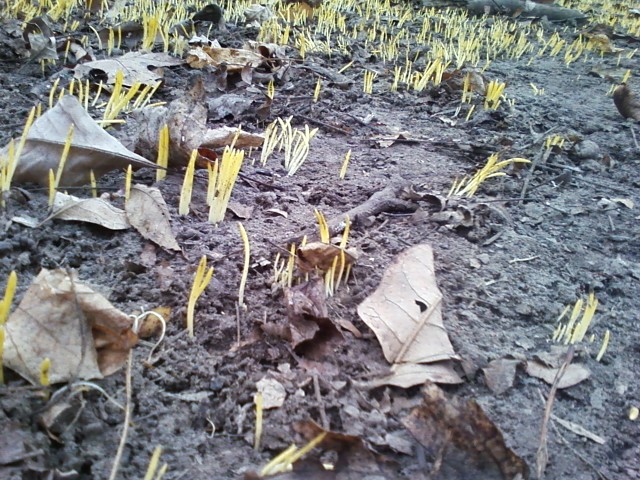
springshootsonwinterdayI passed right by them while crossing through a lightly wooded park on New Year’s day. The ground was frozen, the average temperature 28 F. Last spring’s fallen leaves still covered much of the hard earth, a threadbare blanket at best. And so it took me a moment to realize what I had just seen on this day early in Winter: Hundreds of green shoots jutting just above the cold dirt and thin layer of brittle dry leaves. They spread over an area almost a dozen feet in length

What were these nascent early risers?  Too early for me to tell, but this patch presaged a patch of robust wild plants. I doubled back when the incongruity of springtime growth on the first of January  dawned upon me. Bent over to get a closer look I thought about how nice this area would look in a few months time covered with dense vegetation.shootsandleaves

Earlier in the day I had visited a patient in a nursing home, a woman confined to bed, unable to walk due to advanced multiple sclerosis. Her room was nice enough with pictures of her family, holiday cards hanging and she was cheerful, happy to greet a new visitor. She had walked, like me, but not for more than two decades, yet she still smiled and offered warmth to a stranger.

Her ability to warmly embrace the moment regardless of her own physical limitations reminded me of another person I once visited in the hospital, a father who became a paraplegic after a car accident. Without the use of his arm or legs he cherished any function he could still perform on his own, such as breathing. A devout and learned man, he quoted to me, actually admonished me, with an interpretation of a sentence from the Book of Psalms: For every breath, I praise God.

Cherish what you perceive as inconsequential.

As I looked at the shoots I started to question my own assumptions, that saplings always grow into strapping trees, that young shoots always grow into verdant plants, that life follows an upward trajectory. Perhaps these unlucky shoots poked out too early and well, that’s it for them.  Their moment in the sunlight was their first and last stand. Indeed within four days they were once again covered by snow. Will they survive until Springtime?0105141541

Breathing hard, feeling sore in my legs, I had been running past the new shoots when I first spied them and I admit, I was happy for an excuse to stop running and rest. Yet I keep wondering, when will I finally be able to run this route effortlessly, without even wanting to stop, with nary a hint of tiredness in my body? Am I not destined to improve?

My answer was in front of me.

No guarantees. No promises.

Perhaps each footstep today is its own triumph to be celebrated while on the journey toward ‘better’.  I do not preach defeatism. Indeed, “better” is the currency of mankind: farther for a hiker, faster for a runner, higher for a climber.

Rather I offer that one should learn to revel even in the seemingly mundane moments along the way. One’s ultimate goal may or may not be reached.  But either way, at least the journey itself will bring joy.

Running in the snow with Ozymandias

English: Footsteps on a bridleway My footsteps...

English: Footsteps on a bridleway My footsteps in the snow on a bridleway from Kinnersley to Earl’s Croome. (Photo credit: Wikipedia)

I ran this morning in 3-5 inches of snow, some fresh powder, some crusted hard pack. Stretches of my route are through a wooded section parallel to a road, crosses a soccer field and baseball diamond, continues along a grassy strip bordering some railroad tracks, and heads straight through undulating terrain amongst oaks and maples on a slope ten feet above the flat asphalt track of our town park. And so, I immediately noticed my own footprints from several days earlier when I ran this same route, in the first snow of the season. There were no other footprints anywhere nearby and I rarely see anyone run along these grassy paths.

I was pleased to become reacquainted with my run of a few days before, to see an actual trace of my earlier endeavor, to know that I had indeed left a mark. But than I saw the inevitable – my yesterdays footprints were fading fast. Covered in by new snow, filling up, the sharp edges of my trail shoe tread footprint crumbling. My own footprints were going the way of the statue of Ozymandias. His statue, memorializing his life, crumbled into the sand. My footprint was also vanishing into the surrounding snow, after only a few days.

So what, really? Ozymandias lived his life. His dissolving statue was merely a testament to the folly of his hubris. My footprints on the other hand were an unintended consequence of a run through the snow. Yet seeing that my path was now marked for all to see, filled me with hubris for my effort of slogging through miles of snow; “Look on my works…”  all ye passersby.

But the disappearing footprints were a quick reminder. The mark, if any, I leave from today’s run is indeed ephemeral. The run, the hike, the long walk lives on. No memorial is needed since the feeling of well-being and sense of accomplishment last long, long after even if I am the only one who knows.

To Walk the World…

For walkers, trail runners, travelers and even armchair explorers, read about one man’s slow seven year walk retracing the route of human migration over millennia. Journalist Paul Slopek, partially funded by National Geographic, is making this journey and posting every several hundred miles with text, photos and even a short audio track of the sounds that surround him, wherever he may be, desert, town, market, or no where particular. In this article Slopek writes his first extended length article about this journey he began earlier this year, starting in Ethiopia. Now he has crossed the Red Sea and is walking north along the coast in Saudi Arabia.

Here are some of his opening thoughts in his National Geographic essay. (He can also be followed at outofedenwalk.com ):

“Each step we take is an arrested plunge, a collapse averted, a disaster braked. In this way, to walk becomes an act of faith. We perform it daily: a two-beat miracle—an iambic teetering, a holding on and letting go. For the next seven years I will plummet across the world.

I am on a journey. I am in pursuit of an idea, a story, a chimera, perhaps a folly. I am chasing ghosts. Starting in humanity’s birthplace in the Great Rift Valley of East Africa, I am retracing, on foot, the pathways of the ancestors who first discovered the Earth at least 60,000 years ago. This remains by far our greatest voyage. Not because it delivered us the planet. No. But because the early Homo sapiens who first roamed beyond the mother continent—these pioneer nomads numbered, in total, as few as a couple of hundred people—also bequeathed us the subtlest qualities we now associate with being fully human: complex language, abstract thinking, a compulsion to make art, a genius for technological innovation, and the continuum of today’s many races.”

Here is a link to the NG article:

via To Walk the World.

To be or not to be Barefoot. Is that the Question?

English: Barefoot hiking south of Penzberg, Ge...

English: Barefoot hiking south of Penzberg, Germany (Photo credit: Wikipedia)

Barefoot running and barefoot hiking have been discussed continuously since at least May 2009 when Chris McDougall’s book Born to Run was published and fueled nationwide interest in running very long distances barefooted, or, at least with only a flexible piece of rubber under one’s foot and nothing more. McDougall chronicled the ultra long distance runs of the Tarahumara Indian tribe of Mexico who’s members, men, women and children routinely logged long distance runs in a type of sandal.

And barefoot running received a further boost in 2010 when Harvard Evolutionary Biology professor Daniel Lieberman published an article in the respected science journal  Nature  about foot strike patterns in habitually barefoot runners compared to shod runners. In fact, Dr. Lieberman’s work was cited in McDougall’s book.

And since that time ‘barefoot’ has been a hundred million dollar word.

Every major shoe manufacturer and many less well known have marketed ‘barefoot’ running shoes, admittedly an oxymoron, Dr. Lieberman has noted. The shoe sole manufacturer Vibram introduced the iconic Vibram Five Fingers  a cross between a glove and a rubber soled moccasin. New Balance and others heavily marketed ‘minimalist’ shoes invoking themes suggestive of running barefoot.

And bloggers and newly minted experts cropped up overnight inveighing the virtues of the barefoot gospel. If it was good enough for Austrolapithicus, it must be good enough for us, was a general sentiment. Indeed, the modern running shoe as we know it only dates back to the 1970s (of the common era). And even according to anthropologists  who date shoe wearing among Homo Sapiens as far back as 40,000 or so years (Trinkhaus and Shang,  “Anatomical evidence for the antiquity of human footwear”, Journal of Archealogical Science 2008), ancient man’s shoes surely did not include motion controlling ethyl vinyl acetate heel cushions and a thermal polyurethane reinforced arch support.

And so authors Tam, et. al of the Department of Human Biology at the University of Cape Town rightly questioned many of the commonly accepted notions about barefooted running in their October 2013 article, “Barefoot running, an evaluation of current hypothesis, future research and clinical applications”, in the British Journal of Sports Medicine published first on-line.

A woman wears Vibram "Five Fingers" ...

A woman wears Vibram “Five Fingers” shoes. (Photo credit: Wikipedia)

Tam, et. al thoroughly review much of what is known about barefoot running, making their article an important one for someone new to the discussion about this ongoing phenomenon. Their central question remains, however,  Does running barefooted reduce the rate of injuries? And toward that end they quote Daniel Lieberman from his most recently published analysis on the topic. “How one runs is probably more important than what is on one’s feet, but what is on one’s feet may affect how one runs”, Lieberman writes near the beginning of a 2012 article.

However, what Lieberman writes at the end of his lucid, organized and thorough review of barefoot running is perhaps more cogent. In “What We Can Learn About Running From Barefoot Running: An Evolutionary Medical Perspective”, published in Exercise and Sport Sciences Review (April 2012), he writes: “My prediction – which I readily admit is nothing more than hypothesis that could be incorrect – is that shod runners with lower injury rates have a more barefoot style form…Likewise I predict that injury rates are higher among barefoot runners who either lack enough musculoskeletal strength in their calves and feet…or who still run as if they were shod with long strides and slow stride frequencies.”

It seems than that many questions about barefoot running remain outstanding. But some truths have been established. Lighter weight shoes do reduce the oxygen need of the runner with a one percent decreased need for every 100 gm decreased weight of the shoes. A mid foot or forefoot strike avoids the high pressure impacts of a heel strike. And shorter strides with a higher frequency cadence do seem to be correlated with a reduction in injuries.

So while one is vacillating about what shoes to buy, in the meanwhile run like a hunter gatherer may (or may not) have run: shorten your stride, land on the middle or front of your foot and increase the number of steps you take per minute. Unless of course you develop pain in your foot, leg, hip, back or elsewhere.  In that case, go back to whatever you were doing before!