The Adirondacks, 135 years later…

A boy and his canoe

A boy and his canoe

Recently back from a canoe camping trip to the Adirondacks, I spent some time thinking about how different our trip was from the canoe trips described by George Washington Sears (he died in 1890) who wrote about his paddling adventures around the Adirondack lakes in the magazine Forest and Stream magazine, which was published from 1873 to 1930. Reports on three of his trips when he was in his early sixties were published as a book in 1962 and reprinted in 1993 as a more critical edition titled Canoeing the Adirondacks with Nessmuk: the collected letters of George Washington Sears. Sears, who wrote under a pen name, Nessmuk, the name of his Indian friend, which means wood drake, a type of duck, in the Algonquin language, preferred light weight camping. And, he paddled what by today’s standards would be considered an ultra light weight canoe, weighing less than 15 pounds, and only about 10 feet in length.
51RM8PGEHTL._AA160_Sears also eschewed packing a large ‘duffle’ as he described it, criticizing tourists to the Adirondacks for overpacking and taking too much “stuff” into the woods.

But reading Nessmuk’s accounts of the Adirondacks while we were in the Adirondacks, I came to understand what has changed, and what has not. And those differences say something not only about the 6 million acres that make up the Adirondacks but about us, as tourists of the great forests, as canoeists and most importantly, as human beings.

The Adirondacks were not even made a state park until 1892 and by then had been heavily logged for timber as well as for leather tanning. But when Sears plied the waters there were not yet restrictions on cutting down a tree to make a lean-to. Our trip to Follensby Clear Pond, between the Saranac Lakes and the St. Regis chain of lakes, restricted our camping to a designated camp site and also included a strict rule of using only “downed or dead timber” for camp fires.
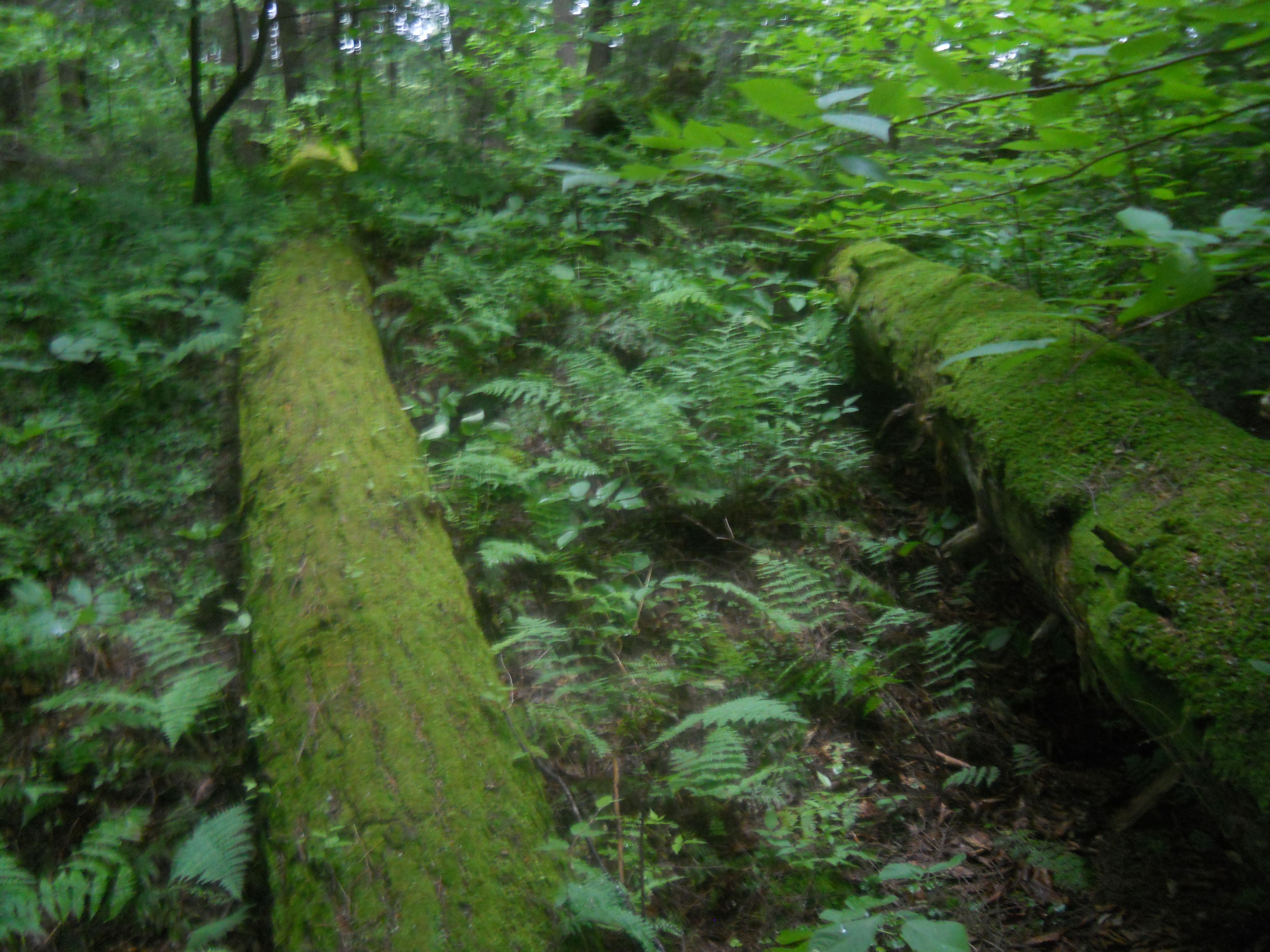
Undisturbed moss covered trunks in Follensby area.

Undisturbed moss covered trunks in Follensby area.

Nessmuk was a master woodsman, skilled in the art of bushcraft. He was able to create a shelter with the aide of his ax and able to provide food either from fishing or with the muzzle of his rifle. In his light weight canoe, though, he tended to rely on fishing, since hooks, line and a pole weighed precious little.

As I surveyed our own camp site with its three tents, kitchen and two canoes, I could not help but be wistful for a simpler time. We, like the tourists Sears criticized, traveled to the forests of the Adirondacks to enjoy a nature experience and to simply get away, in a way that traveling to a hotel or resort could not provide. Nonetheless, our ability to immerse ourselves on an island in the middle of Follensby Clear Pond surrounded by quite possibly virgin forest, hemlock and pine trees towering about 100 feet over us deep in the depths of the Adirondack State Park, was totally enabled by modern technology.

Follensby Clear Pond. Early morning.

Follensby Clear Pond. Early morning.

First of all, we drove there, covering almost 300 miles in about five and a half hours. Our tents were made of synthetic materials with aluminum poles that collapsed but were held together themselves with elastic threading. Our boats were plastic, one even made from ultra light weight Kevlar material. We cooked aided by a canister of compressed gas, burning iso-butane fuel and we stretched a blue plastic tarp over our cooking space to shield the wind and rain. 2014-06-29 17.35.47True, we did make a camp fire twice a day and did our best to start the fire with one match or two after gathering tinder and kindling. But, at one point, frustrated with my inabilities at keeping the fire going, I doused the wood with hand sanitizer and watched the flames reawaken and dance merrily. And all three of us smiled when we realized that we had cell phone reception on our island campsite in the middle of the wilderness, even if the reception was spotty at times.

So was our trip a true nature experience? We did endure some of the privations that Nessmuk described, such as mosquitoes. But we reached for our store bought insect repellent. Sears created and publicized the recipe for his own insect repellent concoction, cooking a mixture consisting of castor oil, tar and pennyroyal and applied it liberally to the skin with instructions to his readers not to wash it off themselves until they were out of the woods. And, like Sears, we did carry our canoes and all our gear from one lake to the next, but in our case, wishing we had less to carry. But one area where our misery probably equaled his was canoeing in the rain, becoming thoroughly soaked, a scene he described frequently (we either were late in donning rain jackets, or, they did not provide complete rain protection).

In Sear’s day, tourists hired guides to row them in heavy wooden dorries, carry the boats from lake to lake over the trails and set up camp and prepare food. The tourists did crave a wilderness experience. If they didn’t, they could have remained back at the great camp lodge, with many of the conveniences a home provided in the late 1800s. Nonetheless, he criticized them for taking too much stuff with them. Sears himself traveled with a very light weight pack, weighing less than about 15 pounds he writes, although some question the accuracy of his estimate. His pack consisted of an extra shirt and pair of socks, a blanket for sleeping, a knife and hatchet, fishing tackle and pole, homemade insect repellent, and a few other items. He probably carried some food with him but also relied on fishing and hunting. He took no tent as he made his own shelter from trees, trunks and branches.

We did not over pack but could have packed lighter. But even if we packed lighter, we could still not have done without modern technology. Sears never wrote about water purification. And, while some will argue that the waters of the Adirondack lakes do not require sterilization, being children of modernity, we erred on the side of caution and used an ultra violet light Steri-pen device. Furthermore, we could not have found enough appropriately sized ‘downed or dead’ wood to make our own shelter even if we wanted to and fortunately, with the rain we experienced, we had solid rain proof shelters. We could have tried to cook only with a campfire, but would first have had to master the art of creating reliable camp fires.

The Adirondacks have changed since the time of George Washington Sears. Now a New York State Park, the land comes with rules and regulations. But we, as people, have fundamentally changed in our increasing dependence on more and more advanced technology. This is not an indictment of modern society. Man has always craved, even depended on, better and better methods for producing food, shelter, and simply surviving.
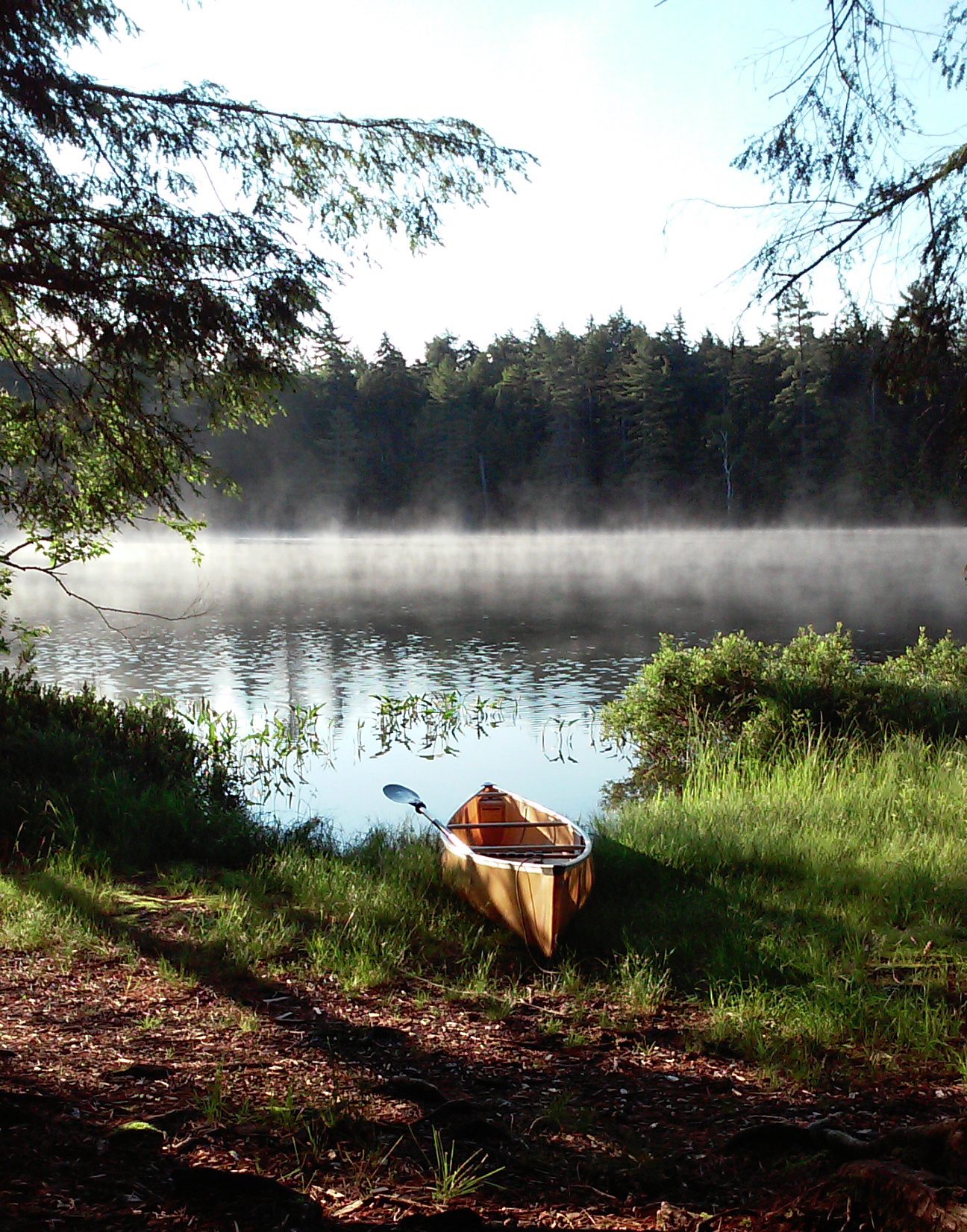
kevlar canoe, ready to row. (Y. Friedman 2015)

kevlar canoe, ready to row. (Y. Friedman 2015)

I do not think that one has to have experienced the measles to appreciate the measles vaccine, or, develop frostbite to appreciate warm winter socks and gloves. And having been cold and wet, I can tick that wilderness experience off of my list. Yet, on the whole, I would still argue that when we enter the wilderness but temper our backcountry privations with the tools of modernity, we risk losing something intangible and irreplaceable. Our experience begins to approach a virtual experience. The food is the same, the shelter is clearly a modern machination even if we sleep in a sleeping bag on the ground, and even our mode of transportation feels high tech, sitting in an ultra light weight canoe made of space age plastic.

Zeroing in on an authentic and satisfying nature experience that includes modern technologies is truly a balance. Our early hominin ancestors embraced new technologies at every opportunity even if it was only a better stone tool. The American Indians eventually embraced the rifle and the horse when they came into contact with these new tools. And we continue to upgrade from a pen and ink to a fountain pen to a ball point pen to a typewriter to a word processor to a desk top computer to a lap top to a smart phone. But isn’t part of the reason for diving back into nature to leave most of that, or at least some of those modern trappings, behind?

Maybe yes, maybe no. Each person has her or his own reason for leaving their warm bed and 120 volt electrical outlets and stepping under the forest canopy of tall trees, big sky and a seemingly never ending ceiling of twinkling stars. But even then, when we gaze toward the celestial heavens, we have to wonder, are we looking at a timeless star’s ancient light, or is that sparkling star just the orbiting international space station reflecting the light of the sun.

Howard E. Friedman

-30-

Off the Trail: The Anthropocene is here to stay.

The term Anthropocene is starting to appear more and more frequently. The “cene” ending of the word is familiar from any number of geologic epochs such as Holocene or Pleistocene. But in the case of Anthropocene we humans are the subjects, not dinosaurs, or glaciers or seismic events of unimaginable proportion.

Scientists continue to try and understand how we humans, the “anthro” in Anthropocene, are impacting our planet. Are we causing irreversible changes with development? Or over-population? Or did we start to irrevocably alter the planet when we began agriculture more than 10,000 years ago, deforesting and tilling the earth?  And anthropology professor Dr. John Hawks has written about some anthropologists who wonder if we should capitalize the word at all or refer to our epoch with a little ‘a’ just to signal that this time period is currently unfolding and its full details can not yet be known.

Read below for two scientists thoughts on this topic after convening an expert panel to think and write about our current geologic era and try to determine where we can go from here in understanding the “Anthropocene” and the impact we are having on what is for now, at least, our solar system’s only known habitable planet.

Below is the beginning of the article which was published in theconversation.com and which I saw re-posted on earthsky.org. I encourage you to read the entire piece, written by Professors Ben A. Minteer and Stephen Pyne, both of Arizona State University.

HF

What does it mean to preserve nature in the Age of Humans

“Is the Earth now spinning through the “Age of Humans?” More than a few scientists think so. They’ve suggested, in fact, that we modify the name of the current geological epoch (the Holocene, which began roughly 12,000 years ago) to the “Anthropocene.” It’s a term first put into wide circulation by Nobel-Prize winning atmospheric chemist Paul Crutzen in an article published in Nature in 2002. And it’s stirring up a good deal of debate, not only among geologists.

The idea is that we needed a new planetary marker to account for the scale of human changes to the Earth: extensive land transformation, mass extinctions, control of the nitrogen cycle, large-scale water diversion, and especially change of the atmosphere through the emission of greenhouse gases. Although naming geological epochs isn’t usually a controversial act, the Anthropocene proposal is radical because it means that what had been an environmental fixture against which people acted, the geological record, is now just another expression of the human presence.

It seems to be a particularly bitter pill to swallow for nature preservationists, heirs to the American tradition led by writers, scientists and activists such as John Muir, Aldo Leopold, David Brower, Rachel Carson and Edward Abbey. That’s because some have argued the traditional focus on the goal of wilderness protection rests on a view of “pristine” nature that is simply no longer viable on a planet hurtling toward nine billion human inhabitants.

Given this situation, we felt the time was ripe to explore the impact of the Anthropocene on the idea and practice of nature preservation. Our plan was to create a salon, a kind of literary summit. But we wanted to cut to the chase: What does it mean to “save American nature” in the age of humans?”

(the rest of the article can be accessed here)

On the trail: the grass survives, again.

The grass survived.

The snow has melted, finally, and you can once again run, walk or hike through the grass. After months under a foot or more of snow, the grass is still green, and alive, mostly.

How does grass survive the freezing cold, the darkness, buried under the snow?Humans can not survive being buried in an avalanche for more than a few minutes. Yet grass survives the cold, the weight, the desiccation. How do its cells resist rupturing, imploding and becoming a protoplasmic organic slime? How do its fragile roots maintain their grasp on a soil which has itself frozen and is no longer nurturing.

This week marks the beginning of the holiday of Passover, commemorating the exodus of the Children of Israel from slavery in Egypt. The holiday has many themes, revisited each year by parents and children and grandparents and grandchildren in a performance art like meal called the ‘seder’ where the story of the exodus is retold, using food as symbolic props.

But one idea often gets lost in all the preparation and the re-telling. The name of the holiday, Passover in English and ‘Pesach’ (pronounced peh-sakh) in hebrew, conveys a most basic but critical thematic idea. The name of the holiday references God’s sending an angel to visit death upon the first born males in pharonic Egypt as a punishment. God instructed the angel of death to spare the Jewish children. The name, then, focuses on a celebration of survival and an acknowledgement of God as both the taker and sustainer of life in a world filled with Divine intervention in the matters of mankind.

It is by design that Passover always occurs near beginning of springtime, a period of rebirth. And the blades of grass are the first signs of that renewal. They persist through a winter that really should have killed them. But at winter’s end the grasses stand up with no flowery announcement of their arrival. Unannounced and unadorned, they unfurl themselves and reach for the warmth of the nourishing sun.

The springtime holiday of Passover marks not only re-birth but also the birth of a nation that survived its own long winter of oppression, deprivation and servitude. Not every blade of grass survives the winter and neither did every member of the nation survive to leave Egypt 3,000 or so years ago. Which is why seeing the grass again in the springtime is the perfect time to truly celebrate life.

Walk in alone. Walk out together.

March is the unofficial start to the hiking season, at least for people setting out to hike a long trail, like the 2,100 mile Appalachian trail. Setting out in March avoids the coldest, snowiest part of winter and provides a long enough time to walk until the cold settles in again in the fall. More times than not, hikers start out on a solo journey, hoping to challenge themselves.  But along the way, even the most solo of solo hikers will find comfort in commiserating, camping, hiking, with others he or she meets along the way. And while the time spent in the company of others may be brief, that joining together can lift the spirits of even the most aching, blistered and tired soul.

We have many journeys in life that we must embark on alone. But ‘alone’ does not mean abandoned. My nieces and nephews just lost their mother, my brother lost his wife, who passed away at the age of 55. The end arrived as they sat by her side for long days and nights over several weeks. They are a close and united family, but naturally still face this challenge each on his and her own terms. The husband and the children entered the hospice room as individuals but they emerged from that space and a week of mourning together, bereaved, yet even closer.

The Appalachian Trail is often referred to as ‘the long green tunnel’. The trail is a single-track which passes through mostly forest, a long tunnel amidst maple, birch, oak and hickory leaves, verdant green in the spring and summer. Walking  along you can feel isolated, traveling alone with the burden of your gear on your back,  rays of light squeezing between the dense canopy of leaf filled branches, illuminating the ground with occasional spots of light here and there. But as you make your way and meet others who share your journey, your steps feel lighter as you share your burden. And despite your physical and emotional exhaustion, the journey through the long green tunnel does eventually come to an end. When you emerge, no matter how alone your sojourn felt, at journey’s end, know that you did not walk it completely alone.

Howard E. Friedman

-30-

On the Trail: Winter and the Big Bang

(Forestwander.com via Wikimedia Commons)

(Forestwander.com via Wikimedia Commons)

In a week riddled with more senseless and barbaric killings around the globe one small item of astrophysical import did not  garner much attention, even though it addressed the fundamental question of how the universe began.

The mercury began this morning in the teens when I awoke.  Dressed in layers I ran  to the nearby woods to see what I would see. In winter, all is hidden yet all is revealed. I saw no animals running about but only remnants of their activity from the day or night before. Squirrel tracks galore, raccoon and opossum prints, the occasional deer tracks and even the footprints of a family of mallards on the ice covered portion of the slow moving creek, webbed toes pointed toward open water. Two red tailed hawks and a great blue heron took off from their hidden perches, quickly, silently, vanishing like actors disappearing into the wings.

I ran a familiar route on snow and ice and came to the small pond, now frozen solid, a rare opportunity to walk out on the ice. The water is never deep here so the only risk would be wet and frigid feet if the ice cracked below. But it held.

The harsh frozen landscape seems ancient, as if it could exist for eternity, in contrast to Spring where flowers and their petals seem so fragile, even at the peak of their beauty. Winter conjures images of frozen planets in our solar system, or the frozen dark side of the moon, dry, seemingly lifeless. And thus winter makes me ponder the origins of our universe and the earth itself.

Professor Brian Koberrlein expanded on an article explaining how our universe did not necessarily begin with one defined singular moment, the ‘Big Bang’. Rather, the professor at Rochester Institute of Technology wrote in Physics Letters B, citing research from the University of Benha in Egypt and Letherbridge University in Alberta, Canada this month, the universe always existed and will always exist. A ‘big bang’ happened along the way, but that moment, referred to as “singularity” by astrophysicists, does not have to have been the first moment.

“Singularity”, one point from which all else emanates, is a comforting idea, and, we each can identify defining moments in our lives that marked a new beginning. But, outdoors in nature, peering down the snow covered trail that fades into a sun filled patina of white and ice, the infinite seems more real than the finite.

And I am glad to welcome “infinity” back into the model of how the universe began. The concept of timelessness helps frame our own travails and challenges. Whatever will be, the universe always was and always will be and we are a part of that timelessness. And while winter on the trail evinces a natural timeless quality, you can follow that same path in the Fall, or Summer, or Spring, and it will still take you to forever.

Howard E. Friedman

-30-

On the trail: Walking and newness

“Are you getting tired of walking?”, Steve Inskeep, host of NPR’s Morning Edition asked National Geographic adventurer Paul Salopek after he had completed the first year of his planned seven year walk retracing human migration from Ethiopia, through the Middle East, Asia, North and South America and ending at Tierra del Fuego, the southern tip of Chile. Salopek is wintering in Turkey for a few months, to rest, catch up on documenting his trip and plan the next section of his walk.

Salopek did not hesitate to answer.

Myriad reasons attract people to walk the open road or trail. Many are motivated by the need to exercise. Some are seduced onto the rocky trail by the siren call of rustling leaves, or a cascading creek, or the birdsongs which are so prominent a part of nature’s soundtrack.

And if you are fortunate, you returned from your hike or run or walk in the woods feeling emotionally recharged, even if physically tired. You may have seen an animal or flower that quickened your heart beat. Worries dissipated, at least for a time, and where to place your next footstep was your most pressing concern.

But how does it happen? How can running along a brook, hiking in a meadow or walking through the park be so therapeutic?

Today at twilight I ran along a creek, a small river, actually. And I was surprised by what I did not see. No birds. No herons, or egrets or cormorants. No swallows diving toward the water than soaring toward the sky. And I saw precious little animal life. One cottontail, not the dozen I usually see. And one doe, large eyes staring straight at me, but all alone.

The branches were bare save for the pine and spruce boughs. And no trefoils or clover were in bloom. All was quiet, nature bereft.

As I contemplated the stillness I thought of the answer Salopek gave at the end of his interview.

Salopek interacts with villagers (photo by Paul Salopek) http://www.nationalgeographic.com/explorers/bios/paul-salopek/

Salopek interacts with villagers (photo by Paul Salopek) http://www.nationalgeographic.com/explorers/bios/paul-salopek/

“Are you tired of walking?”, Inskeep asked.

“No”, he answered immediately. “I think, on the contrary, that’s what this walk does. This walk has the power I never imagined, to make the whole world seem new again”, Paul Salopek concluded.

How than does the trail recharge the soul? When you engage the world at a slow human pace, and remain in contact with the ground, you have the opportunity to see the world anew.

Around the globe, many people will soon mark a new calendar year. But make no mistake. What makes the year, or month or day new, is not the date on the calendar. Rather, the ability to look at the day with open eyes, and take the time to contemplate that experience, that is what endows sameness with newness.

I do not have Salopek’s seven years to walk. But I can wander into a nearby forest or field, and when I do and whatever the season, even on a barren winter eve, all seems new, again.

Howard E. Friedman

-30-

On the Trail: Boots on the ground

"Wild" from Fox Searchlight Pictures, featuring Reese Witherspoon, and Danner boots,

“Wild” from Fox Searchlight Pictures, featuring Reese Witherspoon, and Danner boots,

The movie “Wild” is coming to a theater near you, the screen adaptation of the eponymous book about Cheryl ‘Strayed’, a newbie hiker who set off and thru-hiked the 2,600 mile Pacific Crest Trail on a journey of self discovery and emotional healing.

When you see a trailer for the movie, you will see Cheryl’s boots, the camera pointing straight down toward her heavy backpacking boots. Big, solid leather boots with prominent red laces and metal lacing hooks. For the movie at least, the actress Reese Witherspoon wore Danner boots, made by the long-time boot manufacturer in Portland, OR. I know this because I ordered a pair of Danner Station boots which I wear to work and therefore I am on their email list. They proudly sent me an email newsletter with a short film about the making of Reese’s boots, including footage of the Danner manufacturing plant and interviews with the employees, craftsmen, really, who assemble this old-fashioned bespoke footwear. (See Danner’s well done promo about their Mountain Light Cascade boot worn in the movie here).

Danner;s Mountain Light Cascade

Danner’s Mountain Light Cascade

Over the past several years, hikers, backpackers, runners and anyone who takes more than a passing interest in walking or running, shoe wear and design knows that the trend toward lighter weight foot wear has taken over much of the industry, at least for the shoe cognoscenti. Hikers are routinely thru-hiking the country’s longest trails, the Appalachian, Pacific Crest and Continental Divide trails, in running shoes or low cut hiking shoes.  And the reasons are simple. Researchers have established incontrovertibly that every 100 gram decrease in shoe weight results in about 1% less oxygen consumption required during activity. Basically, lighter weight shoes are simply easier to wear over long distances.

But, is there a hidden cost to our light weight foot wear?

Cam Honan who Backpacker magazine says “trekked 50,000 miles” on foot is reported in the March 2014 issue to have worn through 28 pairs of shoes on a 15,000 mile hike of all of the longest trails in the US including the AT, PCT and CDT. He switched out shoes on average every 535 miles. His experience is not unique. Long distance hikers often literally wear out multiple pairs of shoes. Old shoes, if we are conservation minded, get donated to a charity, if they are in any kind of wearable condition. Otherwise, they get added to the growing pile of the world’s refuse heaps.

So while boots like Danner’s Mountain Light boots are very heavy (probably approaching 2 pounds each), they are resoleable, what Danner calls “recraftable”. Perhaps Cam Honan could have covered 15,000 miles in two boots, the one he was wearing and the one that was being resoled. Who knows? But as we embrace lighter weight footwear, we should think about the issue of durability and having to throw more junk into our landfills.

The hiking and trail running shoe manufacturers should start to take a cue from rock climbing shoes, which take a beating, getting scraped and brushed against all manner of hard rock surfaces, yet, can be resoled and more than once. I have been wearing a pair of Five Ten Guide Tennies for a number of years and have had them resoled. Why can’t hiking shoes be light weight and resoleable?

I challenge hiking and trail running shoe manufacturers to design technical footwear that is both lightweight and ‘recraftable’. That way we can be both good to our feet and good to the planet.

Howard E. Friedman

-30-

On the Trail: Great Blue and You

Great Blue Heron, by Marie Read, allaboutbirds.org

Great Blue Heron, by Marie Read, allaboutbirds.org

Twenty minutes watching a great blue heron from fifteen feet away can teach you a few things.

I sideled up  to the waters edge of Overpeck Creek recently after running in the large urban park, to see what I would see. Usually not much. A distant cormorant or a snowy egret on the far side in the phragmites. But this morning would be one I would remember. A great blue heron stood motionless on the kayak dock just a few feet off shore. Completely motionless. Statuesque. Immaculately attired actually.

And there it stood. I  sat on a nearby granite rock and noted the time. It did not move, fixed in its gaze toward the water. Five minutes passed. Ten minutes. Than in balletic form it turned 180 degrees. And again stood still, now gazing at the water in the opposite direction. Another five minutes. No movement, until slowly the heron stepped off the dock and into the water, clearly a more strategic position. It lowered its head to within inches of the water, than looked up and moved away,  crouching under the sloped gangplank of the dock, compressing its neck into a perfect S shape, its dagger like beak pointed, poised, primed to strike.

Then in one explosive action the bird uncoiled its neck, and in so doing buried its beak full into the water with nary a splash.

Great Blue Heron, by Greg Bishop, flickr.com/photos/gregbishop160/2928315528/

Great Blue Heron, by Greg Bishop, flickr.com/photos/gregbishop160/2928315528/

What happened below the surface, though, remains a mystery for it raised its head high, its beak empty. Had it caught something small and quickly ingested? Whether because of its success or its failure, the great blue than strode away.

I took away some lessons from watching the heron, lessons of patience, perseverance. Lessons of focus, stillness and, that solitude is often essential.

But I also learned that clear, cool autumn morning by the shore of the wide slow moving river that if you plan to survive hunting small aquatic wildlife near the water’s edge, you should arm yourself with a very long, flexible neck and a beak as lethal as a bayonet.

Howard E. Friedman

-30-

On the Trail: A Walk into the Unknown

adventureblog.nationalgeographic.com

adventureblog.nationalgeographic.com

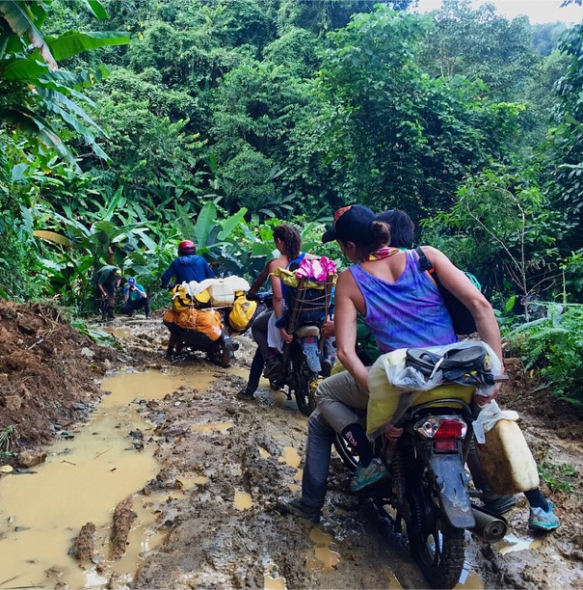
National Geographic together with The North Face are on an expedition to find the highest peak in southeast Asia. A group of six seasoned adventurers are traveling primarily on foot with some boat and motorcycle assistance deep into the jungle on a trip that will require two weeks of unsupported hiking and travel in each direction. The group is so off the grid they are carrying their own stash of anti venom to treat a possible, or even likely, poisonous snake bite by any one of a kaleidoscope of colorful and lethal vipers, cobras and kraits. Mark Jenkins, a seasoned writer of adventure non-fiction is documenting the group’s trip with regular posts at adventureblog.nationalgeographic.com

This expedition has all the hallmarks of real exploration and is reminiscent of expeditions of  the 19th and early 20th centuries. The objective is vague, the route is potentially deadly and what the outcome will be is far from clear.

adventureblog.nationalgeographic.com

adventureblog.nationalgeographic.com

Below is a link to the first post, including a very closeup picture of Trimeresurus albolabris, the lethal white lipped pit viper, which expedition member Hilaree O’Neill nearly stepped on.

Myanmar Climb: Welcome to the Jungle – Dispatch #1 – Beyond the Edge.

Off the Trail: Marking time.

This weekend Jewish congregations around the globe will once again resume the weekly out-loud public readings of the Torah (Five Books of Moses, aka Old Testament)  from the beginning, Genesis. “In the beginning, God created the heavens and the earth” the Torah opens. The statement is simple but jarring. Every year at this time we are confronted with our humblest of beginnings. Not our personal beginnings but the earliest explosive cataclysmic beginnings of a universe so vast as to be incomprehensible.

Geologists estimate the age of our planet Earth as 4.6 billion years old. Yet multicellular life did not make its appearance for almost 4 billion years. John McPhee, pulitzer prize winning non-fiction author of Annals of a Former World, a 660 page collection of five books published under one title for the first time in 1998, writes succinctly: From an interstellar gas cloud, evidently, the solar system began to form about 4.56 billion years ago. The first eleven verses of Genesis cover more than 4 billion of those years – the entire Precambrian and the first one hundred and fifty million years of Phanerozoic time (p. 630).

jpegIn his five separate books written over about 20 years, McPhee accompanies leading geologists along as they explore and explain the geology of the United States. McPhee’s plum line is Interstate 80, which starts near the basaltic columns lining the Hudson River just north of New Jersey’s George Washington bridge and following it as it crosses the mid-portion of the country )what he refers to as “the craton” and continuing from East to West ending in or about the San Andreas fault which runs right through San Francisco. McPhee queried one geologist and asked him how he reconciled his professional work that dealt in hundreds of millions and billions of years with his daily life which operates on minutes and hours, days and weeks. The rock scientist explained that his was indeed a schizophrenic existence.

We focus on the now, because, after all, that is where we live our lives. The present. Our sense of history spans decades, and in some cases, centuries and once in a while, a millenium or two. “Classic rock” music goes back only fifty or so year, making a mockery of the word “classic”. But, rock music is not that old. The rocks that are the actual foundations of our cities, the bedrocks under the dirt holding our homes up, are, however, beyond ancient. I don’t think we have a word to capture the span of ‘billions of years ago’. “Ancient” is lacking. “Old” is not even a consideration.

The woods are an antidote to the “now-ness” of mundane living. In the forest, or mountains, or wadi, whether hiking or running, you travel among the extraordinarily ancient rocks, some sculpted by water running intermittently over thousands of year, between boulders carried and left behind by advancing than retreating glaciers, and summit mountain tops rounded by tens of thousands of years of erosion, shaping the land bit by bit. Out there is where we are confronted with our planet’s unfathomable past. And at least once a year, Judaism reminds us all that our lives area a fleeting nanosecond in God’s intergalactic time scale. But soon enough, within minutes of the opening of Genesis,  we will begin reading about the exploits of Man and Woman, as they begin to build their lives, in the slow motion that sometimes seems so real. In fact, we make our appearance just 16 sentences later, and mankind remains the focus from then on.

Our challenge is to synthesize these two schizophrenic realities, and make some sense of the now.