On the Trail: Ski shoeing, a mix of cross country and snow shoeing.

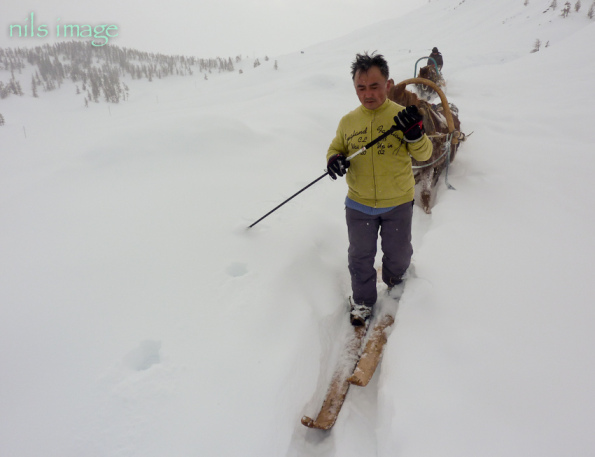
Ski-shoeing In the Altai Mountains (https://altaiskis.wordpress.com/, Nils Image)

Ski-shoeing In the Altai Mountains (https://altaiskis.wordpress.com/, Nils Image)

Thanks to ancestors of Mongolian horsemen and warriors who trace their lineage to Genghis Kahn, winter hikers do not have to choose between either cross country skiing or snow shoeing. Rather, they can benefit from the centuries of experience of the Altai people, the indigenous Chinese citizens of the Altai mountain range, bordering China, Mongolia, Kazakhstan and Russia, who have mastered a hybrid form of winter snow travel, best described as “ski-shoeing”. This technique uses short and wide skis designed to enable walking up snowy hills as with snowshoes, but allows skiing downhill like with cross country skis yet enables sliding across level snow covered ground. And, ski-shoes, which are about 70-75% the length of traditional skis and weigh about 5-6 lbs. per pair, can break trail too.

The ski shoes, called Hoks, which means “skis” in the native Tuwa language of the Altai people, includes a fabric climbing ‘skin’ built in to the undersurface of the skis, as well as metal edges, commonly found on backcountry skis. The Altai Hok skis were designed to be more efficient than snow shoeing yet easy to learn even for non-skiers, Nils Larsen, president of Altai Skis, interviewed by phone from Curlew, WA, said. In fact, hikers can use their existing hiking or backpacking boot with the ski’s universal binding, or, use a cross-country ski boot with a different binding for increased control.

Altai Hok skis, front, and back, showing climbing skin (http://altaiskis.com/)

Altai Hok skis, front, and back, showing climbing skin (http://altaiskis.com/)

The Altai people have been using similar type skis for centuries or longer. They use horsehide, however, as the climbing skin, with the stiff hairs facing downhill to provide traction when climbing. The Hok skis use a similarly stiff but synthetic fabric. Unlike traditional cross country and down hill skis, the Altai people use only one pole, made of larch or birch wood, not two poles. Called a ‘tiak’ this one pole is held by both hands and dragged behind the skier to provide balance when skiing downhill. Larsen explained that using the one pole in this manner really improves stability. The pole is not used to propel the skier forward.

The Hoks could be used on as little as several inches of snow, Mr. Larsen said, and can be used to climb most hiking trails with the exception of thinly covered icy trails. They excel, though, in deeper snow. The Hoks can traverse exposed rocks but the skier has to walk over them like with snow-shoes. Compared to cross country skis, the Hoks are slower both on flat terrain and downhill, and they do not fit into groomed cross country tracks, Mr. Larsen said. But, he maintained, they are more efficient than snow shoes since the user can slide his foot forward each step instead of lifting it up. And, the shorter ski length makes the Hoks more maneuverable than longer skis when navigating around trees in wooded areas, he added.

The Altai people use their ski shoes for daily travel around their villages as well as tracking of Elk in their nearby forests. An Altai Elk hunt on ski shoes was well documented by National Geographic in their December 2013 issue (including some video footage of the Altai skiers nationalgeographic.com). Researchers suggest that short, wide skis lined with animal hair could date back thousands of years and may represent some of the earliest skis ever. Winter hikers may find that this simple design could enhance their winter adventures by making snow travel on the trail more efficient than with snow shoes and more versatile than with cross country skis.

Howard E. Friedman

-30-

On the Trail: Boots on the ground

"Wild" from Fox Searchlight Pictures, featuring Reese Witherspoon, and Danner boots,

“Wild” from Fox Searchlight Pictures, featuring Reese Witherspoon, and Danner boots,

The movie “Wild” is coming to a theater near you, the screen adaptation of the eponymous book about Cheryl ‘Strayed’, a newbie hiker who set off and thru-hiked the 2,600 mile Pacific Crest Trail on a journey of self discovery and emotional healing.

When you see a trailer for the movie, you will see Cheryl’s boots, the camera pointing straight down toward her heavy backpacking boots. Big, solid leather boots with prominent red laces and metal lacing hooks. For the movie at least, the actress Reese Witherspoon wore Danner boots, made by the long-time boot manufacturer in Portland, OR. I know this because I ordered a pair of Danner Station boots which I wear to work and therefore I am on their email list. They proudly sent me an email newsletter with a short film about the making of Reese’s boots, including footage of the Danner manufacturing plant and interviews with the employees, craftsmen, really, who assemble this old-fashioned bespoke footwear. (See Danner’s well done promo about their Mountain Light Cascade boot worn in the movie here).

Danner;s Mountain Light Cascade

Danner’s Mountain Light Cascade

Over the past several years, hikers, backpackers, runners and anyone who takes more than a passing interest in walking or running, shoe wear and design knows that the trend toward lighter weight foot wear has taken over much of the industry, at least for the shoe cognoscenti. Hikers are routinely thru-hiking the country’s longest trails, the Appalachian, Pacific Crest and Continental Divide trails, in running shoes or low cut hiking shoes.  And the reasons are simple. Researchers have established incontrovertibly that every 100 gram decrease in shoe weight results in about 1% less oxygen consumption required during activity. Basically, lighter weight shoes are simply easier to wear over long distances.

But, is there a hidden cost to our light weight foot wear?

Cam Honan who Backpacker magazine says “trekked 50,000 miles” on foot is reported in the March 2014 issue to have worn through 28 pairs of shoes on a 15,000 mile hike of all of the longest trails in the US including the AT, PCT and CDT. He switched out shoes on average every 535 miles. His experience is not unique. Long distance hikers often literally wear out multiple pairs of shoes. Old shoes, if we are conservation minded, get donated to a charity, if they are in any kind of wearable condition. Otherwise, they get added to the growing pile of the world’s refuse heaps.

So while boots like Danner’s Mountain Light boots are very heavy (probably approaching 2 pounds each), they are resoleable, what Danner calls “recraftable”. Perhaps Cam Honan could have covered 15,000 miles in two boots, the one he was wearing and the one that was being resoled. Who knows? But as we embrace lighter weight footwear, we should think about the issue of durability and having to throw more junk into our landfills.

The hiking and trail running shoe manufacturers should start to take a cue from rock climbing shoes, which take a beating, getting scraped and brushed against all manner of hard rock surfaces, yet, can be resoled and more than once. I have been wearing a pair of Five Ten Guide Tennies for a number of years and have had them resoled. Why can’t hiking shoes be light weight and resoleable?

I challenge hiking and trail running shoe manufacturers to design technical footwear that is both lightweight and ‘recraftable’. That way we can be both good to our feet and good to the planet.

Howard E. Friedman

-30-

On the Trail: An Ode to Old Shoes

Fare thee well, old running and hiking shoes,

companion for oh, about 15 moons.

Time has run out on thee, though I am fond of you,

like the day I first spied thee in thine box.


Do not be angry upon me my Italian Wildcats

You have served me well, o’er hill and dale

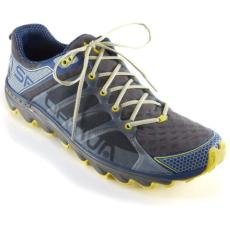
La Sportiva Wildcat

La Sportiva Wildcat

and along the Escarpment Trail.

And through puddles and snow, and in day and in night.


But you show your wear, though thee be but one year and some months old.

Your midsole is full of lines, creases, that cannot be ignored.

It is beaten down, and you feel hard beneath my soft feet.

Though, to be kind,  overall you still look so youthful.


But oh thy tread, thy tread, it is too worn, flattened smooth in areas

And gives me great fear on slick wet rock or damp tree roots

lest I go glissading, skittering into the air,

only to land and break a vital bone or tear a sinew.


We have indeed had joyous times,

running here, walking there

or sitting in quiet contemplation. But time moves on

And moreover, my fickle self also seeks a lighter model with a lower heel.


Lest you think me cruel, I will not totally abandon you.

Nay, I shall not drop you in the Salvation Army donation box

Or, send you to Soles 4 Souls, though that be wise and kind and useful

No, I will keep you in my closet, to don once a fortnight or so to run an errant errand.

(Until such time as I will decide to donate you at last.)


And no Wildcats, I will not make you meet your heir to my feet.

La Sportiva Helios

La Sportiva Helios

But know they too hail from your same Italian villa, and, probably are a close cousin,

But a full year younger, and lighter, and, oh, their tread, it is just fine.

No, Wildcats, you need not meet Helios now.


Rather, you will meet them in the closet, in, oh, about a year or so.


H.F.

-30-

On the trail: the fast keep getting faster

Much has been written recently about the widening income disparity in the United States. The rich continue to get richer while the poor stay poor and the income of the middle class slowly erodes.

This phenomenon is not limited to the economy alone. The fast get faster, too, while the slow, well, let’s just say they don’t get too much faster.

AP Photo/Andrew A. Nelles, from http://espn.go.com/sports/endurance/index

AP Photo/Andrew A. Nelles, from http://espn.go.com/sports/endurance/index

This past week in the 2014 Berlin Marathon, Kenyan Dennis Kimetto set a new world record for the 26.2 mile road race, completing the run in less than two hours and three minutes, beating the previous record by over 20 seconds, which is a significant improvement. Even the second place winner, Emmanuel Muthai, also broke the previous world record. Both runners are still a long way from crashing through the psychological and likely physical barrier of running a sub-two-hour marathon, though.

Kimetto, Muthai and the two top female finishers all had one thing in common. They wore the same type of shoes, the adidas Boost series “made up of thousands of energy capsules that store and return energy in every step”. I would be interested in running in these shoes to experience the sensation addidas promises.

adidas Adizero Boost

adidas Adizero Boost

I was initially excited about Mr. Kimetto’s finish, foolishly thinking somehow that it augured well for me personally, raising the bar of the possible, dangling a new aspiration. I am similarly excited to read about lightening fast speed records set hiking the entire Appalachian or Pacific Crest trails. Maybe I should buy the same shoes those record setters wore. Or, eat the same pre race meal.

But I have no illusion that Kimetto’s shoes will make me run appreciably faster, just as I have no illusion that driving the “luxury sedan” I see advertised on TV or wearing the very expensive watch mountaineer Ed Viesturs wore on Mt. Everest will appreciably enhance my life.

Most likely, or, shall I say, most definitely, mimicry of the elite is just mimicry, and will not result in significant change. So each year the Kenyans get faster while the middle of the pack runners continue to own the middle. And, the five-plus hour marathon finishers, well, they are happy just to finish.

One reason we humans focus on time and speed is because the discrete numbers are easy to measure and easy to understand.  But we should appreciate that, for the non-elite among us, watching those elite athletes push themselves to run and hike faster and faster, breaking record after record, is really, just entertainment. What happened in Berlin last week says lots about Dennis Kimetto and Emmanuel Muthai as runners, their training regimens and their ability to endure pain, and yes, perhaps something about their lung and heart capacities too. Their accomplishments do reveal something about the potential of the most fit members of our species. But, the new world marathon record, most regrettably, says practically nothing about me as an individual.

But hey, that’s entertainment.

Howard E. Friedman

-30-

On the trail: defining “trail”

What is “the trail”?

Recently I responded to trail shoe company Vasque’s request for product testers for a new model of trail running shoes. I had to itemize how many miles a week I run and on what surface. The choices were single-track trail, dirt, grass or pavement. I ticked off checks in the first three boxes. I don’t run on pavement.

I started wondering, am I a trail runner if I run on grass and dirt in urban environs more than I run on single track paths in the forest?

For a trail runner or hiker, must the ‘trail’ be surrounded by forest or rolling hills? Must it have rocks and roots? What about running on the grass and uneven dirt to the side of an asphalt path in a dimly lit urban park, at night? Does that constitute ‘trail running’.  What about if you run  on a wood chip path in a tree filled park but you see buildings beyond its sylvan perimeter? Is that a ‘trail’ run’? How about starting a run in a park but leaving the graded path to run through high grass, emerging with burrs and maybe a tick or two? Does that count?

Or does “the trail” really limit you to a path in the woods, or wilderness, somewhere far away, a car drive away? Perhaps running on a graded trail, maintained by trail volunteers who trim away brambles, fix the blazes, remove fallen trees, is not even real trail running. Maybe you need to bushwack your own trail through the forest to really make it count.

I never heard back from the folks at Vasque. My mileage was probably too low. My age probably too high. Maybe they don’t count running on grass as real trail running. Fair enough. They should find the hardest charging trail runners out there to test their shoes. Admittedly, that’s not me.

But I am left with my question. Am I a trail runner? On most days, honestly, probably not. But neither am I a road runner. I would accept the moniker “off-road” runner, however. But even when trying to harvest a trail run out of a city park, I aspire to return to the trail, for all the reasons more and more people are running on single track paths in the woods: the inherent challenge, the beauty of the scenery, the need for rapt attention to every foot fall. And I will return. Maybe this weekend, or next. In the meantime, I will continue to nurture my aspirations with the resources I have available. And that is the best training there is.

Howard E. Friedman

-30-


On the Trail: Really Smart Socks

published in Trail Walker Spring 2014, official publication of New York/New Jersey Trail Conference, nynjtc.org

By Howard E. Friedman DPM  Image

High tech companies keep trying to push their products onto the trail either in your backpack or on your wrist. Mapping apps for smart phones and ipads. Solar powered recharging stations so you can recharge your ipad and smart phone. But many hikers, backpackers and trail runners continue to eschew the idea of letting technology get between them and the trail. But this spring the newest high tech product for hikers will actually come between you and the trail – as long as you are wearing socks. Really smart socks.

 This spring a new high-tech sock will be available to runners and hikers that will record and project an image of exactly how your feet are striking the ground. Are you a heel striker, forefoot striker or mid-foot striker? Do you put all your pressure under your great toe but no pressure under your smallest toe? Understanding how the foot strikes the ground can be an important distinction especially for runners since many researchers suggest that mid-foot and forefoot strikers are less prone to injuries than heel strikers. (Walkers and hikers are normally heel strikers). The socks can also detect if the wearer’s gait has changed during a hike or run.

ImageCalled Sensoria, these socks will also record distance traveled, cadence (number of foot strikes per minute), number of steps taken, calories burned, as well as other metrics. A number of existing products can also tell you similar information, such as the Nike+Sportswatch. But no other device on the market geared for the athletic consumer can generate data and images of the pressure generated under your feet.

The Sensoria sock made of a washable, synthetic wicking fabric will be available this spring from Heapsylon LLC, a  Redmond, WA based technology company, Ceo Davide Vigiano said in a telephone interview. The company also manufactures a shirt and sports bra that use a sensor to record heart rate.

The sock incorporates three sensors, one each under the heel, near the big toe and near the small toe, which are less than 1 mm thick. To activate the sensors, the hiker or runner attaches an anklet to the sock via snaps. The  battery powered anklet contains an accelerometer and other technology which allow it to capture data from the sensors in the sock. The user can then see the data as it is being collected on his or her smart  phone or even Google glasses, with pressure reflected as either green, the lowest reading, or yellow or red, a high reading. Or the user could download the data from the anklet via Blue Tooth technology  or using a USB connection, after the hike to see a video strip of their foot strike history and other data, like distance traveled. Harvard evolutionary biologist Daniel Lieberman Ph.D, who has authored many studies on barefoot running and is the author of The Story of the Human Body (2013 Pantheon) is collaborating on the mobile application, according to Mr. Vigiano. The sock sensors do not have a GPS but can be paired with existing GPS units, Vigiano said.

Image

These smart socks are ideal for trail or road runners who not only want to know how far and fast they have traveled but also want to modify their gait, be notified if they have started suddenly pronating or supinating and want to try and minimize injury. Moreover, the sock could give a before and after look at exactly how an arch support or foot orthotic changes the pressure under the foot.

Howard E. Friedman

Tenacity on the Trail

Catskill Waterfall, John Frederick Kensett (1816-1872), at Yale Museum of Art

Catskill Waterfall, John Frederick Kensett (1816-1872), at Yale Museum of Art

Humans aim to thrive.  Yet nature is oft satisfied with merely surviving. And at times, merely surviving is good enough. For example, some trees survive rooted only in a thin crevice of rock. And hikers and trail runners pushing through their day should take inspiration.

Gardeners strive to plant seeds and plants in the most fertile soil, and may even enrich the earth with compost or other fertilizer. And maple trees drop their seeds on the forest floor, rich with years of accumulated soil and decomposed leaf litter. Both gardener and maple tree aim to plant in a nutrient dense environment. Soil is the accumulation of lichens, mosses, fungi, animal and insect waste, decomposed leaves, twigs and fallen branches, a rich mix of nutrients ready to nourish the next seed that settles in its midst.

So it is shocking then to see that some trees are able to sprout from a rock without the benefit of a rich bed of soil. As the seed degrades and germinates, it must leach any and all available nourishment trapped alongside it in its rocky lair. And it must soak up precious drops of rainwater that find their way down the sides of the cold rock walls. Furthermore it must sprout with only the minimal amount of sunlight that makes its way deep into the dark crevasse.

Surprisingly, the sight of a tree emerging from a rock entombment is not so unusual in the forest. ‘Catskill Waterfall’, by Hudson River landscape painter John Frederick Kensett (1816-1872), seen above hanging in the Yale Art Museum, depicts a white birch seemingly emanating from a granite block, at the far right of his painting. And even today when driving through rocky terrain, one can often see saplings and trees growing almost magically right out of the crags that line our highways.

treeinrockTo a hiker or trail runner struggling on a hike or run, seeing a sapling or even a full grown tree swaying above its rocky foundation should give encouragement: to see life that has grown and persevered in adverse conditions. True, the tree growing out from a crack in a granite boulder may not be the tallest tree in the forest, but the tree has survived, and can help propagate its species. The tree can be a home to birds’ nests and provide refuge to insects galore which can burrow under its bark. But the tallest or the biggest tree it likely will never be.

The act of survival in the outdoors plays itself out again and again. Witness any of the birds resident through the winter. On a recent winter walk I was surprised to find myself within feet of a golden crowned kinglet, feeding among fir branches. This species, weighing less than a third of an ounce, is known to be able to survive even at temperatures of -40 F. The kinglet need not thrive on the coldest winter days, merely survive, to live so it can breed again in the spring. And so it is with the song sparrows, chickadees, nuthatches, titmice, cardinals, bluejays and downy woodpeckers one sees foraging, relentlessly, for their day’s nourishment throughout the winter.

Survive another day.

Such a lesson, while extreme for a recreational hiker or trail runner, is nevertheless a good one. The next mile which might seem to be insurmountable need not be covered in style. Breathlessness is okay. Sore muscles are okay. Walking and stopping are okay. Even thirst, at least for a short while, is okay. Know your limits, but persevere if possible.

The life force to survive is tenacious.

Thriving, however, may have to wait for another day.

Howard E. Friedman

Winter Ghosts on the Trail

Beech tree in January

Beech tree in January

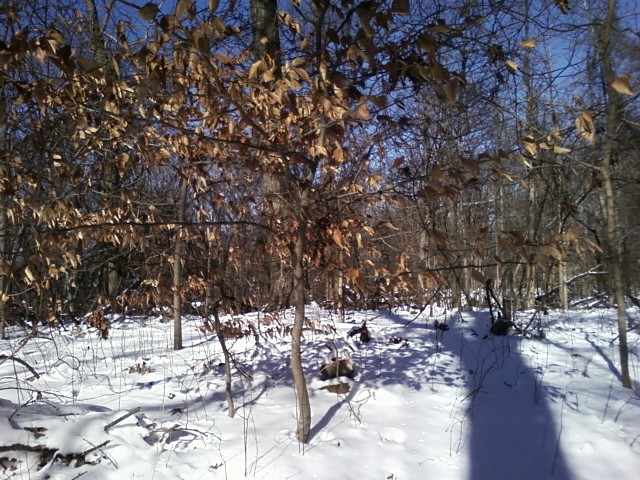
Wisps of last year linger even at the end of January. Almost all leaves dropped off  their branches months ago but the beech tree clings to last season. Even as it stands in a carpet of snow, its leaves rustle in a wind, one of the few sounds in the forest now. Though the leaves have lost their green color and are now only a ghost of their former selves, they summon up the images of the new leaves that will replace them and the millions of leaves that will appear on the trees that now stand bare in the dry winter air.

Needle bearing trees, pines, spruces, firs, hemlocks are covered in green year around, though even they lose needles from time to time. But they do not lose them all at once. And maples and birch trees lose their leaves in a continuous rain of colorful but dead and dying leaves in late autumn. Yet some beech trees hold on to their leaves throughout the winter in a process botanists call ‘marcescence’, a trait shared with oak trees. The tan wispy leaves that last throughout the winter  no longer participate in photosynthesis. Yet some scientists have postulated that these marcescent leaves serve to protect the new yet-to-bud leaves. And some have suggested that oaks and beeches are an intermediate type of tree on the evolutionary spectrum; occupying a space between the coniferous trees and the maples and birches. (Losing leaves in the fall can be a help to trees by limiting water loss and limit damage from severe cold, while holding on to needles year round may maximize photosynthesis).

Running through the snow-covered trails at Flat Rock Brook park in New Jersey, the leaves on the beech tree seemed incongruous viewed against a snow-filled backdrop. A leaf, after all, represents growth and fertility and hope and springtime. Yet the snow cover bespeaks a winter dormancy, a time of inactivity for forests and gardens. But seeing the ground covered with snow does not mean we cannot see what it hides.

My route took me over a brook crossing, one I had done many times before, rock hopping my way across. I knew the rocks were there but they were under a pile of snow and some hidden in thin ice. I looked down, but saw only mounds of snow and despite the snow cover, intuited my path.

Beech leaves have finally fallen.

Beech leaves have finally fallen.

Yet staring at the translucent leaves both on the trees and the ones that finally succumbed to their fate, I saw re-birth. Springtime. Looking at the snow covered trail and the snow on the ground to my right and left I saw, or at least wanted to see, spring wildflowers and grasses, buds on trees and nesting birds. I did see those things I think.

What can we see when we can’t see the real thing?

Educators, psychologists and others have written about the effects of watching television on developing minds.  What happens when everything is revealed? Do we dull our imagination? The advertising industry has certainly settled on ‘selling the sizzle and not the steak’. Leave something to the imagination.

And many researchers have written about our ability to imagine and fill in the visual gaps when we read. I did not find a study comparing our brain function while watching versus our brain activity when reading. But in ‘Your Brain on Fiction‘, a 2012 article in the New York Times, writer Anne Murphy Paul cites findings of neuroscientists who used MRIs to evaluate brain activity in people while they were  reading.The research shows that the written word on the page stimulates even non verbal areas of our brain. A word like “cinnamon” stimulates the olfactory portion of our brains. Fiction, it turns out, is good for our brains.

And last Sunday, running through the snow seeing ghost leaves dangling on the tree and no Joe Pye weed where it is supposed to grow, I would add: experiencing the naked forest in winter has the power to stimulate the springtime portion of our brains even while we enjoy the winter landscape.

0126141223

Winter light. What does your shadow say?

By by simonwakefield [CC-BY-2.0 (http://creativecommons.org/licenses/by/2.0)], via Wikimedia Commons

By by simonwakefield [CC-BY-2.0 (http://creativecommons.org/licenses/by/2.0)%5D, via Wikimedia Commons

Overland foot travel in winter requires extra care, like warm clothing. But there is one element even more critical,  that, unlike clothing, can not be added or subtracted easily at will.

Sunlight.

By liz west (Sundial) [CC-BY-2.0 (http://creativecommons.org/licenses/by/2.0)], via Wikimedia Commons

By liz west (Sundial) [CC-BY-2.0 (http://creativecommons.org/licenses/by/2.0)%5D, via Wikimedia Commons

True enough that hiking in the dark could be augmented with a bright headlamp. But there is no substitute for pervasive sunlight, the way it illuminates earth and sky. Regrettably, in the Winter, natural light is in short supply. Even on sunny Winter days, the radiance of the sun seems dim and insufficient. The sun can not bathe us in an intense bright  light from its low wintry perch no matter how much we strain to see.

Sundials have been in use for thousands of years, marking the sun’s transit across the sky. Once ancient people realized that our shadows shorten from morning until noon and than lengthen again toward evening, they could use that information to build reliable sun clocks, using a shadow to mark time. Sundials date back to ancient Egypt about 3,500 years ago and a reference to a sundial exists in the Book of Isaiah (38:8): “Behold, I will cause the shadow of the dial, which is gone down on the sun-dial of Ahaz, to return backward ten degrees.’ So the sun returned ten degrees, by which degrees it was gone down.”

Even Stonehenge is thought to be an ancient sun dial of sorts, not marking the hours of the day but marking rather the annual interconnected cycle of the sun and the earth, identifying both the shortest and longest days. And Stonehenge scholars believe that the midwinter solstice was more important to its worshippers than the summer solstice. Perhaps the reaffirmation of the sun’s travel across the sky was most appreciated in the depths of the dark winter days.

Sundials mark the passing of daylight, not by the sun’s light but by its shadow when the light hits the dial’s ‘gnomon’, the element that obstructs the light and casts the shadow.  Winter hikers are quite familiar with their shadow since the leaf cover that often shades the trail is absent, allowing light to filter its way down through the naked branches. Walk east in the early parts of the day and your shadow follows you, urging you along the way. Walk west and your shadow leads the way, pulling you along the trail,  the absence of light your personal guide.

You are your gnomon.

Photo source: Wikipedia, by Willy Leenders

Photo source: Wikipedia, by Willy Leenders

We know shadows from our early childhood. Shadow plays on the wall in nursery school. Picture books about frightened children cowering from their giant shadow. We know about shadows from language and literature. To Cast a Giant Shadow comes to mind. “Yeah though I walk through the valley of the shadow of death” is a more somber example from the book of Psalms.

Yet light is what we crave in the winter and even though sun beams reach the forest floor those rays of golden light still seem without their full luster. And it is our shadow that reminds us of both the presence of the sun and the absence of its light.

Now slowly approaching winter’s mid point the sun rises earlier and sets later and later if only by a few minutes at a time, increasing daylight by an additional two minutes each day by the end of January. While the sunlight has not yet fully awoken buds and bulbs from their sleep, we can see our way on wintry walks in the woods for longer and longer each passing day.  Just follow you shadow toward the light.

Springtime in the Winter, But No Promises

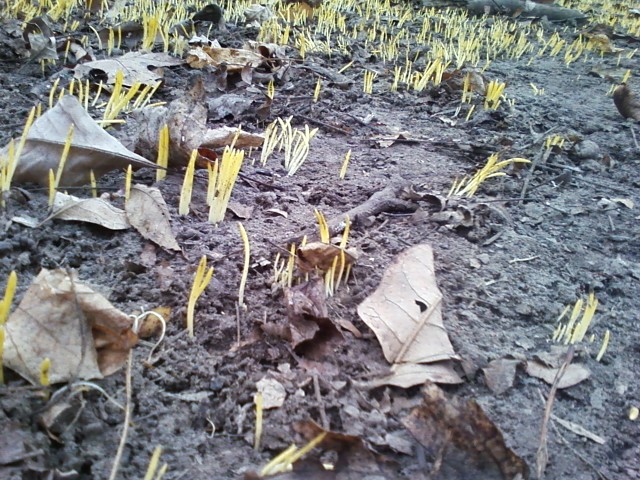
springshootsonwinterdayI passed right by them while crossing through a lightly wooded park on New Year’s day. The ground was frozen, the average temperature 28 F. Last spring’s fallen leaves still covered much of the hard earth, a threadbare blanket at best. And so it took me a moment to realize what I had just seen on this day early in Winter: Hundreds of green shoots jutting just above the cold dirt and thin layer of brittle dry leaves. They spread over an area almost a dozen feet in length

What were these nascent early risers?  Too early for me to tell, but this patch presaged a patch of robust wild plants. I doubled back when the incongruity of springtime growth on the first of January  dawned upon me. Bent over to get a closer look I thought about how nice this area would look in a few months time covered with dense vegetation.shootsandleaves

Earlier in the day I had visited a patient in a nursing home, a woman confined to bed, unable to walk due to advanced multiple sclerosis. Her room was nice enough with pictures of her family, holiday cards hanging and she was cheerful, happy to greet a new visitor. She had walked, like me, but not for more than two decades, yet she still smiled and offered warmth to a stranger.

Her ability to warmly embrace the moment regardless of her own physical limitations reminded me of another person I once visited in the hospital, a father who became a paraplegic after a car accident. Without the use of his arm or legs he cherished any function he could still perform on his own, such as breathing. A devout and learned man, he quoted to me, actually admonished me, with an interpretation of a sentence from the Book of Psalms: For every breath, I praise God.

Cherish what you perceive as inconsequential.

As I looked at the shoots I started to question my own assumptions, that saplings always grow into strapping trees, that young shoots always grow into verdant plants, that life follows an upward trajectory. Perhaps these unlucky shoots poked out too early and well, that’s it for them.  Their moment in the sunlight was their first and last stand. Indeed within four days they were once again covered by snow. Will they survive until Springtime?0105141541

Breathing hard, feeling sore in my legs, I had been running past the new shoots when I first spied them and I admit, I was happy for an excuse to stop running and rest. Yet I keep wondering, when will I finally be able to run this route effortlessly, without even wanting to stop, with nary a hint of tiredness in my body? Am I not destined to improve?

My answer was in front of me.

No guarantees. No promises.

Perhaps each footstep today is its own triumph to be celebrated while on the journey toward ‘better’.  I do not preach defeatism. Indeed, “better” is the currency of mankind: farther for a hiker, faster for a runner, higher for a climber.

Rather I offer that one should learn to revel even in the seemingly mundane moments along the way. One’s ultimate goal may or may not be reached.  But either way, at least the journey itself will bring joy.