On the trail: A virtual backpacking trip thru Yosemite…

from Project Yosemite by Sheldon Neill and Colin Delehanty

from Project Yosemite by Sheldon Neill and Colin Delehanty

With warmer weather, thoughts turn to epic hiking and backpacking trips, many of which, unfortunately, will not materialize, at least not this season. While I do not profess that technology can replace a true outdoors experience, I would be foolish not to at least acknowledge that the increasing marvels of technology are bringing the outdoors closer and closer to our fingertips.

I would love to spend some time backpacking through Yoesmite Valley. But, it won’t happen this summer. In the meanwhile, my eyes and even my soul can feast on the magnificent time lapse video footage capturing the movements of land and sky filmed over 10 months with sophisticated equipment to create a pretty darned good simulation of sights and sound of a hike throughYosemite National Park.

Colin Delehanty and Sheldon Neill hiked 200 miles carrying 70 lbs. of camera equipment on their backs to make the following five minute outstanding video. Visit www.projectyose.com to see this video (a Vimeo editor’s choice), nourish your soul, learn more about their project and see links to others they met along the way who have also captured on film the beauty that is Yosemite National Park.

Howard E. Friedman

“A Window on Eternity”, in Gorongosa and Chernobyl

Destruction of our natural habitat comes in many many different forms. Edward O. Wilson writes about destruction and rebirth in one such place, Gorongosa National Park in Mozambique. And Timothy Mousseau, professor of Biology at University of South Carolina, studies destruction and its impact on rebirth in another location, Chernobyl, Ukraine.

A Window on EternityIn A Window on Eternity, A biologist’s walk through Gorongosa National Park (Simon & Schuster 2014), Wilson briefly recounts the history of Mozambique’s 16 year civil war ending in 1994 which resulted in nearly a million people killed and the creation of several million refugees. A collateral effect of the war was near extinction of what Wilson describes as “the megafauna” of Gorongosa National Park, a wildlife refuge located in Mozambique, but too close to the fighting. Large edible and/or valuable animals were killed for food or profit. Elephants decreased by 80-90% in number. Cape buffalos went from 13,000 in 1972 to 15 in 2001, Wilson writes. Wildebeest went from 6,400 to one and zebras from 3,300 to just 12 he adds.

Thanks to the great efforts of U.S. businessman and philanthropist Gregory Carr who began over seeing the reintroduction of large animlas back into the park, Gorongosa is staging a slow resurrection.

“Another several decades may be needed for Gorongosa to return to its old preeminence, but given the persistence of its undergirding of plants and invertebrates which largely survived the war intact, I believe this  will surely come to pass,” Wilson concludes in the chapter called ‘War and Redemption’. In the chapters that follow Dr. Wilson describes findings from his and his colleague’s expeditions to Gorongosa as he shares their ground-eye view of ants, katydids, praying mantises and others. “None to me is a bug,” he writes, “Each instead is one kind of insect, the ancient legatee of an ancient history adapted to the natural world in its own special way. I wish I had a hundred lifetimes to study them all,”  he writes in the beginning of chapter eight, ‘The Clash of Insect Civilizations’.

But while E.O.Wilson is sanguine about ‘The Conservation of Eternity’ (title of chapter eleven) in nature’s ability to recover from war in Gorongosa park, fellow biologist   Timothy Mousseau, professor at University of South Carolina is less optimistic about the resilience of various phyla of the animal kingdom to survive nuclear fallout. Dr. Mousseau has been studying how various species of birds, spiders and insects have fared in and around the Chernobyl nuclear reactor which exploded 25 years ago, releasing large amounts of radioactivity into the atmosphere. His work was featured on Newyorktimes.com.

Dr. Mousseau in Red Forest, Chernobyl (http://cricket.biol.sc.edu/Mousseau/Mousseau.html)

Dr. Mousseau in Red Forest, Chernobyl (http://cricket.biol.sc.edu/Mousseau/Mousseau.html)

Still a hot zone, the area around the old plant has been off limits to humans, making it an interesting living laboratory to study flora and fauna without the day to day interference of human life (though one could make an easy argument that after contaminating an entire region with radioactive waste, day to day human activity is kind of negligible). Since 1999 Mousseau and Dr. Pape Moeller have been documenting aberrations in spider webs, bird beaks,  insects and rodents, all of which they say reflect genetic mutations in animals living in the most radioactive zones around Chernobyl. And, while some researchers take issue with Mousseau and  have pointed to the fact that any wildlife that persists around Chernobyl is proof of the resilience of  various species, Dr. Mousseau cautions that if you look more carefully, life has persisted but not robustly and not in good health.

Neither scenario is appealing. Dr. Wilson documents a resurgence of wildlife in an area that witnessed almost a million human deaths, thousands of animal deaths and which required importing ‘megafauna’ species to help repopulate the area. Dr. Mousseau documents the persistence of weakened and wounded life which, however, has been able to survive a near direct nuclear explosion but which has little hope of ever returning to full health. Perhaps for either scenario, Edward O.Wilson was prescient in selecting the opening quote in his latest book: “I have set before you life and death, blessing and cursing: therefore choose life, that both thou and thy seed may live . – Moses at Mount Nebo, Deuteronomy 30:19.”

Howard E. Friedman

The Evolution of Walking: From Laetoli to the Exodus to the Appalachian Trail

hiking in Chamonix

Ambulating on two legs dates back  3.6 million years ago according to anthropologists who have studied human like foot prints preserved in the volcanic ash in Laetoli, Tanzania. Those foot prints were discovered by anthropologist Mary Leakey in 1978.

http://www.getty.edu/conservation/publications_resources/newsletters/10_1/laetoli.html

The Laetoli footprints, from http://www.getty.edu, photo-Martha Demas, 1995.

The human like Austrolapithicenes who left those foot prints were quite possibly walking for a utilitarian purpose, like searching for food or shelter, or returning to their shelter. As our human society has evolved, however, walking has evolved right along with it. In fact, one could suggest that as a species, we have evolved to no longer need walking for distance travel.

We walk now to thrive, not survive. Evening strolls, weekend hikes, backpacking trips, laps around the high school track. Humans continue to find new but non-essential ways to exploit the simple, elegant act of placing one foot in front the other. And that act, in fact, is one of the hallmarks of what it means to be human.

Today, walking for long distance travel,  on the other hand, has become rare. And this might explain why last month, when the Tougas family of New Richmond, Canada, announced their plans to walk more than two thousand miles, together, on the Appalachian Trail,  they saw it as a viable marketing opportunity to raise money for their project.

The Tougas family announced their planned family through-hike of the AT on Kickstarter.com.  They  received pledges of $19,109 (Canadian), surpassing their goal of $16,000. The family spokesperson and father, Damien Tougas, explains on his KickStarter site that the monies raised will go to fund production of a video series that sponsors will receive in installments, once a month. The money raised, he said, will not be used to pay for the hike itself. The family has already put aside funds for their 6 month sojourn, he explains.

Walking has always been a sure mode of human transportation. Early humans of course had no alternative. Hunting and gathering required walking and beasts of burden had presumably not yet become part of daily life.  Even Americans, thousands of years following hunter-gatherers, still walked alongside their covered wagons,  for upwards of six months.  400,000 or so people migrated, on foot, westward to  Oregon, Utah, New Mexico and California, between 1840 to almost 1870. Their wagons were so full of family belongings and food there was precious little room left for riders. But these hearty pioneers were perhaps among the last of the long-distance migratory walkers, at least in North America.

Human beings have slowly, but persistently, sought out alternatives to walking. Even several thousand years ago, Egyptian soldiers used horses to pull their chariots. Some Greek warriors rode into battle on the backs of elephants and trade routes in the Middle East have domesticated the camel.  In more recent times horses have either carried riders or pulled wagons and carriages.  The horseless carriage morphed into the car, and now motorized transportation has become ubiquitous.  Walking as a daily means of transportation has become a rarity, at least in western civilization.

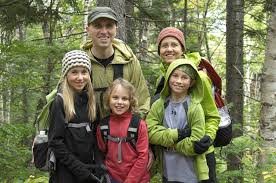
Tougas family (fimby.tougas.net)

Tougas family (fimby.tougas.net)

And while the Tougas’ get great credit for their planned family adventure, we are left with the question, why is watching another family walk intrinsically interesting? Certainly there are challenges and risks with a long distance hike and even more so for the younger Tougas children.  The AT however,  is well marked, well traveled and fairly close to civilization along most of the route. Although  a 2,100 mile trek is big undertaking, and the trail is quite strenuous at times and weather is always a variable.

Nonetheless, I suggest that our societal de-evolution of long distance walking is the key to family Tougas’ ability to raise close to twenty thousand dollars from 267 people who are willing to pay to see that family walk. Almost like paying to watch an IMAX movie about rock climbers, or cliff divers or base jumpers. In 2014, traveling a long distance on foot is a novelty and considered an adventure, only for the intrepid among us. And I suspect that even if family Tougas said they were going to walk strictly along back-country roads from Georgia to Maine and stay in bed and breakfasts along the way, and not pitch their tent in the woods, they still would have been able to raise money for their trip.
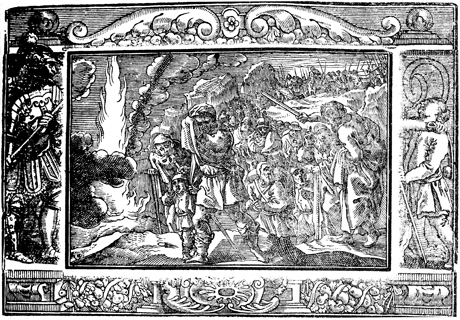
From Biblia Das Ist, Martin Luther (1486-1583), a depiction of the Exodus. Courtesy of the Digital Image Archive, Pitts Theology Library, Candler School of Theology, Emory University

From Biblia Das Ist, Martin Luther (1486-1583), a depiction of the Exodus. Courtesy of the Digital Image Archive, Pitts Theology Library, Candler School of Theology, Emory University

In one week the Jewish people mark the exodus of the Children of Israel out of Egypt, when they began their forty year sojourn toward the Promised Land. After hundreds of years of bitter enslavement the Israelites walked out of Egypt, away from their life of servitude, to follow Moses, a leader appointed by God. During four decades the Hebrew tribe walked from encampment to encampment in the Sinai peninsula, until they finally crossed the Jordan River to enter the city of Jericho in the land of Israel.

Next week, when Jewish families gather to commemorate that night about four thousand years ago when the Israelite  begin their long walk toward freedom, let us also remember that one of the most basic human functions, walking, is so simple and elegant. The long walk should not be considered a novelty,  since  the process of walking can transport us, physically and figuratively, toward a new beginning.

Howard E. Friedman


On the Trail: Really Smart Socks

published in Trail Walker Spring 2014, official publication of New York/New Jersey Trail Conference, nynjtc.org

By Howard E. Friedman DPM  Image

High tech companies keep trying to push their products onto the trail either in your backpack or on your wrist. Mapping apps for smart phones and ipads. Solar powered recharging stations so you can recharge your ipad and smart phone. But many hikers, backpackers and trail runners continue to eschew the idea of letting technology get between them and the trail. But this spring the newest high tech product for hikers will actually come between you and the trail – as long as you are wearing socks. Really smart socks.

 This spring a new high-tech sock will be available to runners and hikers that will record and project an image of exactly how your feet are striking the ground. Are you a heel striker, forefoot striker or mid-foot striker? Do you put all your pressure under your great toe but no pressure under your smallest toe? Understanding how the foot strikes the ground can be an important distinction especially for runners since many researchers suggest that mid-foot and forefoot strikers are less prone to injuries than heel strikers. (Walkers and hikers are normally heel strikers). The socks can also detect if the wearer’s gait has changed during a hike or run.

ImageCalled Sensoria, these socks will also record distance traveled, cadence (number of foot strikes per minute), number of steps taken, calories burned, as well as other metrics. A number of existing products can also tell you similar information, such as the Nike+Sportswatch. But no other device on the market geared for the athletic consumer can generate data and images of the pressure generated under your feet.

The Sensoria sock made of a washable, synthetic wicking fabric will be available this spring from Heapsylon LLC, a  Redmond, WA based technology company, Ceo Davide Vigiano said in a telephone interview. The company also manufactures a shirt and sports bra that use a sensor to record heart rate.

The sock incorporates three sensors, one each under the heel, near the big toe and near the small toe, which are less than 1 mm thick. To activate the sensors, the hiker or runner attaches an anklet to the sock via snaps. The  battery powered anklet contains an accelerometer and other technology which allow it to capture data from the sensors in the sock. The user can then see the data as it is being collected on his or her smart  phone or even Google glasses, with pressure reflected as either green, the lowest reading, or yellow or red, a high reading. Or the user could download the data from the anklet via Blue Tooth technology  or using a USB connection, after the hike to see a video strip of their foot strike history and other data, like distance traveled. Harvard evolutionary biologist Daniel Lieberman Ph.D, who has authored many studies on barefoot running and is the author of The Story of the Human Body (2013 Pantheon) is collaborating on the mobile application, according to Mr. Vigiano. The sock sensors do not have a GPS but can be paired with existing GPS units, Vigiano said.

Image

These smart socks are ideal for trail or road runners who not only want to know how far and fast they have traveled but also want to modify their gait, be notified if they have started suddenly pronating or supinating and want to try and minimize injury. Moreover, the sock could give a before and after look at exactly how an arch support or foot orthotic changes the pressure under the foot.

Howard E. Friedman

On the trail: Retreat and the edge effect

Tenafly Nature Center at Rt. 9 (H. Friedman)

Tenafly Nature Center at Rt. 9 (H. Friedman)

I finally turned back.

Perhaps my plan was ill advised from the start. To run and hike in two feet of snow without the aid of snow shoes or skis. Or even boots. Just La Sportive Wildcat trail shoes and a plastic bag I had slipped over each of my feet before I put my shoes on. But I really thought the snow would have been tamped down already by other hikers with their snow shoes or cross country skis or boots.

Apparently very few people had been out and the trail was covered with thick pillowy snow, softening in the warming temperatures. But on I ran, counting on my Kahtoola Microspikes to grab the ice and hard packed snow and prevent slipping. They were no match for today’s conditions. In some cases I crashed through the top layer of hard packed snow. But in other spots I post holed, my foot slipping into a cauldron of cold. After thirty minutes I finally accepted that I was neither trail running nor hiking, but rather slowly and inefficiently slogging my way uncomfortably through a forest blanketed in snow.

It was time to retreat, that moment when hope collides with reality.

Mountaineers must deal with the quandary of retreat. If a mountaineer advances to a summit when the odds are against her, she risks her life. Yet if she retreats she will have spent thousand of dollars and weeks or months on an unsuccessful expedition. Successful climbers, however, succeed in part because they know when to advance and when to retreat.

photo by Jake Norton/adventure.nationalgeographic.com

photo by Jake Norton/adventure.nationalgeographic.com

American mountaineer Ed Visteurs, the first U.S. climber to ascend all of the world’s 14 peaks over 8,000 meters (and without the use of supplemental oxygen), offered realistic advice about success in mountain climbing. “Getting to the top is optional. Getting down is mandatory”, he said. Each person who sets out on an adventure, be it large or small, must respect his own limits, his own edge of ability.

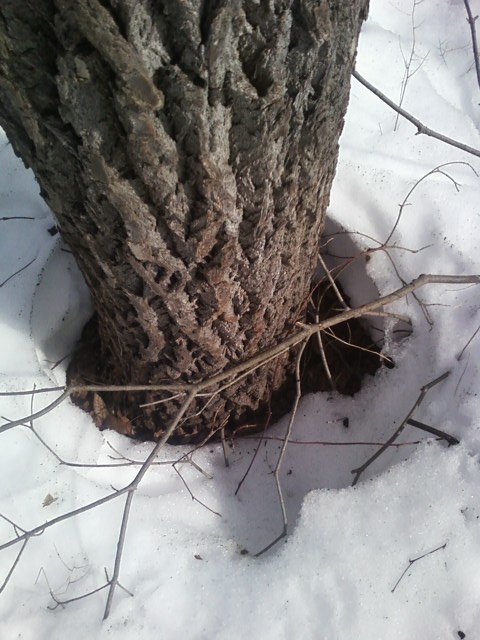
During my retreat I noticed that snow that had settled around the edge of the base of the trees was now melting away from those same trunks, leaving a ring of snow. And that ring forms a thin edge. The snow was disappearing gradually from around the trunks. The edge where the two had coexisted was the first spot to melt away.

Tenafly Nature Center 2014 (H. Friedman)

Tenafly Nature Center 2014 (H. Friedman)

Snow always begins its retreat at the edges, where it abuts a fencepost, or sidewalk or stone wall. The edge is a fragile place. Retreat for humans also occurs at the edge, the edge of ability or mental discipline. And when retreat comes, it starts with just one foot step, one step back. But that one step may be the difference between adventure and misadventure.  When you are standing on the edge, knowing whether to walk forward or back is one of life’s great challenges. But do not mistake turning back for defeat. Retreat is simply an opportunity to try another day.

Howard E. Friedman

Tenacity on the Trail

Catskill Waterfall, John Frederick Kensett (1816-1872), at Yale Museum of Art

Catskill Waterfall, John Frederick Kensett (1816-1872), at Yale Museum of Art

Humans aim to thrive.  Yet nature is oft satisfied with merely surviving. And at times, merely surviving is good enough. For example, some trees survive rooted only in a thin crevice of rock. And hikers and trail runners pushing through their day should take inspiration.

Gardeners strive to plant seeds and plants in the most fertile soil, and may even enrich the earth with compost or other fertilizer. And maple trees drop their seeds on the forest floor, rich with years of accumulated soil and decomposed leaf litter. Both gardener and maple tree aim to plant in a nutrient dense environment. Soil is the accumulation of lichens, mosses, fungi, animal and insect waste, decomposed leaves, twigs and fallen branches, a rich mix of nutrients ready to nourish the next seed that settles in its midst.

So it is shocking then to see that some trees are able to sprout from a rock without the benefit of a rich bed of soil. As the seed degrades and germinates, it must leach any and all available nourishment trapped alongside it in its rocky lair. And it must soak up precious drops of rainwater that find their way down the sides of the cold rock walls. Furthermore it must sprout with only the minimal amount of sunlight that makes its way deep into the dark crevasse.

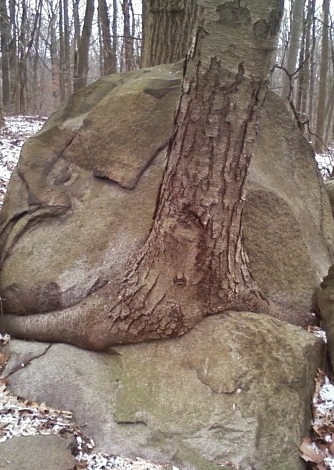
Surprisingly, the sight of a tree emerging from a rock entombment is not so unusual in the forest. ‘Catskill Waterfall’, by Hudson River landscape painter John Frederick Kensett (1816-1872), seen above hanging in the Yale Art Museum, depicts a white birch seemingly emanating from a granite block, at the far right of his painting. And even today when driving through rocky terrain, one can often see saplings and trees growing almost magically right out of the crags that line our highways.

treeinrockTo a hiker or trail runner struggling on a hike or run, seeing a sapling or even a full grown tree swaying above its rocky foundation should give encouragement: to see life that has grown and persevered in adverse conditions. True, the tree growing out from a crack in a granite boulder may not be the tallest tree in the forest, but the tree has survived, and can help propagate its species. The tree can be a home to birds’ nests and provide refuge to insects galore which can burrow under its bark. But the tallest or the biggest tree it likely will never be.

The act of survival in the outdoors plays itself out again and again. Witness any of the birds resident through the winter. On a recent winter walk I was surprised to find myself within feet of a golden crowned kinglet, feeding among fir branches. This species, weighing less than a third of an ounce, is known to be able to survive even at temperatures of -40 F. The kinglet need not thrive on the coldest winter days, merely survive, to live so it can breed again in the spring. And so it is with the song sparrows, chickadees, nuthatches, titmice, cardinals, bluejays and downy woodpeckers one sees foraging, relentlessly, for their day’s nourishment throughout the winter.

Survive another day.

Such a lesson, while extreme for a recreational hiker or trail runner, is nevertheless a good one. The next mile which might seem to be insurmountable need not be covered in style. Breathlessness is okay. Sore muscles are okay. Walking and stopping are okay. Even thirst, at least for a short while, is okay. Know your limits, but persevere if possible.

The life force to survive is tenacious.

Thriving, however, may have to wait for another day.

Howard E. Friedman

Winter Ghosts on the Trail

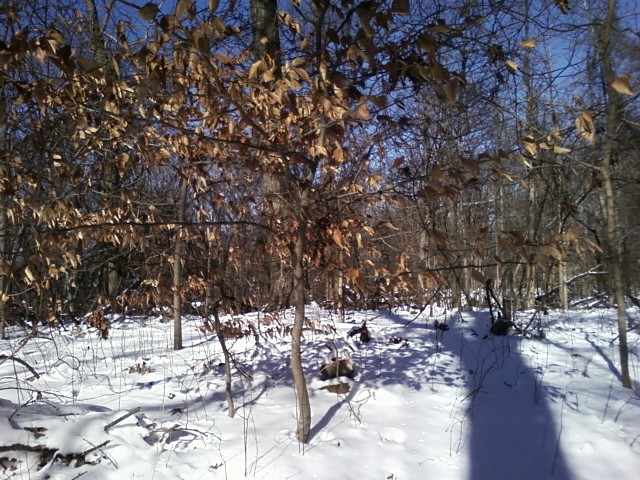
Beech tree in January

Beech tree in January

Wisps of last year linger even at the end of January. Almost all leaves dropped off  their branches months ago but the beech tree clings to last season. Even as it stands in a carpet of snow, its leaves rustle in a wind, one of the few sounds in the forest now. Though the leaves have lost their green color and are now only a ghost of their former selves, they summon up the images of the new leaves that will replace them and the millions of leaves that will appear on the trees that now stand bare in the dry winter air.

Needle bearing trees, pines, spruces, firs, hemlocks are covered in green year around, though even they lose needles from time to time. But they do not lose them all at once. And maples and birch trees lose their leaves in a continuous rain of colorful but dead and dying leaves in late autumn. Yet some beech trees hold on to their leaves throughout the winter in a process botanists call ‘marcescence’, a trait shared with oak trees. The tan wispy leaves that last throughout the winter  no longer participate in photosynthesis. Yet some scientists have postulated that these marcescent leaves serve to protect the new yet-to-bud leaves. And some have suggested that oaks and beeches are an intermediate type of tree on the evolutionary spectrum; occupying a space between the coniferous trees and the maples and birches. (Losing leaves in the fall can be a help to trees by limiting water loss and limit damage from severe cold, while holding on to needles year round may maximize photosynthesis).

Running through the snow-covered trails at Flat Rock Brook park in New Jersey, the leaves on the beech tree seemed incongruous viewed against a snow-filled backdrop. A leaf, after all, represents growth and fertility and hope and springtime. Yet the snow cover bespeaks a winter dormancy, a time of inactivity for forests and gardens. But seeing the ground covered with snow does not mean we cannot see what it hides.

My route took me over a brook crossing, one I had done many times before, rock hopping my way across. I knew the rocks were there but they were under a pile of snow and some hidden in thin ice. I looked down, but saw only mounds of snow and despite the snow cover, intuited my path.

Beech leaves have finally fallen.

Beech leaves have finally fallen.

Yet staring at the translucent leaves both on the trees and the ones that finally succumbed to their fate, I saw re-birth. Springtime. Looking at the snow covered trail and the snow on the ground to my right and left I saw, or at least wanted to see, spring wildflowers and grasses, buds on trees and nesting birds. I did see those things I think.

What can we see when we can’t see the real thing?

Educators, psychologists and others have written about the effects of watching television on developing minds.  What happens when everything is revealed? Do we dull our imagination? The advertising industry has certainly settled on ‘selling the sizzle and not the steak’. Leave something to the imagination.

And many researchers have written about our ability to imagine and fill in the visual gaps when we read. I did not find a study comparing our brain function while watching versus our brain activity when reading. But in ‘Your Brain on Fiction‘, a 2012 article in the New York Times, writer Anne Murphy Paul cites findings of neuroscientists who used MRIs to evaluate brain activity in people while they were  reading.The research shows that the written word on the page stimulates even non verbal areas of our brain. A word like “cinnamon” stimulates the olfactory portion of our brains. Fiction, it turns out, is good for our brains.

And last Sunday, running through the snow seeing ghost leaves dangling on the tree and no Joe Pye weed where it is supposed to grow, I would add: experiencing the naked forest in winter has the power to stimulate the springtime portion of our brains even while we enjoy the winter landscape.

0126141223

Winter light. What does your shadow say?

By by simonwakefield [CC-BY-2.0 (http://creativecommons.org/licenses/by/2.0)], via Wikimedia Commons

By by simonwakefield [CC-BY-2.0 (http://creativecommons.org/licenses/by/2.0)%5D, via Wikimedia Commons

Overland foot travel in winter requires extra care, like warm clothing. But there is one element even more critical,  that, unlike clothing, can not be added or subtracted easily at will.

Sunlight.

By liz west (Sundial) [CC-BY-2.0 (http://creativecommons.org/licenses/by/2.0)], via Wikimedia Commons

By liz west (Sundial) [CC-BY-2.0 (http://creativecommons.org/licenses/by/2.0)%5D, via Wikimedia Commons

True enough that hiking in the dark could be augmented with a bright headlamp. But there is no substitute for pervasive sunlight, the way it illuminates earth and sky. Regrettably, in the Winter, natural light is in short supply. Even on sunny Winter days, the radiance of the sun seems dim and insufficient. The sun can not bathe us in an intense bright  light from its low wintry perch no matter how much we strain to see.

Sundials have been in use for thousands of years, marking the sun’s transit across the sky. Once ancient people realized that our shadows shorten from morning until noon and than lengthen again toward evening, they could use that information to build reliable sun clocks, using a shadow to mark time. Sundials date back to ancient Egypt about 3,500 years ago and a reference to a sundial exists in the Book of Isaiah (38:8): “Behold, I will cause the shadow of the dial, which is gone down on the sun-dial of Ahaz, to return backward ten degrees.’ So the sun returned ten degrees, by which degrees it was gone down.”

Even Stonehenge is thought to be an ancient sun dial of sorts, not marking the hours of the day but marking rather the annual interconnected cycle of the sun and the earth, identifying both the shortest and longest days. And Stonehenge scholars believe that the midwinter solstice was more important to its worshippers than the summer solstice. Perhaps the reaffirmation of the sun’s travel across the sky was most appreciated in the depths of the dark winter days.

Sundials mark the passing of daylight, not by the sun’s light but by its shadow when the light hits the dial’s ‘gnomon’, the element that obstructs the light and casts the shadow.  Winter hikers are quite familiar with their shadow since the leaf cover that often shades the trail is absent, allowing light to filter its way down through the naked branches. Walk east in the early parts of the day and your shadow follows you, urging you along the way. Walk west and your shadow leads the way, pulling you along the trail,  the absence of light your personal guide.

You are your gnomon.

Photo source: Wikipedia, by Willy Leenders

Photo source: Wikipedia, by Willy Leenders

We know shadows from our early childhood. Shadow plays on the wall in nursery school. Picture books about frightened children cowering from their giant shadow. We know about shadows from language and literature. To Cast a Giant Shadow comes to mind. “Yeah though I walk through the valley of the shadow of death” is a more somber example from the book of Psalms.

Yet light is what we crave in the winter and even though sun beams reach the forest floor those rays of golden light still seem without their full luster. And it is our shadow that reminds us of both the presence of the sun and the absence of its light.

Now slowly approaching winter’s mid point the sun rises earlier and sets later and later if only by a few minutes at a time, increasing daylight by an additional two minutes each day by the end of January. While the sunlight has not yet fully awoken buds and bulbs from their sleep, we can see our way on wintry walks in the woods for longer and longer each passing day.  Just follow you shadow toward the light.

Springtime in the Winter, But No Promises

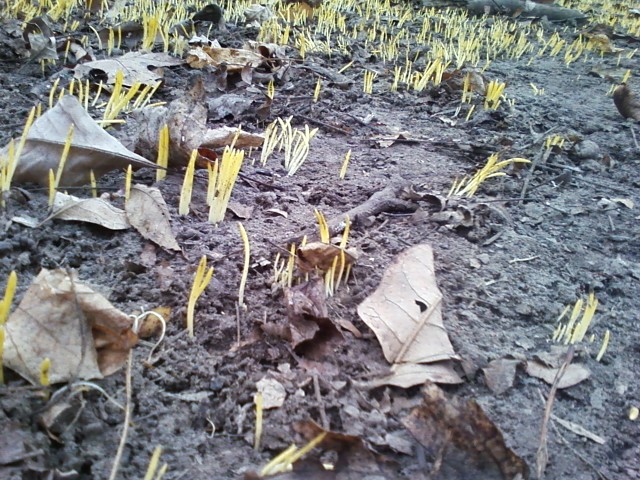
springshootsonwinterdayI passed right by them while crossing through a lightly wooded park on New Year’s day. The ground was frozen, the average temperature 28 F. Last spring’s fallen leaves still covered much of the hard earth, a threadbare blanket at best. And so it took me a moment to realize what I had just seen on this day early in Winter: Hundreds of green shoots jutting just above the cold dirt and thin layer of brittle dry leaves. They spread over an area almost a dozen feet in length

What were these nascent early risers?  Too early for me to tell, but this patch presaged a patch of robust wild plants. I doubled back when the incongruity of springtime growth on the first of January  dawned upon me. Bent over to get a closer look I thought about how nice this area would look in a few months time covered with dense vegetation.shootsandleaves

Earlier in the day I had visited a patient in a nursing home, a woman confined to bed, unable to walk due to advanced multiple sclerosis. Her room was nice enough with pictures of her family, holiday cards hanging and she was cheerful, happy to greet a new visitor. She had walked, like me, but not for more than two decades, yet she still smiled and offered warmth to a stranger.

Her ability to warmly embrace the moment regardless of her own physical limitations reminded me of another person I once visited in the hospital, a father who became a paraplegic after a car accident. Without the use of his arm or legs he cherished any function he could still perform on his own, such as breathing. A devout and learned man, he quoted to me, actually admonished me, with an interpretation of a sentence from the Book of Psalms: For every breath, I praise God.

Cherish what you perceive as inconsequential.

As I looked at the shoots I started to question my own assumptions, that saplings always grow into strapping trees, that young shoots always grow into verdant plants, that life follows an upward trajectory. Perhaps these unlucky shoots poked out too early and well, that’s it for them.  Their moment in the sunlight was their first and last stand. Indeed within four days they were once again covered by snow. Will they survive until Springtime?0105141541

Breathing hard, feeling sore in my legs, I had been running past the new shoots when I first spied them and I admit, I was happy for an excuse to stop running and rest. Yet I keep wondering, when will I finally be able to run this route effortlessly, without even wanting to stop, with nary a hint of tiredness in my body? Am I not destined to improve?

My answer was in front of me.

No guarantees. No promises.

Perhaps each footstep today is its own triumph to be celebrated while on the journey toward ‘better’.  I do not preach defeatism. Indeed, “better” is the currency of mankind: farther for a hiker, faster for a runner, higher for a climber.

Rather I offer that one should learn to revel even in the seemingly mundane moments along the way. One’s ultimate goal may or may not be reached.  But either way, at least the journey itself will bring joy.

Achilles Tendon Treatment Review

Protect Your Achilles Tendon

published in Trail Walker (NY/NJ Trail Conference) Winter 2014

Achilles, wounded. Depicted by Ernst Herter

Achilles, wounded. Depicted by Ernst Herter

By Howard E. Friedman DPM

Problems of the achilles tendon are often associated with runners but hikers are at risk for problems with this tendon too.  Hiking uphill for long periods of time is one risk factor for developing this condition.  And Achilles tendon disorders is one hikers should try hard to avoid. A painful achilles often requires three or more months of rehabilitation to heal enough to allow a hiker to resume hiking free of pain.

The achilles tendon is the largest tendon in the human body. A tendon connects a muscle to bone and the achilles tendon connects the powerful gastrocnemius muscle and smaller soleus muscle located in the calf behind the knee joint  to the back of the calcaneus, or heel bone. The tendon is several inches in length and is critical in lifting the heel   off of the ground when walking or running.

Achilles tendon problems are common among runners and  estimated to occur in 10-30% of male runners and even  5-8% in even well trained elite runners. No statistics exist for how many hikers develop this condition. Nonetheless, problems of the achilles often ail non athletes and often occur in people with one of many risk factors including having very flat feet or very high arch feet, or a diagnosis of obesity, diabetes or hypertension. In addition, a course of antibiotics in the Quinolone family, including Ciprofloxacin and Levaquin, can also cause tendon disorders. Overall achilles tendon issues occur in men more frequently than in women.

Hikers are at particular risk since walking up a steep incline especially with the extra weight of a back pack can cause excessive strain on the tendon. The tendon consists of millions of fibrils of the biochemical molecule collagen in addition to millions of tenocytes, or, tendon producing cells. Unlike other tissues in the human body which react to injury by producing inflammation, an influx of tissue repairing cells,  a damaged tendon degenerates with injury. No robust repair mechanism is programmed into the cells. Thus an injury to a tendon can be devastating.

For years doctors referred to achilles tendon injuries as “tendonitis”, meaning an inflammation. Now however, health professionals treating this injury call it a “tendinopathy” meaning a damaged tendon. This distinction is not very important because it has guided new and more effective treatments. The treatment used for an inflammation, “rest, ice, compression and elevation (RICE)”, can augment the treatment for a damaged achilles tendon but is not sufficient to repair the tendon.

Achilles tendinopathy can include damage to the lining of the tendon, called the paratenon, damage to the tendon itself via stretching or tearing of the tendon fibers, or in the worst case, result in a complete tear, or rupture, of the tendon. A complete rupture is usually the result of a hard landing on one foot, say, jumping down from a rocky ledge and landing on one foot. The injury creates immediate pain, often creates a popping or snapping sound and will result in significant difficulty walking. A complete tear is usually considered a surgical emergency.

But the less serious injuries are the more common types. Repetitive uphill walking and over stretching of the achilles tendon will stretch the fibers and result in a swollen section of tendon which is painful if squeezed in addition to painful when walking uphill or running. This type of injury which has a slow onset can result in a partial tear of the tendon. A partial tear has similar symptoms to a simple over stretching but the degree of swelling and pain are increased. A diagnostic ultrasound or more commonly an MRI can discern the extent of the injury.

May different treatments have been advocated over the years ranging from cortisone injections to general physical therapy to ankle braces and arch supports. But the past few years have validated one treatment as most effective: a program of eccentric stretching. This type of stretching can be done while standing on a step with the heels dangling off the step’s edge and slowly dropping the heels to stretch the tendon, holding that position and repeating. The exercise however is part of a multi week program which includes gradually increasing the force of the stretching. If done incorrectly the can condition can be exacerbated and therefore is best supervised by a health professional knowledgeable in the technique. In addition, using a lift in the heel portion of the shoe is often helpful as well.

What can the hiker or trail runner do to avoid this condition? When traveling uphill, reduce stride length to reduce the strain on the achilles tendon. Take smaller more frequent steps. And, use hiking poles for any sustained climb. And respond to any discomfort in the achilles tendon promptly. Icing the area can help reduce some of the accompanying soft tissue inflammation and local massage may help reduce the pain as well. Most important, however, is to correctly diagnose the extent of the injury and than, if appropriate, begin a program of eccentric stretching.