On the trail: Walking and newness

“Are you getting tired of walking?”, Steve Inskeep, host of NPR’s Morning Edition asked National Geographic adventurer Paul Salopek after he had completed the first year of his planned seven year walk retracing human migration from Ethiopia, through the Middle East, Asia, North and South America and ending at Tierra del Fuego, the southern tip of Chile. Salopek is wintering in Turkey for a few months, to rest, catch up on documenting his trip and plan the next section of his walk.

Salopek did not hesitate to answer.

Myriad reasons attract people to walk the open road or trail. Many are motivated by the need to exercise. Some are seduced onto the rocky trail by the siren call of rustling leaves, or a cascading creek, or the birdsongs which are so prominent a part of nature’s soundtrack.

And if you are fortunate, you returned from your hike or run or walk in the woods feeling emotionally recharged, even if physically tired. You may have seen an animal or flower that quickened your heart beat. Worries dissipated, at least for a time, and where to place your next footstep was your most pressing concern.

But how does it happen? How can running along a brook, hiking in a meadow or walking through the park be so therapeutic?

Today at twilight I ran along a creek, a small river, actually. And I was surprised by what I did not see. No birds. No herons, or egrets or cormorants. No swallows diving toward the water than soaring toward the sky. And I saw precious little animal life. One cottontail, not the dozen I usually see. And one doe, large eyes staring straight at me, but all alone.

The branches were bare save for the pine and spruce boughs. And no trefoils or clover were in bloom. All was quiet, nature bereft.

As I contemplated the stillness I thought of the answer Salopek gave at the end of his interview.

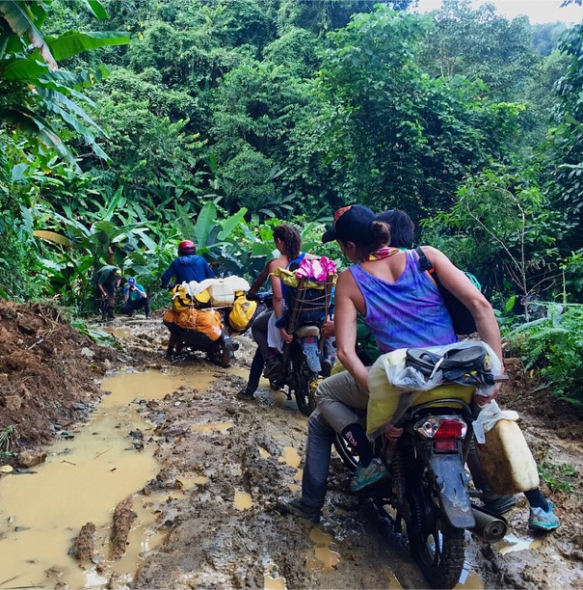
Salopek interacts with villagers (photo by Paul Salopek) http://www.nationalgeographic.com/explorers/bios/paul-salopek/

Salopek interacts with villagers (photo by Paul Salopek) http://www.nationalgeographic.com/explorers/bios/paul-salopek/

“Are you tired of walking?”, Inskeep asked.

“No”, he answered immediately. “I think, on the contrary, that’s what this walk does. This walk has the power I never imagined, to make the whole world seem new again”, Paul Salopek concluded.

How than does the trail recharge the soul? When you engage the world at a slow human pace, and remain in contact with the ground, you have the opportunity to see the world anew.

Around the globe, many people will soon mark a new calendar year. But make no mistake. What makes the year, or month or day new, is not the date on the calendar. Rather, the ability to look at the day with open eyes, and take the time to contemplate that experience, that is what endows sameness with newness.

I do not have Salopek’s seven years to walk. But I can wander into a nearby forest or field, and when I do and whatever the season, even on a barren winter eve, all seems new, again.

Howard E. Friedman

-30-

On the Trail: Boots on the ground

"Wild" from Fox Searchlight Pictures, featuring Reese Witherspoon, and Danner boots,

“Wild” from Fox Searchlight Pictures, featuring Reese Witherspoon, and Danner boots,

The movie “Wild” is coming to a theater near you, the screen adaptation of the eponymous book about Cheryl ‘Strayed’, a newbie hiker who set off and thru-hiked the 2,600 mile Pacific Crest Trail on a journey of self discovery and emotional healing.

When you see a trailer for the movie, you will see Cheryl’s boots, the camera pointing straight down toward her heavy backpacking boots. Big, solid leather boots with prominent red laces and metal lacing hooks. For the movie at least, the actress Reese Witherspoon wore Danner boots, made by the long-time boot manufacturer in Portland, OR. I know this because I ordered a pair of Danner Station boots which I wear to work and therefore I am on their email list. They proudly sent me an email newsletter with a short film about the making of Reese’s boots, including footage of the Danner manufacturing plant and interviews with the employees, craftsmen, really, who assemble this old-fashioned bespoke footwear. (See Danner’s well done promo about their Mountain Light Cascade boot worn in the movie here).

Danner;s Mountain Light Cascade

Danner’s Mountain Light Cascade

Over the past several years, hikers, backpackers, runners and anyone who takes more than a passing interest in walking or running, shoe wear and design knows that the trend toward lighter weight foot wear has taken over much of the industry, at least for the shoe cognoscenti. Hikers are routinely thru-hiking the country’s longest trails, the Appalachian, Pacific Crest and Continental Divide trails, in running shoes or low cut hiking shoes.  And the reasons are simple. Researchers have established incontrovertibly that every 100 gram decrease in shoe weight results in about 1% less oxygen consumption required during activity. Basically, lighter weight shoes are simply easier to wear over long distances.

But, is there a hidden cost to our light weight foot wear?

Cam Honan who Backpacker magazine says “trekked 50,000 miles” on foot is reported in the March 2014 issue to have worn through 28 pairs of shoes on a 15,000 mile hike of all of the longest trails in the US including the AT, PCT and CDT. He switched out shoes on average every 535 miles. His experience is not unique. Long distance hikers often literally wear out multiple pairs of shoes. Old shoes, if we are conservation minded, get donated to a charity, if they are in any kind of wearable condition. Otherwise, they get added to the growing pile of the world’s refuse heaps.

So while boots like Danner’s Mountain Light boots are very heavy (probably approaching 2 pounds each), they are resoleable, what Danner calls “recraftable”. Perhaps Cam Honan could have covered 15,000 miles in two boots, the one he was wearing and the one that was being resoled. Who knows? But as we embrace lighter weight footwear, we should think about the issue of durability and having to throw more junk into our landfills.

The hiking and trail running shoe manufacturers should start to take a cue from rock climbing shoes, which take a beating, getting scraped and brushed against all manner of hard rock surfaces, yet, can be resoled and more than once. I have been wearing a pair of Five Ten Guide Tennies for a number of years and have had them resoled. Why can’t hiking shoes be light weight and resoleable?

I challenge hiking and trail running shoe manufacturers to design technical footwear that is both lightweight and ‘recraftable’. That way we can be both good to our feet and good to the planet.

Howard E. Friedman

-30-

On the Trail: An Ode to Old Shoes

Fare thee well, old running and hiking shoes,

companion for oh, about 15 moons.

Time has run out on thee, though I am fond of you,

like the day I first spied thee in thine box.


Do not be angry upon me my Italian Wildcats

You have served me well, o’er hill and dale

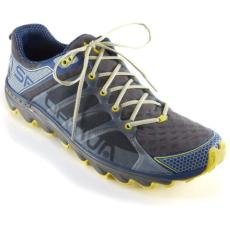
La Sportiva Wildcat

La Sportiva Wildcat

and along the Escarpment Trail.

And through puddles and snow, and in day and in night.


But you show your wear, though thee be but one year and some months old.

Your midsole is full of lines, creases, that cannot be ignored.

It is beaten down, and you feel hard beneath my soft feet.

Though, to be kind,  overall you still look so youthful.


But oh thy tread, thy tread, it is too worn, flattened smooth in areas

And gives me great fear on slick wet rock or damp tree roots

lest I go glissading, skittering into the air,

only to land and break a vital bone or tear a sinew.


We have indeed had joyous times,

running here, walking there

or sitting in quiet contemplation. But time moves on

And moreover, my fickle self also seeks a lighter model with a lower heel.


Lest you think me cruel, I will not totally abandon you.

Nay, I shall not drop you in the Salvation Army donation box

Or, send you to Soles 4 Souls, though that be wise and kind and useful

No, I will keep you in my closet, to don once a fortnight or so to run an errant errand.

(Until such time as I will decide to donate you at last.)


And no Wildcats, I will not make you meet your heir to my feet.

La Sportiva Helios

La Sportiva Helios

But know they too hail from your same Italian villa, and, probably are a close cousin,

But a full year younger, and lighter, and, oh, their tread, it is just fine.

No, Wildcats, you need not meet Helios now.


Rather, you will meet them in the closet, in, oh, about a year or so.


H.F.

-30-

On the Trail: A Walk into the Unknown

adventureblog.nationalgeographic.com

adventureblog.nationalgeographic.com

National Geographic together with The North Face are on an expedition to find the highest peak in southeast Asia. A group of six seasoned adventurers are traveling primarily on foot with some boat and motorcycle assistance deep into the jungle on a trip that will require two weeks of unsupported hiking and travel in each direction. The group is so off the grid they are carrying their own stash of anti venom to treat a possible, or even likely, poisonous snake bite by any one of a kaleidoscope of colorful and lethal vipers, cobras and kraits. Mark Jenkins, a seasoned writer of adventure non-fiction is documenting the group’s trip with regular posts at adventureblog.nationalgeographic.com

This expedition has all the hallmarks of real exploration and is reminiscent of expeditions of  the 19th and early 20th centuries. The objective is vague, the route is potentially deadly and what the outcome will be is far from clear.

adventureblog.nationalgeographic.com

adventureblog.nationalgeographic.com

Below is a link to the first post, including a very closeup picture of Trimeresurus albolabris, the lethal white lipped pit viper, which expedition member Hilaree O’Neill nearly stepped on.

Myanmar Climb: Welcome to the Jungle – Dispatch #1 – Beyond the Edge.

On the trail: the fast keep getting faster

Much has been written recently about the widening income disparity in the United States. The rich continue to get richer while the poor stay poor and the income of the middle class slowly erodes.

This phenomenon is not limited to the economy alone. The fast get faster, too, while the slow, well, let’s just say they don’t get too much faster.

AP Photo/Andrew A. Nelles, from http://espn.go.com/sports/endurance/index

AP Photo/Andrew A. Nelles, from http://espn.go.com/sports/endurance/index

This past week in the 2014 Berlin Marathon, Kenyan Dennis Kimetto set a new world record for the 26.2 mile road race, completing the run in less than two hours and three minutes, beating the previous record by over 20 seconds, which is a significant improvement. Even the second place winner, Emmanuel Muthai, also broke the previous world record. Both runners are still a long way from crashing through the psychological and likely physical barrier of running a sub-two-hour marathon, though.

Kimetto, Muthai and the two top female finishers all had one thing in common. They wore the same type of shoes, the adidas Boost series “made up of thousands of energy capsules that store and return energy in every step”. I would be interested in running in these shoes to experience the sensation addidas promises.

adidas Adizero Boost

adidas Adizero Boost

I was initially excited about Mr. Kimetto’s finish, foolishly thinking somehow that it augured well for me personally, raising the bar of the possible, dangling a new aspiration. I am similarly excited to read about lightening fast speed records set hiking the entire Appalachian or Pacific Crest trails. Maybe I should buy the same shoes those record setters wore. Or, eat the same pre race meal.

But I have no illusion that Kimetto’s shoes will make me run appreciably faster, just as I have no illusion that driving the “luxury sedan” I see advertised on TV or wearing the very expensive watch mountaineer Ed Viesturs wore on Mt. Everest will appreciably enhance my life.

Most likely, or, shall I say, most definitely, mimicry of the elite is just mimicry, and will not result in significant change. So each year the Kenyans get faster while the middle of the pack runners continue to own the middle. And, the five-plus hour marathon finishers, well, they are happy just to finish.

One reason we humans focus on time and speed is because the discrete numbers are easy to measure and easy to understand.  But we should appreciate that, for the non-elite among us, watching those elite athletes push themselves to run and hike faster and faster, breaking record after record, is really, just entertainment. What happened in Berlin last week says lots about Dennis Kimetto and Emmanuel Muthai as runners, their training regimens and their ability to endure pain, and yes, perhaps something about their lung and heart capacities too. Their accomplishments do reveal something about the potential of the most fit members of our species. But, the new world marathon record, most regrettably, says practically nothing about me as an individual.

But hey, that’s entertainment.

Howard E. Friedman

-30-
On the Trail: ‘Shelter’ outside

West Mountain Shelter, Eric Koppel

West Mountain Shelter, Eric Koppel

“Shelter” is not a word commonly invoked to describe the vagaries of our modern 21st century day to day lives. We don’t say “I am going into my shelter now”. Rather, we say “I am going inside”, meaning, of course, we are returning into the safety and security of our homes. In fact, “shelter” evokes images not of home and hearth but of a bomb or air raid shelter, remnants of the 1950s cold war. If you live in Israel, a “shelter” is part of your normal vocabulary as all new construction must include a shelter or “safe room” to protect from missile attacks, or worse. And, a little over a year ago the word “shelter” was repeated frequently as Boston police warned residents to “shelter inside” while they searched for the Boston marathon bomber.

In all recent examples, “shelter” has a negative connotation: a place to retreat from mortal danger.

And so, the notion of a 3-sided low ceilinged stone structure built on the side of mountain, miles from a road,  town or city being called a “shelter” is anachronistic. Afterall, this primitive structure could only protect from rain and snow, and that only if they are not blowing in sideways. These shelters are no protection from wild animals, big or small, and offer only partial protection from cold or heat. Yet, these structures found along most long distance hiking trails are in fact referred to as “shelters” for they do offer a hiker  a modicum of protection from the weather. A “primitive shelter” is a more apt name.

As I set my backpack down last Sunday on the stout wooden floor boards of the West Mountain shelter in Harriman State Park, about a half mile from the Appalachian Trail, I felt indebted to the men who, in about 1928-29, went to great effort to build this structure in the woods. In their prescience, they sited the West Mountain shelter on pre-Cambrian granite bedrock,  to face an unobstructed view of the Hudson River and off in the distance, the Manhattan skyline, a skyline that was only just getting started at the end of the roaring twenties.

This shelter, like so many shelters on hiking trails in the northeast, is a substantial structure consisting of three walls built from bowling ball sized boulders of different colors and shapes, held together with no mortar noticeable, yet impermeable to wind and rain blowing through the walls. The ceiling consists of shingles on top of wooden beams and slats. The West Mountain shelter even includes two built in fireplaces on either side of the broad open front entrance. It does not have a water source nearby but I can not fault the nameless men who built this edifice 85 years ago. They were clearly taken with the beautiful view, water or not.

Volunteers continue to maintain and build hiking trails all over and even refurbish shelters when needed. But I do not hear of many cases of shelters being built at new locations, although it probably happens. As I ‘sheltered inside’ the West Mountain lean-to, protected from nothing in particular on that sunny, balmy, picture perfect day, I wished I could have offered a personal thanks to the people who chose this location, gathered the boulders and wood needed to build this old fashioned trail shelter so many years ago, rock by rock, beam by beam.

Howard E. Friedman

-30-

Why Walking Helps Us Think – The New Yorker

by Alex Majoli (Magnum), in The New Yorker Sep. 3, 2014

by Alex Majoli (Magnum), in The New Yorker Sep. 3, 2014

As you settle in to the beginning of a new work week, here is something to ponder. The following article by Ferris Jabr which appeared in The New Yorker September 3rd, 2014 looks at the role walking has played in some popular English literature and how walking might just make us more productive thinkers. This, of course, will come as no surprise to walkers. Thanks to my son for the link.

Why Walking Helps Us Think – The New Yorker.

Howard E. Friedman

On the trail: defining “trail”

What is “the trail”?

Recently I responded to trail shoe company Vasque’s request for product testers for a new model of trail running shoes. I had to itemize how many miles a week I run and on what surface. The choices were single-track trail, dirt, grass or pavement. I ticked off checks in the first three boxes. I don’t run on pavement.

I started wondering, am I a trail runner if I run on grass and dirt in urban environs more than I run on single track paths in the forest?

For a trail runner or hiker, must the ‘trail’ be surrounded by forest or rolling hills? Must it have rocks and roots? What about running on the grass and uneven dirt to the side of an asphalt path in a dimly lit urban park, at night? Does that constitute ‘trail running’.  What about if you run  on a wood chip path in a tree filled park but you see buildings beyond its sylvan perimeter? Is that a ‘trail’ run’? How about starting a run in a park but leaving the graded path to run through high grass, emerging with burrs and maybe a tick or two? Does that count?

Or does “the trail” really limit you to a path in the woods, or wilderness, somewhere far away, a car drive away? Perhaps running on a graded trail, maintained by trail volunteers who trim away brambles, fix the blazes, remove fallen trees, is not even real trail running. Maybe you need to bushwack your own trail through the forest to really make it count.

I never heard back from the folks at Vasque. My mileage was probably too low. My age probably too high. Maybe they don’t count running on grass as real trail running. Fair enough. They should find the hardest charging trail runners out there to test their shoes. Admittedly, that’s not me.

But I am left with my question. Am I a trail runner? On most days, honestly, probably not. But neither am I a road runner. I would accept the moniker “off-road” runner, however. But even when trying to harvest a trail run out of a city park, I aspire to return to the trail, for all the reasons more and more people are running on single track paths in the woods: the inherent challenge, the beauty of the scenery, the need for rapt attention to every foot fall. And I will return. Maybe this weekend, or next. In the meantime, I will continue to nurture my aspirations with the resources I have available. And that is the best training there is.

Howard E. Friedman

-30-


On the Trail: Peer into the Shade


Shade on the Escarpment Trail in the Catskills (http://www.nature-photography-in-the-rough.com/)

Shade on the Escarpment Trail in the Catskills (http://www.nature-photography-in-the-rough.com/)

Summer has begun and in the northern hemisphere that usually means hot and sunny especially if trails are above tree line. But in the northeastern United States we are lucky that miles and miles of hiking trails remain well shaded as they traverse forests under a canopy of millions of maple. birch, hickory, oak and beech leaves, among others. The shade is a balm on a hot and sunny day.

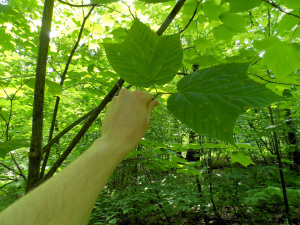
Striped Maple, an understory tree (http://njurbanforest.com/about-nj-urban-forest/)

Striped Maple, an understory tree (http://njurbanforest.com/about-nj-urban-forest/)

Running through a shady trail last week, I thought about the challenges of life in the shadows. For plant and tree life dependent on sunlight for photosynthesis, shade would seem to a be a punishment, like half rations for a prisoner, or no rations at all. Yet, the understory of forests, the part that is mostly in the shade, does teem with verdant greenery. Indeed, some trees, notably the striped maple, inhabit only the understory and do not ever breech the forest canopy. Other trees, however, are shade tolerant. That is, they can survive in the shade, for years if needed, until they have an opportunity to leave the understory and poke their tallest limbs into sunlight, perhaps after a nearby taller tree topples over, clearing a space in the forest canopy. And, many plants, even in our own gardens, flourish only in the shade.

How does life tolerate the dimness of the daytime darkness, the absence of direct sunlight, especially when that light is a currency of life for most plants and trees? There is no one answer. Instead, plants in the shade use a cornucopia of adaptations for their survival.

Think of common shade plant in many home gardens, Hostas. Notice that they have large leaves, an adaptation to collect as much sunlight as possible. In addition, the chloroplasts in the leaves of shade dwelling plants and trees are larger than in trees and plants that live in full light and their epidermal cells are better designed to maximize light. Also, shade trees and plants have no waxy layer on their leaves, something that trees in full light use to help reflect away unneeded light. And, in addition, shaded plants can change the angle of their leaves to maximize any available light during the day.

Shade is not only sunlight blocked, but rather potential not yet realized, growth untapped, waiting for opportunity. Shade tolerant plants, though, have it figured out. Do not wither during lean times. Adapt and be patient. If you find yourself struggling out on your trail, peer into the shade for inspiration, then continue on your way.

The sunlight, it is a coming.

Howard E. Friedman


(for more information about shade apaptations, visit : http://plantsinaction.science.uq.edu.au)


On the Trail: One Dose of The Escarpment Trail

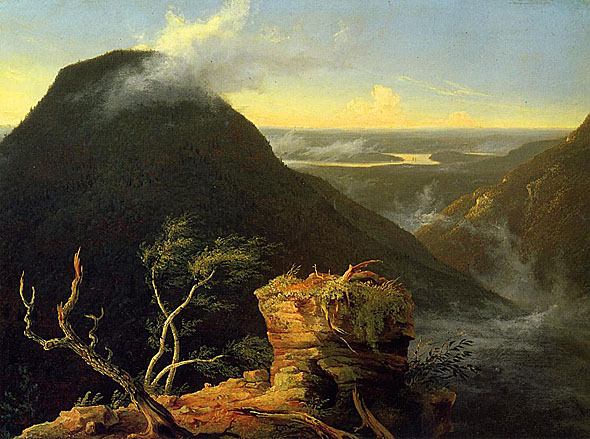
Sunny Morning on the Hudson, Thomas Cole, c. 1820 (explorethomascole.org)

On the last Sunday and Monday of May I was fortunate to backpack 19 miles of the Escarpment Trail, a footpath dating back in parts to the early 1800s, which climbs up, and down, and up and down as it traverses the eastern most ridge of the Catskill mountains, providing a commanding view towering 2,000 feet above the Hudson River valley and the self-same river seven miles in the distance. The escarpment, a rocky buttress which extends for more than 30 miles in all, inspired many American painters in the nineteenth century who carried their easels from the southern section of the trail up onto the rocks overlooking nearby North-South Lake and river and valley below, garnering the name for themselves, Hudson River School painters.

Our path began in the town of Windham, NY with a three mile climb to Windham peak at just over 3,500 feet elevation. Our trail followed due south, cresting Blackhead Mountain, 3,950 feet elevation before dipping back to lower elevations. We camped along the ridge top after completing 11 miles, setting out early the next morning to continue our journey, stopping to refill water at a piped spring gushing water from a sandstone massif. The trail transects several types of flora along its course, from Northern hardwood forests of birch, beech, maple and pine trees to Alpine type forests of primarily Balsalm Fir, which fill the air with the smell of Spring itself. The forest than changes to large stands of primarily birch trees along the way. Splashing the trail with colors on either side of the single track footpath were abundant amounts of Purple Trillium flowers (also called Wake Robin) along with Canada Violet, Spring Beauty and Wild Columbine.

Purple Trillium, photo by Jim Salge (www.vftt.org)

Purple Trillium, photo by Jim Salge (www.vftt.org)

My mind was still playing back scenes from the Escarpment Trail days later when I read about new research that found that modest exercise in senior citizens can help them maintain their mobility. These findings were reported on May 27th, 2014 at the annual American College of Sports Medicine conference and published in the recent Journal of the American Medical Association . Researchers found that a daily walk of only 400 meters, or once around a high school running track, was sufficient to keep older, primarily sedentary people mobile. Of course, everyone knows that exercise is good for you. But, we don’t really know how much is needed to get results.  This study establishes that for this group of 1,635 sedentary people, ages 70-89, walking only four hundred meters could be considered one “dose” of exercise. And according to Wendy Kort Ph.d. from the University of Colorado, who reviewed the study, this research begins to refine the notion of what is an appropriate “dose” of exercise.

Our backpacking trip was necessarily short to accommodate work and family responsibilities. We left at 8:30 Sunday morning and returned home around 5 p.m. Monday but, with travel, our time on the trail really extended for just a bit over 24 hours to cover the 19 steep, rocky miles and allow time for eating and sleeping.

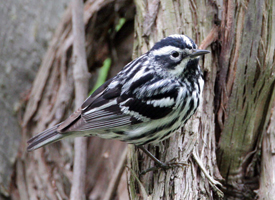
Black-and-white warbler, photo by John McKean (www.allaboutbirds.org)

While the trip was short we did manage to traverse most of a well established hiking path, packed with beauty on the trail including not only wildflowers and shifting forest types, but vistas of the horizon, including the Hudson River, views of other Catskill peaks and even an unexpected close-up view of a black and white warbler only several feet away, perched on a spruce branch. The trail does include one macabre reminder of the power of windy downdrafts along a 2,000 foot escarpment: the well preserved fuselage of a Cessna plane that rests feet from the trail, exactly where it crashed in this mountainous area decades ago, killing its pilot.

This trek into the woods I would say, was one dose, or perhaps a double dose, of immersion into nature untamed. Time will tell how long it will last before I will needs prescribe myself another dose.

Howard E. Friedman