Off the trail: A fresh look at dirt.

I have hiked or run on dirt trails for a number of years now so it is odd to look at dirt in a new way. But now, I am careful where I tread on the dirt, lest I stomp on and kill a seedling.

A few weeks ago I was assigned a community garden plot. I did not receive the news until almost the end of June so it was a real race to find seeds to purchase, till the soil and plant my garden. By the middle of July, late one night after work, after dark, my garden was fully planted. I opened the spigot and jiggled my thumb over the end of the hose to create an arcing spray. By the light of my headlamp,  globules of water looked like pearls in the beam of light, disappearing silently into the dirt. With a great deal of good fortune I might just get a crop of corn, lettuce, carrots and zucchini in the early fall.

Now on summer evenings I am drawn to my garden like I used to be drawn to the dirt on the trail. But now I am not interested in how much ground I can cover and what I might see along the way. Rather, I am interested in how much I can grow out of this plot of earth.

Surprising as it might seem, gardening in any organized way, and certainly modern corporate farming, is relatively new to the human race. What with homo sapiens dating back almost 200,000 years ago, anthropologists believe that we humans only began to actually plant seeds to grow food sometime around ten thousand years ago. We gathered plants, fruits and nuts to eat prior to that. But cultivating an understanding of gardening took many, many years.

Indeed, scientists explain that at first human ancestors practiced not agriculture, the planting of seeds in cleared plots of lands, but rather vegeculture, that is planting a seed or two outside of the cave entrance in an available clearing. Only after years of experience with vegeculture did humans develop the ideas and concepts which ultimately led to modern gardening and farming: clearing tracts of land, mass planting of seeds and watering and fertilizing the crops.

When hiking along the dirt trail in the forest I pass through the land. Now I  myself am rooted to the soil, fingers deep into the dirt, like tendrils of a seedling. I tread lightly, checking each step again and again so as not to stray onto the tiny emerging sprouts.  And though I stay by my hundred square foot space, the experience is immersive, expansive, not claustrophobic or limiting. And I leave with a similar sense of calm I get from time spent deep in the woods.

The dirt is common to both the trail and garden.   It is an alluvial silty outwash from rocky sediment, mixed in with composted lichen and forest litter, serving as a home to thousands of microbes, yielding a magic carpet that bedizens our forests and farms and helps nourish a planet. And we should respect this life giving resource. Now well into the summer of 2014 we are inundated with painful news of planes falling from the sky killing all aboard, school girls gone missing, teenage boys abducted and murdered, conflicts around the globe, in Ukraine and Israel and Gaza. Body counts of killed and wounded climb.Mourners’ tears water cemetery grass. One response to ongoing conflict will ultimately come from the soil, which will outlast all combatants and go on in the fullness of time to hide the remnants of the warfare we wage. American poet Carl Sandburg (1878-1967) recognized the power of the soil to hide the horrible in his poem Grass. For Sandburg, the grass hid the memories. Perhaps we the citizens of the earth can learn to till hope from the soil, instead:

Grass

BY CARL SANDBURG

Pile the bodies high at Austerlitz and Waterloo.
Shovel them under and let me work—
                                          I am the grass; I cover all.
And pile them high at Gettysburg
And pile them high at Ypres and Verdun.
Shovel them under and let me work.
Two years, ten years, and passengers ask the conductor:
                                          What place is this?
                                          Where are we now?
                                          I am the grass.
                                          Let me work.
Howard E. Friedman


“A Window on Eternity”, in Gorongosa and Chernobyl

Destruction of our natural habitat comes in many many different forms. Edward O. Wilson writes about destruction and rebirth in one such place, Gorongosa National Park in Mozambique. And Timothy Mousseau, professor of Biology at University of South Carolina, studies destruction and its impact on rebirth in another location, Chernobyl, Ukraine.

A Window on EternityIn A Window on Eternity, A biologist’s walk through Gorongosa National Park (Simon & Schuster 2014), Wilson briefly recounts the history of Mozambique’s 16 year civil war ending in 1994 which resulted in nearly a million people killed and the creation of several million refugees. A collateral effect of the war was near extinction of what Wilson describes as “the megafauna” of Gorongosa National Park, a wildlife refuge located in Mozambique, but too close to the fighting. Large edible and/or valuable animals were killed for food or profit. Elephants decreased by 80-90% in number. Cape buffalos went from 13,000 in 1972 to 15 in 2001, Wilson writes. Wildebeest went from 6,400 to one and zebras from 3,300 to just 12 he adds.

Thanks to the great efforts of U.S. businessman and philanthropist Gregory Carr who began over seeing the reintroduction of large animlas back into the park, Gorongosa is staging a slow resurrection.

“Another several decades may be needed for Gorongosa to return to its old preeminence, but given the persistence of its undergirding of plants and invertebrates which largely survived the war intact, I believe this  will surely come to pass,” Wilson concludes in the chapter called ‘War and Redemption’. In the chapters that follow Dr. Wilson describes findings from his and his colleague’s expeditions to Gorongosa as he shares their ground-eye view of ants, katydids, praying mantises and others. “None to me is a bug,” he writes, “Each instead is one kind of insect, the ancient legatee of an ancient history adapted to the natural world in its own special way. I wish I had a hundred lifetimes to study them all,”  he writes in the beginning of chapter eight, ‘The Clash of Insect Civilizations’.

But while E.O.Wilson is sanguine about ‘The Conservation of Eternity’ (title of chapter eleven) in nature’s ability to recover from war in Gorongosa park, fellow biologist   Timothy Mousseau, professor at University of South Carolina is less optimistic about the resilience of various phyla of the animal kingdom to survive nuclear fallout. Dr. Mousseau has been studying how various species of birds, spiders and insects have fared in and around the Chernobyl nuclear reactor which exploded 25 years ago, releasing large amounts of radioactivity into the atmosphere. His work was featured on Newyorktimes.com.

Dr. Mousseau in Red Forest, Chernobyl (http://cricket.biol.sc.edu/Mousseau/Mousseau.html)

Dr. Mousseau in Red Forest, Chernobyl (http://cricket.biol.sc.edu/Mousseau/Mousseau.html)

Still a hot zone, the area around the old plant has been off limits to humans, making it an interesting living laboratory to study flora and fauna without the day to day interference of human life (though one could make an easy argument that after contaminating an entire region with radioactive waste, day to day human activity is kind of negligible). Since 1999 Mousseau and Dr. Pape Moeller have been documenting aberrations in spider webs, bird beaks,  insects and rodents, all of which they say reflect genetic mutations in animals living in the most radioactive zones around Chernobyl. And, while some researchers take issue with Mousseau and  have pointed to the fact that any wildlife that persists around Chernobyl is proof of the resilience of  various species, Dr. Mousseau cautions that if you look more carefully, life has persisted but not robustly and not in good health.

Neither scenario is appealing. Dr. Wilson documents a resurgence of wildlife in an area that witnessed almost a million human deaths, thousands of animal deaths and which required importing ‘megafauna’ species to help repopulate the area. Dr. Mousseau documents the persistence of weakened and wounded life which, however, has been able to survive a near direct nuclear explosion but which has little hope of ever returning to full health. Perhaps for either scenario, Edward O.Wilson was prescient in selecting the opening quote in his latest book: “I have set before you life and death, blessing and cursing: therefore choose life, that both thou and thy seed may live . – Moses at Mount Nebo, Deuteronomy 30:19.”

Howard E. Friedman

The Evolution of Walking: From Laetoli to the Exodus to the Appalachian Trail

hiking in Chamonix

Ambulating on two legs dates back  3.6 million years ago according to anthropologists who have studied human like foot prints preserved in the volcanic ash in Laetoli, Tanzania. Those foot prints were discovered by anthropologist Mary Leakey in 1978.

http://www.getty.edu/conservation/publications_resources/newsletters/10_1/laetoli.html

The Laetoli footprints, from http://www.getty.edu, photo-Martha Demas, 1995.

The human like Austrolapithicenes who left those foot prints were quite possibly walking for a utilitarian purpose, like searching for food or shelter, or returning to their shelter. As our human society has evolved, however, walking has evolved right along with it. In fact, one could suggest that as a species, we have evolved to no longer need walking for distance travel.

We walk now to thrive, not survive. Evening strolls, weekend hikes, backpacking trips, laps around the high school track. Humans continue to find new but non-essential ways to exploit the simple, elegant act of placing one foot in front the other. And that act, in fact, is one of the hallmarks of what it means to be human.

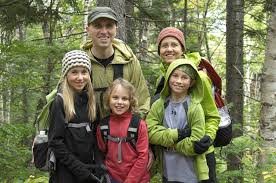
Today, walking for long distance travel,  on the other hand, has become rare. And this might explain why last month, when the Tougas family of New Richmond, Canada, announced their plans to walk more than two thousand miles, together, on the Appalachian Trail,  they saw it as a viable marketing opportunity to raise money for their project.

The Tougas family announced their planned family through-hike of the AT on Kickstarter.com.  They  received pledges of $19,109 (Canadian), surpassing their goal of $16,000. The family spokesperson and father, Damien Tougas, explains on his KickStarter site that the monies raised will go to fund production of a video series that sponsors will receive in installments, once a month. The money raised, he said, will not be used to pay for the hike itself. The family has already put aside funds for their 6 month sojourn, he explains.

Walking has always been a sure mode of human transportation. Early humans of course had no alternative. Hunting and gathering required walking and beasts of burden had presumably not yet become part of daily life.  Even Americans, thousands of years following hunter-gatherers, still walked alongside their covered wagons,  for upwards of six months.  400,000 or so people migrated, on foot, westward to  Oregon, Utah, New Mexico and California, between 1840 to almost 1870. Their wagons were so full of family belongings and food there was precious little room left for riders. But these hearty pioneers were perhaps among the last of the long-distance migratory walkers, at least in North America.

Human beings have slowly, but persistently, sought out alternatives to walking. Even several thousand years ago, Egyptian soldiers used horses to pull their chariots. Some Greek warriors rode into battle on the backs of elephants and trade routes in the Middle East have domesticated the camel.  In more recent times horses have either carried riders or pulled wagons and carriages.  The horseless carriage morphed into the car, and now motorized transportation has become ubiquitous.  Walking as a daily means of transportation has become a rarity, at least in western civilization.

Tougas family (fimby.tougas.net)

Tougas family (fimby.tougas.net)

And while the Tougas’ get great credit for their planned family adventure, we are left with the question, why is watching another family walk intrinsically interesting? Certainly there are challenges and risks with a long distance hike and even more so for the younger Tougas children.  The AT however,  is well marked, well traveled and fairly close to civilization along most of the route. Although  a 2,100 mile trek is big undertaking, and the trail is quite strenuous at times and weather is always a variable.

Nonetheless, I suggest that our societal de-evolution of long distance walking is the key to family Tougas’ ability to raise close to twenty thousand dollars from 267 people who are willing to pay to see that family walk. Almost like paying to watch an IMAX movie about rock climbers, or cliff divers or base jumpers. In 2014, traveling a long distance on foot is a novelty and considered an adventure, only for the intrepid among us. And I suspect that even if family Tougas said they were going to walk strictly along back-country roads from Georgia to Maine and stay in bed and breakfasts along the way, and not pitch their tent in the woods, they still would have been able to raise money for their trip.

From Biblia Das Ist, Martin Luther (1486-1583), a depiction of the Exodus. Courtesy of the Digital Image Archive, Pitts Theology Library, Candler School of Theology, Emory University

From Biblia Das Ist, Martin Luther (1486-1583), a depiction of the Exodus. Courtesy of the Digital Image Archive, Pitts Theology Library, Candler School of Theology, Emory University

In one week the Jewish people mark the exodus of the Children of Israel out of Egypt, when they began their forty year sojourn toward the Promised Land. After hundreds of years of bitter enslavement the Israelites walked out of Egypt, away from their life of servitude, to follow Moses, a leader appointed by God. During four decades the Hebrew tribe walked from encampment to encampment in the Sinai peninsula, until they finally crossed the Jordan River to enter the city of Jericho in the land of Israel.

Next week, when Jewish families gather to commemorate that night about four thousand years ago when the Israelite  begin their long walk toward freedom, let us also remember that one of the most basic human functions, walking, is so simple and elegant. The long walk should not be considered a novelty,  since  the process of walking can transport us, physically and figuratively, toward a new beginning.

Howard E. Friedman


Losing and finding the trail: an Olympic lesson

Outdoors educators advise lost hikers to stay put, make a shelter, and wait for help, instead of striking out in a new direction and risk getting even more lost. If you stay put you might be safe and not get more lost. But staying put will only help if someone comes to find you and leads you home. There are no guarantees you will be found. Sometimes you have no choice but to walk yourself back to where you began, or at least to where you lost your way.

A series of television commercials from the 2014 Sochi Olympics consider the value of looking back, or more precisely, walking, running, jumping, skiing –  backward, and back to your earliest beginnings.

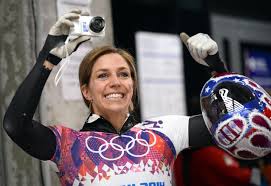
Noelle Pikus Pace (Photo: Kevin Jairaj, USA TODAY Sports)

Noelle Pikus Pace
(Photo: Kevin Jairaj, USA TODAY Sports)

TD Ameritrade presents a series of ads that begin with images of an olympian on the podium in gold medal position. Than, we see a montage of that athlete’s life in reverse, with video, in one example, of olympian skeleton slider Noelle Pikus-Pace sliding backward, running backward, sliding backward up a water slide, with additional images of of Noelle as a child, than as a toddler and finally sliding backward up a sliding board as an infant. The screen goes black with a tagline that says: Behind every big moment there are lots of small ones.

Of course, we are the sum or our total experiences, as this commercial emphasizes. But those life experiences are rooted in our childhood. William Wordsworth (1770-1850) made that point in seven words in his poem, The Rainbow:

The Rainbow

by William Wordsworth

William Wordsworth. (c) The Wordsworth Trust; Supplied by The Public Catalogue Foundation

William Wordsworth.
(c) The Wordsworth Trust; Supplied by The Public Catalogue Foundation

My heart leaps up when I behold

A rainbow in the sky:

So was it when my life began:

So is it now I am a man;

So be it when I shall grow old,

or let me die!

The Child is father of the Man;

I could wish my days to be

Bound each to each by natural piety.

“The child is father of the man” is a frequent theme among people hoping to make sense of their lives. Where did the happy child go? What happened to hopes, dreams and aspirations?Psychologists walk patients back to their childhood to try and help then understand who they were and in so doing help them understand who, what and why they are what they are now.

Teachers understand the importance of rallying around a child’s natural talents and ambitions. The wise King Solomon wrote in his Book of Proverbs: Educate the child according to his ways. So when he is old he will not depart from it (Proverbs 22:6). And this advice has become a mantra for educators  who need to teach different children differently, whether a child is a visual or auditory learner, to cite just two examples.

But the TD Ameritrade commercials portray not only the importance of rallying around our children to help them make their dreams come true. The television spots capture other qualities that are rare yet necessary for an olympic caliber athlete: passion. And not even the most supportive of parents can create passion in a child. Yet, since passion breeds perseverance, it is an important prerequisite for success.

Pikus-Pace wins silver at Sochi 2014 (NBCnews.com)

Pikus-Pace wins silver at Sochi 2014 (NBCnews.com)

Even the non-olympians among us should note the path to greatness these athletes exhibit and we could learn a lesson from these vignettes. To walk ahead with determination and resolve starts by knowing one’s self at the start of the journey. True, not everyone has the passion of an olympian, nor the skill. But everyone is on a journey, and, if you lose the path, than what?

Noelle Pikus-Pace left her sport after the 2010 Olympics. But after a miscarriage last year left her feeling lost she walked herself back to where she started and with the support of her husband returned to the skeleton track. I would suggest that when lost in the forest, real or metaphorical, you at least attempt to find that point where you lost your way. Then, if nothing in the woods seems familiar, stay put and wait for help. But in your mind continue to walk yourself backward.  Try and understand  how and where you became so lost. Once you answer those questions, you can start to find your way back home again.

Winter light. What does your shadow say?

By by simonwakefield [CC-BY-2.0 (http://creativecommons.org/licenses/by/2.0)], via Wikimedia Commons

By by simonwakefield [CC-BY-2.0 (http://creativecommons.org/licenses/by/2.0)%5D, via Wikimedia Commons

Overland foot travel in winter requires extra care, like warm clothing. But there is one element even more critical,  that, unlike clothing, can not be added or subtracted easily at will.

Sunlight.

By liz west (Sundial) [CC-BY-2.0 (http://creativecommons.org/licenses/by/2.0)], via Wikimedia Commons

By liz west (Sundial) [CC-BY-2.0 (http://creativecommons.org/licenses/by/2.0)%5D, via Wikimedia Commons

True enough that hiking in the dark could be augmented with a bright headlamp. But there is no substitute for pervasive sunlight, the way it illuminates earth and sky. Regrettably, in the Winter, natural light is in short supply. Even on sunny Winter days, the radiance of the sun seems dim and insufficient. The sun can not bathe us in an intense bright  light from its low wintry perch no matter how much we strain to see.

Sundials have been in use for thousands of years, marking the sun’s transit across the sky. Once ancient people realized that our shadows shorten from morning until noon and than lengthen again toward evening, they could use that information to build reliable sun clocks, using a shadow to mark time. Sundials date back to ancient Egypt about 3,500 years ago and a reference to a sundial exists in the Book of Isaiah (38:8): “Behold, I will cause the shadow of the dial, which is gone down on the sun-dial of Ahaz, to return backward ten degrees.’ So the sun returned ten degrees, by which degrees it was gone down.”

Even Stonehenge is thought to be an ancient sun dial of sorts, not marking the hours of the day but marking rather the annual interconnected cycle of the sun and the earth, identifying both the shortest and longest days. And Stonehenge scholars believe that the midwinter solstice was more important to its worshippers than the summer solstice. Perhaps the reaffirmation of the sun’s travel across the sky was most appreciated in the depths of the dark winter days.

Sundials mark the passing of daylight, not by the sun’s light but by its shadow when the light hits the dial’s ‘gnomon’, the element that obstructs the light and casts the shadow.  Winter hikers are quite familiar with their shadow since the leaf cover that often shades the trail is absent, allowing light to filter its way down through the naked branches. Walk east in the early parts of the day and your shadow follows you, urging you along the way. Walk west and your shadow leads the way, pulling you along the trail,  the absence of light your personal guide.

You are your gnomon.

Photo source: Wikipedia, by Willy Leenders

Photo source: Wikipedia, by Willy Leenders

We know shadows from our early childhood. Shadow plays on the wall in nursery school. Picture books about frightened children cowering from their giant shadow. We know about shadows from language and literature. To Cast a Giant Shadow comes to mind. “Yeah though I walk through the valley of the shadow of death” is a more somber example from the book of Psalms.

Yet light is what we crave in the winter and even though sun beams reach the forest floor those rays of golden light still seem without their full luster. And it is our shadow that reminds us of both the presence of the sun and the absence of its light.

Now slowly approaching winter’s mid point the sun rises earlier and sets later and later if only by a few minutes at a time, increasing daylight by an additional two minutes each day by the end of January. While the sunlight has not yet fully awoken buds and bulbs from their sleep, we can see our way on wintry walks in the woods for longer and longer each passing day.  Just follow you shadow toward the light.

Springtime in the Winter, But No Promises

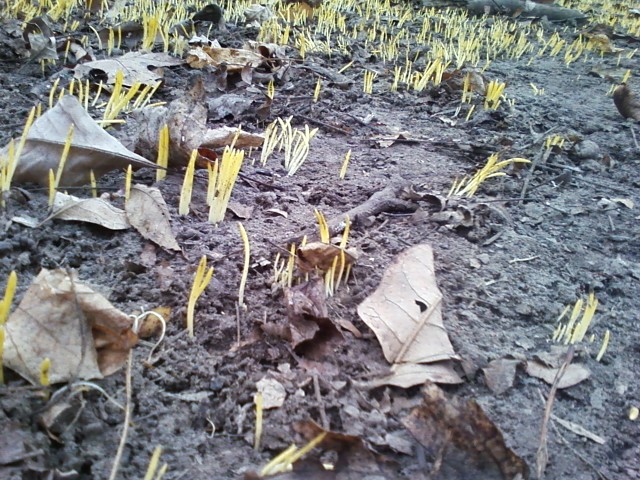
springshootsonwinterdayI passed right by them while crossing through a lightly wooded park on New Year’s day. The ground was frozen, the average temperature 28 F. Last spring’s fallen leaves still covered much of the hard earth, a threadbare blanket at best. And so it took me a moment to realize what I had just seen on this day early in Winter: Hundreds of green shoots jutting just above the cold dirt and thin layer of brittle dry leaves. They spread over an area almost a dozen feet in length

What were these nascent early risers?  Too early for me to tell, but this patch presaged a patch of robust wild plants. I doubled back when the incongruity of springtime growth on the first of January  dawned upon me. Bent over to get a closer look I thought about how nice this area would look in a few months time covered with dense vegetation.shootsandleaves

Earlier in the day I had visited a patient in a nursing home, a woman confined to bed, unable to walk due to advanced multiple sclerosis. Her room was nice enough with pictures of her family, holiday cards hanging and she was cheerful, happy to greet a new visitor. She had walked, like me, but not for more than two decades, yet she still smiled and offered warmth to a stranger.

Her ability to warmly embrace the moment regardless of her own physical limitations reminded me of another person I once visited in the hospital, a father who became a paraplegic after a car accident. Without the use of his arm or legs he cherished any function he could still perform on his own, such as breathing. A devout and learned man, he quoted to me, actually admonished me, with an interpretation of a sentence from the Book of Psalms: For every breath, I praise God.

Cherish what you perceive as inconsequential.

As I looked at the shoots I started to question my own assumptions, that saplings always grow into strapping trees, that young shoots always grow into verdant plants, that life follows an upward trajectory. Perhaps these unlucky shoots poked out too early and well, that’s it for them.  Their moment in the sunlight was their first and last stand. Indeed within four days they were once again covered by snow. Will they survive until Springtime?0105141541

Breathing hard, feeling sore in my legs, I had been running past the new shoots when I first spied them and I admit, I was happy for an excuse to stop running and rest. Yet I keep wondering, when will I finally be able to run this route effortlessly, without even wanting to stop, with nary a hint of tiredness in my body? Am I not destined to improve?

My answer was in front of me.

No guarantees. No promises.

Perhaps each footstep today is its own triumph to be celebrated while on the journey toward ‘better’.  I do not preach defeatism. Indeed, “better” is the currency of mankind: farther for a hiker, faster for a runner, higher for a climber.

Rather I offer that one should learn to revel even in the seemingly mundane moments along the way. One’s ultimate goal may or may not be reached.  But either way, at least the journey itself will bring joy.

To Walk the World…

For walkers, trail runners, travelers and even armchair explorers, read about one man’s slow seven year walk retracing the route of human migration over millennia. Journalist Paul Slopek, partially funded by National Geographic, is making this journey and posting every several hundred miles with text, photos and even a short audio track of the sounds that surround him, wherever he may be, desert, town, market, or no where particular. In this article Slopek writes his first extended length article about this journey he began earlier this year, starting in Ethiopia. Now he has crossed the Red Sea and is walking north along the coast in Saudi Arabia.

Here are some of his opening thoughts in his National Geographic essay. (He can also be followed at outofedenwalk.com ):

“Each step we take is an arrested plunge, a collapse averted, a disaster braked. In this way, to walk becomes an act of faith. We perform it daily: a two-beat miracle—an iambic teetering, a holding on and letting go. For the next seven years I will plummet across the world.

I am on a journey. I am in pursuit of an idea, a story, a chimera, perhaps a folly. I am chasing ghosts. Starting in humanity’s birthplace in the Great Rift Valley of East Africa, I am retracing, on foot, the pathways of the ancestors who first discovered the Earth at least 60,000 years ago. This remains by far our greatest voyage. Not because it delivered us the planet. No. But because the early Homo sapiens who first roamed beyond the mother continent—these pioneer nomads numbered, in total, as few as a couple of hundred people—also bequeathed us the subtlest qualities we now associate with being fully human: complex language, abstract thinking, a compulsion to make art, a genius for technological innovation, and the continuum of today’s many races.”

Here is a link to the NG article:

via To Walk the World.

To be or not to be Barefoot. Is that the Question?

English: Barefoot hiking south of Penzberg, Ge...

English: Barefoot hiking south of Penzberg, Germany (Photo credit: Wikipedia)

Barefoot running and barefoot hiking have been discussed continuously since at least May 2009 when Chris McDougall’s book Born to Run was published and fueled nationwide interest in running very long distances barefooted, or, at least with only a flexible piece of rubber under one’s foot and nothing more. McDougall chronicled the ultra long distance runs of the Tarahumara Indian tribe of Mexico who’s members, men, women and children routinely logged long distance runs in a type of sandal.

And barefoot running received a further boost in 2010 when Harvard Evolutionary Biology professor Daniel Lieberman published an article in the respected science journal  Nature  about foot strike patterns in habitually barefoot runners compared to shod runners. In fact, Dr. Lieberman’s work was cited in McDougall’s book.

And since that time ‘barefoot’ has been a hundred million dollar word.

Every major shoe manufacturer and many less well known have marketed ‘barefoot’ running shoes, admittedly an oxymoron, Dr. Lieberman has noted. The shoe sole manufacturer Vibram introduced the iconic Vibram Five Fingers  a cross between a glove and a rubber soled moccasin. New Balance and others heavily marketed ‘minimalist’ shoes invoking themes suggestive of running barefoot.

And bloggers and newly minted experts cropped up overnight inveighing the virtues of the barefoot gospel. If it was good enough for Austrolapithicus, it must be good enough for us, was a general sentiment. Indeed, the modern running shoe as we know it only dates back to the 1970s (of the common era). And even according to anthropologists  who date shoe wearing among Homo Sapiens as far back as 40,000 or so years (Trinkhaus and Shang,  “Anatomical evidence for the antiquity of human footwear”, Journal of Archealogical Science 2008), ancient man’s shoes surely did not include motion controlling ethyl vinyl acetate heel cushions and a thermal polyurethane reinforced arch support.

And so authors Tam, et. al of the Department of Human Biology at the University of Cape Town rightly questioned many of the commonly accepted notions about barefooted running in their October 2013 article, “Barefoot running, an evaluation of current hypothesis, future research and clinical applications”, in the British Journal of Sports Medicine published first on-line.

A woman wears Vibram "Five Fingers" ...

A woman wears Vibram “Five Fingers” shoes. (Photo credit: Wikipedia)

Tam, et. al thoroughly review much of what is known about barefoot running, making their article an important one for someone new to the discussion about this ongoing phenomenon. Their central question remains, however,  Does running barefooted reduce the rate of injuries? And toward that end they quote Daniel Lieberman from his most recently published analysis on the topic. “How one runs is probably more important than what is on one’s feet, but what is on one’s feet may affect how one runs”, Lieberman writes near the beginning of a 2012 article.

However, what Lieberman writes at the end of his lucid, organized and thorough review of barefoot running is perhaps more cogent. In “What We Can Learn About Running From Barefoot Running: An Evolutionary Medical Perspective”, published in Exercise and Sport Sciences Review (April 2012), he writes: “My prediction – which I readily admit is nothing more than hypothesis that could be incorrect – is that shod runners with lower injury rates have a more barefoot style form…Likewise I predict that injury rates are higher among barefoot runners who either lack enough musculoskeletal strength in their calves and feet…or who still run as if they were shod with long strides and slow stride frequencies.”

It seems than that many questions about barefoot running remain outstanding. But some truths have been established. Lighter weight shoes do reduce the oxygen need of the runner with a one percent decreased need for every 100 gm decreased weight of the shoes. A mid foot or forefoot strike avoids the high pressure impacts of a heel strike. And shorter strides with a higher frequency cadence do seem to be correlated with a reduction in injuries.

So while one is vacillating about what shoes to buy, in the meanwhile run like a hunter gatherer may (or may not) have run: shorten your stride, land on the middle or front of your foot and increase the number of steps you take per minute. Unless of course you develop pain in your foot, leg, hip, back or elsewhere.  In that case, go back to whatever you were doing before!

Walking in a fog…

Fog obscures.

The “fog of war” explains how otherwise  civil men can be driven to act so uncivil. Fog is the rationale. Not only soldiers but poets too have turned their eyes toward the “fog”. For them it is a comfortable literary trope. “Fear death – to feel the fog in my throat and the mist in my face” wrote Sir Robert Browning (1812-1889). And when people look out their window and see the fog, they sigh as if only sunlight can bring happiness.

Last Sunday I hiked a route with which I am quite familiar, a 4 mile trail through boulder fields, along and over brooks, past a cascading waterfall and around fallen trees in an east coast maple-beech-birch forest in northern New Jersey. The trail includes over 1000 feet in elevation change and half of that is a 500 foot ascent up a section with several vistas along the way. From each viewpoint the panorama gets better and better until at the top one can see 30 miles and easily make out the skyline of New York City.

On a clear day.

Fog on Carris Hill Oct. 2013

Fog on Carris Hill Oct. 2013

On a clear day people make their way up the strenuous section which is almost two miles from the trail head. On a clear day a hiker will see others along the way and at the top,  in small groups or large or alone with their dog.

On a foggy, damp day you see no one at the top and just one or two souls  who have turned around complaining about the absent views.

But I for one saw value that day in not seeing. I took comfort in my obstructed view of that which I knew was there yet could not see. And for the first time in my life I made no effort to look past the slate gray cloud which enveloped the summit, which colored the nearby lime green leaves into a drab olive hue and totally hid the canopy only a few dozen feet beyond. No skyline was to be seen no how.

I surrendered any attempt to see beyond my veiled misty curtain for I began to understand that the nature of nature is that it is always beautiful if not always comfortable. We are guests in a vast abode about which we have no say. Yes, I could have waited for a sunny day. But Sunday last the fog at my fingertips was my panorama, and it was good.

The still, small, voice…

When I finally stopped gasping for air I realized what I had done.

After plodding along for the past few years with no attention to speed I decided to see if I could run faster. I looked around and found many recommendations and decided to try interval training: Run a lap at normal speed than run the same lap faster. Repeat. And repeat again and again.

After panting I realized I was able to increase my speed by 20%, if only for a short period of time. I did not know what I had accomplished while I was running, only after I stopped.

The Jewish high holidays have concluded. The liturgy for the Jewish New Year, Rosh Hashanah, is filled with images of the majesterial as we proclaim God the Master of the Universe. We listen to the primal sound of a ram’s horn, the shofar, to punctuate the day. And in one stirring paragraph we describe the power of that sound upon our hearts. But that sentence is mysteriously juxtaposed to the most enigmatic phrase of the day. The sound of the shofar will be sounded, the prayer states, and a “still, thin sound will be heard”.

That phrase comes from the book of Kings 1, chapter 19 and concludes a section about Elijah the prophet who had reestablished God’s honor before crowds of idol worshippers, including Israelites who had strayed from their belief in God. Tired from his battle for truth Elijah beseeched God to end his life. God responded by sending an angel who led Elijah on a 40 day journey to a cave from where he witnessed a sound so loud it crushed rock, caused a devastating earthquake and a great fire.

“God is not there” we are told after each cataclysmic event. Elijah did not find God in the maelstrom. But than a “still, small voice” appeared and there is where Elijah reconnected to his Maker. Immediately afterward we read Elijah leaves his cave and re-enters the world, appointing a king for this nation and for that one. He begins to re-build the world. 19th and 20th century naturalist writers have borrowed this phrase as well and often refer to the “still, small voice” they hear in the forests and the fields.

And I thought of this scene finally standing upright after bracing myself on my knees doubled over, oxygen deprived, the lactic acid burn starting to ebb. We don’t know what we have accomplished in the midst of the thing, in the middle of a run, or long hike. Or in the midst of raising our children. Indeed, physiologists believe that endurance is increased not during the quickened pace while running but rather in the moments right afterward when the the cardiovascular system adjusts to the new challenge.

It is only in the calm moments that follow our accomplishments that we, like Elijah, can realize the truth of our lives, and the work we have done and the work we have yet to accomplish.