Why Walking Helps Us Think – The New Yorker

by Alex Majoli (Magnum), in The New Yorker Sep. 3, 2014

by Alex Majoli (Magnum), in The New Yorker Sep. 3, 2014

As you settle in to the beginning of a new work week, here is something to ponder. The following article by Ferris Jabr which appeared in The New Yorker September 3rd, 2014 looks at the role walking has played in some popular English literature and how walking might just make us more productive thinkers. This, of course, will come as no surprise to walkers. Thanks to my son for the link.

Why Walking Helps Us Think – The New Yorker.

Howard E. Friedman

On the trail: defining “trail”

What is “the trail”?

Recently I responded to trail shoe company Vasque’s request for product testers for a new model of trail running shoes. I had to itemize how many miles a week I run and on what surface. The choices were single-track trail, dirt, grass or pavement. I ticked off checks in the first three boxes. I don’t run on pavement.

I started wondering, am I a trail runner if I run on grass and dirt in urban environs more than I run on single track paths in the forest?

For a trail runner or hiker, must the ‘trail’ be surrounded by forest or rolling hills? Must it have rocks and roots? What about running on the grass and uneven dirt to the side of an asphalt path in a dimly lit urban park, at night? Does that constitute ‘trail running’.  What about if you run  on a wood chip path in a tree filled park but you see buildings beyond its sylvan perimeter? Is that a ‘trail’ run’? How about starting a run in a park but leaving the graded path to run through high grass, emerging with burrs and maybe a tick or two? Does that count?

Or does “the trail” really limit you to a path in the woods, or wilderness, somewhere far away, a car drive away? Perhaps running on a graded trail, maintained by trail volunteers who trim away brambles, fix the blazes, remove fallen trees, is not even real trail running. Maybe you need to bushwack your own trail through the forest to really make it count.

I never heard back from the folks at Vasque. My mileage was probably too low. My age probably too high. Maybe they don’t count running on grass as real trail running. Fair enough. They should find the hardest charging trail runners out there to test their shoes. Admittedly, that’s not me.

But I am left with my question. Am I a trail runner? On most days, honestly, probably not. But neither am I a road runner. I would accept the moniker “off-road” runner, however. But even when trying to harvest a trail run out of a city park, I aspire to return to the trail, for all the reasons more and more people are running on single track paths in the woods: the inherent challenge, the beauty of the scenery, the need for rapt attention to every foot fall. And I will return. Maybe this weekend, or next. In the meantime, I will continue to nurture my aspirations with the resources I have available. And that is the best training there is.

Howard E. Friedman

-30-


Off the trail: A fresh look at dirt.

I have hiked or run on dirt trails for a number of years now so it is odd to look at dirt in a new way. But now, I am careful where I tread on the dirt, lest I stomp on and kill a seedling.

A few weeks ago I was assigned a community garden plot. I did not receive the news until almost the end of June so it was a real race to find seeds to purchase, till the soil and plant my garden. By the middle of July, late one night after work, after dark, my garden was fully planted. I opened the spigot and jiggled my thumb over the end of the hose to create an arcing spray. By the light of my headlamp,  globules of water looked like pearls in the beam of light, disappearing silently into the dirt. With a great deal of good fortune I might just get a crop of corn, lettuce, carrots and zucchini in the early fall.

Now on summer evenings I am drawn to my garden like I used to be drawn to the dirt on the trail. But now I am not interested in how much ground I can cover and what I might see along the way. Rather, I am interested in how much I can grow out of this plot of earth.

Surprising as it might seem, gardening in any organized way, and certainly modern corporate farming, is relatively new to the human race. What with homo sapiens dating back almost 200,000 years ago, anthropologists believe that we humans only began to actually plant seeds to grow food sometime around ten thousand years ago. We gathered plants, fruits and nuts to eat prior to that. But cultivating an understanding of gardening took many, many years.

Indeed, scientists explain that at first human ancestors practiced not agriculture, the planting of seeds in cleared plots of lands, but rather vegeculture, that is planting a seed or two outside of the cave entrance in an available clearing. Only after years of experience with vegeculture did humans develop the ideas and concepts which ultimately led to modern gardening and farming: clearing tracts of land, mass planting of seeds and watering and fertilizing the crops.

When hiking along the dirt trail in the forest I pass through the land. Now I  myself am rooted to the soil, fingers deep into the dirt, like tendrils of a seedling. I tread lightly, checking each step again and again so as not to stray onto the tiny emerging sprouts.  And though I stay by my hundred square foot space, the experience is immersive, expansive, not claustrophobic or limiting. And I leave with a similar sense of calm I get from time spent deep in the woods.

The dirt is common to both the trail and garden.   It is an alluvial silty outwash from rocky sediment, mixed in with composted lichen and forest litter, serving as a home to thousands of microbes, yielding a magic carpet that bedizens our forests and farms and helps nourish a planet. And we should respect this life giving resource. Now well into the summer of 2014 we are inundated with painful news of planes falling from the sky killing all aboard, school girls gone missing, teenage boys abducted and murdered, conflicts around the globe, in Ukraine and Israel and Gaza. Body counts of killed and wounded climb.Mourners’ tears water cemetery grass. One response to ongoing conflict will ultimately come from the soil, which will outlast all combatants and go on in the fullness of time to hide the remnants of the warfare we wage. American poet Carl Sandburg (1878-1967) recognized the power of the soil to hide the horrible in his poem Grass. For Sandburg, the grass hid the memories. Perhaps we the citizens of the earth can learn to till hope from the soil, instead:

Grass

BY CARL SANDBURG

Pile the bodies high at Austerlitz and Waterloo.
Shovel them under and let me work—
                                          I am the grass; I cover all.
And pile them high at Gettysburg
And pile them high at Ypres and Verdun.
Shovel them under and let me work.
Two years, ten years, and passengers ask the conductor:
                                          What place is this?
                                          Where are we now?
                                          I am the grass.
                                          Let me work.
Howard E. Friedman


On the Trail: Peer into the Shade


Shade on the Escarpment Trail in the Catskills (http://www.nature-photography-in-the-rough.com/)

Shade on the Escarpment Trail in the Catskills (http://www.nature-photography-in-the-rough.com/)

Summer has begun and in the northern hemisphere that usually means hot and sunny especially if trails are above tree line. But in the northeastern United States we are lucky that miles and miles of hiking trails remain well shaded as they traverse forests under a canopy of millions of maple. birch, hickory, oak and beech leaves, among others. The shade is a balm on a hot and sunny day.

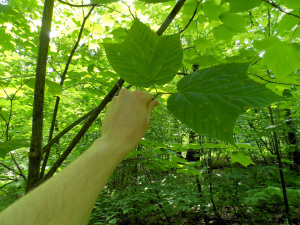
Striped Maple, an understory tree (http://njurbanforest.com/about-nj-urban-forest/)

Striped Maple, an understory tree (http://njurbanforest.com/about-nj-urban-forest/)

Running through a shady trail last week, I thought about the challenges of life in the shadows. For plant and tree life dependent on sunlight for photosynthesis, shade would seem to a be a punishment, like half rations for a prisoner, or no rations at all. Yet, the understory of forests, the part that is mostly in the shade, does teem with verdant greenery. Indeed, some trees, notably the striped maple, inhabit only the understory and do not ever breech the forest canopy. Other trees, however, are shade tolerant. That is, they can survive in the shade, for years if needed, until they have an opportunity to leave the understory and poke their tallest limbs into sunlight, perhaps after a nearby taller tree topples over, clearing a space in the forest canopy. And, many plants, even in our own gardens, flourish only in the shade.

How does life tolerate the dimness of the daytime darkness, the absence of direct sunlight, especially when that light is a currency of life for most plants and trees? There is no one answer. Instead, plants in the shade use a cornucopia of adaptations for their survival.

Think of common shade plant in many home gardens, Hostas. Notice that they have large leaves, an adaptation to collect as much sunlight as possible. In addition, the chloroplasts in the leaves of shade dwelling plants and trees are larger than in trees and plants that live in full light and their epidermal cells are better designed to maximize light. Also, shade trees and plants have no waxy layer on their leaves, something that trees in full light use to help reflect away unneeded light. And, in addition, shaded plants can change the angle of their leaves to maximize any available light during the day.

Shade is not only sunlight blocked, but rather potential not yet realized, growth untapped, waiting for opportunity. Shade tolerant plants, though, have it figured out. Do not wither during lean times. Adapt and be patient. If you find yourself struggling out on your trail, peer into the shade for inspiration, then continue on your way.

The sunlight, it is a coming.

Howard E. Friedman


(for more information about shade apaptations, visit : http://plantsinaction.science.uq.edu.au)


On the Trail: One Dose of The Escarpment Trail

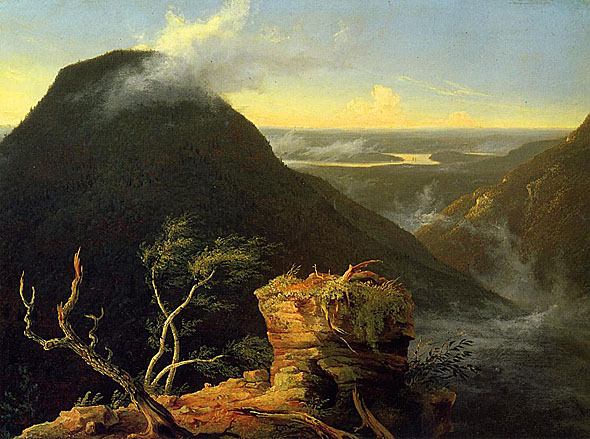
Sunny Morning on the Hudson, Thomas Cole, c. 1820 (explorethomascole.org)

On the last Sunday and Monday of May I was fortunate to backpack 19 miles of the Escarpment Trail, a footpath dating back in parts to the early 1800s, which climbs up, and down, and up and down as it traverses the eastern most ridge of the Catskill mountains, providing a commanding view towering 2,000 feet above the Hudson River valley and the self-same river seven miles in the distance. The escarpment, a rocky buttress which extends for more than 30 miles in all, inspired many American painters in the nineteenth century who carried their easels from the southern section of the trail up onto the rocks overlooking nearby North-South Lake and river and valley below, garnering the name for themselves, Hudson River School painters.

Our path began in the town of Windham, NY with a three mile climb to Windham peak at just over 3,500 feet elevation. Our trail followed due south, cresting Blackhead Mountain, 3,950 feet elevation before dipping back to lower elevations. We camped along the ridge top after completing 11 miles, setting out early the next morning to continue our journey, stopping to refill water at a piped spring gushing water from a sandstone massif. The trail transects several types of flora along its course, from Northern hardwood forests of birch, beech, maple and pine trees to Alpine type forests of primarily Balsalm Fir, which fill the air with the smell of Spring itself. The forest than changes to large stands of primarily birch trees along the way. Splashing the trail with colors on either side of the single track footpath were abundant amounts of Purple Trillium flowers (also called Wake Robin) along with Canada Violet, Spring Beauty and Wild Columbine.

Purple Trillium, photo by Jim Salge (www.vftt.org)

Purple Trillium, photo by Jim Salge (www.vftt.org)

My mind was still playing back scenes from the Escarpment Trail days later when I read about new research that found that modest exercise in senior citizens can help them maintain their mobility. These findings were reported on May 27th, 2014 at the annual American College of Sports Medicine conference and published in the recent Journal of the American Medical Association . Researchers found that a daily walk of only 400 meters, or once around a high school running track, was sufficient to keep older, primarily sedentary people mobile. Of course, everyone knows that exercise is good for you. But, we don’t really know how much is needed to get results.  This study establishes that for this group of 1,635 sedentary people, ages 70-89, walking only four hundred meters could be considered one “dose” of exercise. And according to Wendy Kort Ph.d. from the University of Colorado, who reviewed the study, this research begins to refine the notion of what is an appropriate “dose” of exercise.

Our backpacking trip was necessarily short to accommodate work and family responsibilities. We left at 8:30 Sunday morning and returned home around 5 p.m. Monday but, with travel, our time on the trail really extended for just a bit over 24 hours to cover the 19 steep, rocky miles and allow time for eating and sleeping.

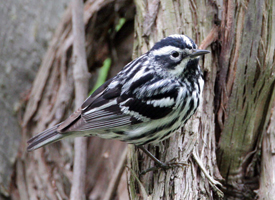
Black-and-white warbler, photo by John McKean (www.allaboutbirds.org)

While the trip was short we did manage to traverse most of a well established hiking path, packed with beauty on the trail including not only wildflowers and shifting forest types, but vistas of the horizon, including the Hudson River, views of other Catskill peaks and even an unexpected close-up view of a black and white warbler only several feet away, perched on a spruce branch. The trail does include one macabre reminder of the power of windy downdrafts along a 2,000 foot escarpment: the well preserved fuselage of a Cessna plane that rests feet from the trail, exactly where it crashed in this mountainous area decades ago, killing its pilot.

This trek into the woods I would say, was one dose, or perhaps a double dose, of immersion into nature untamed. Time will tell how long it will last before I will needs prescribe myself another dose.

Howard E. Friedman

On the trail: A virtual backpacking trip thru Yosemite…

from Project Yosemite by Sheldon Neill and Colin Delehanty

from Project Yosemite by Sheldon Neill and Colin Delehanty

With warmer weather, thoughts turn to epic hiking and backpacking trips, many of which, unfortunately, will not materialize, at least not this season. While I do not profess that technology can replace a true outdoors experience, I would be foolish not to at least acknowledge that the increasing marvels of technology are bringing the outdoors closer and closer to our fingertips.

I would love to spend some time backpacking through Yoesmite Valley. But, it won’t happen this summer. In the meanwhile, my eyes and even my soul can feast on the magnificent time lapse video footage capturing the movements of land and sky filmed over 10 months with sophisticated equipment to create a pretty darned good simulation of sights and sound of a hike throughYosemite National Park.

Colin Delehanty and Sheldon Neill hiked 200 miles carrying 70 lbs. of camera equipment on their backs to make the following five minute outstanding video. Visit www.projectyose.com to see this video (a Vimeo editor’s choice), nourish your soul, learn more about their project and see links to others they met along the way who have also captured on film the beauty that is Yosemite National Park.

Howard E. Friedman

“A Window on Eternity”, in Gorongosa and Chernobyl

Destruction of our natural habitat comes in many many different forms. Edward O. Wilson writes about destruction and rebirth in one such place, Gorongosa National Park in Mozambique. And Timothy Mousseau, professor of Biology at University of South Carolina, studies destruction and its impact on rebirth in another location, Chernobyl, Ukraine.

A Window on EternityIn A Window on Eternity, A biologist’s walk through Gorongosa National Park (Simon & Schuster 2014), Wilson briefly recounts the history of Mozambique’s 16 year civil war ending in 1994 which resulted in nearly a million people killed and the creation of several million refugees. A collateral effect of the war was near extinction of what Wilson describes as “the megafauna” of Gorongosa National Park, a wildlife refuge located in Mozambique, but too close to the fighting. Large edible and/or valuable animals were killed for food or profit. Elephants decreased by 80-90% in number. Cape buffalos went from 13,000 in 1972 to 15 in 2001, Wilson writes. Wildebeest went from 6,400 to one and zebras from 3,300 to just 12 he adds.

Thanks to the great efforts of U.S. businessman and philanthropist Gregory Carr who began over seeing the reintroduction of large animlas back into the park, Gorongosa is staging a slow resurrection.

“Another several decades may be needed for Gorongosa to return to its old preeminence, but given the persistence of its undergirding of plants and invertebrates which largely survived the war intact, I believe this  will surely come to pass,” Wilson concludes in the chapter called ‘War and Redemption’. In the chapters that follow Dr. Wilson describes findings from his and his colleague’s expeditions to Gorongosa as he shares their ground-eye view of ants, katydids, praying mantises and others. “None to me is a bug,” he writes, “Each instead is one kind of insect, the ancient legatee of an ancient history adapted to the natural world in its own special way. I wish I had a hundred lifetimes to study them all,”  he writes in the beginning of chapter eight, ‘The Clash of Insect Civilizations’.

But while E.O.Wilson is sanguine about ‘The Conservation of Eternity’ (title of chapter eleven) in nature’s ability to recover from war in Gorongosa park, fellow biologist   Timothy Mousseau, professor at University of South Carolina is less optimistic about the resilience of various phyla of the animal kingdom to survive nuclear fallout. Dr. Mousseau has been studying how various species of birds, spiders and insects have fared in and around the Chernobyl nuclear reactor which exploded 25 years ago, releasing large amounts of radioactivity into the atmosphere. His work was featured on Newyorktimes.com.

Dr. Mousseau in Red Forest, Chernobyl (http://cricket.biol.sc.edu/Mousseau/Mousseau.html)

Dr. Mousseau in Red Forest, Chernobyl (http://cricket.biol.sc.edu/Mousseau/Mousseau.html)

Still a hot zone, the area around the old plant has been off limits to humans, making it an interesting living laboratory to study flora and fauna without the day to day interference of human life (though one could make an easy argument that after contaminating an entire region with radioactive waste, day to day human activity is kind of negligible). Since 1999 Mousseau and Dr. Pape Moeller have been documenting aberrations in spider webs, bird beaks,  insects and rodents, all of which they say reflect genetic mutations in animals living in the most radioactive zones around Chernobyl. And, while some researchers take issue with Mousseau and  have pointed to the fact that any wildlife that persists around Chernobyl is proof of the resilience of  various species, Dr. Mousseau cautions that if you look more carefully, life has persisted but not robustly and not in good health.

Neither scenario is appealing. Dr. Wilson documents a resurgence of wildlife in an area that witnessed almost a million human deaths, thousands of animal deaths and which required importing ‘megafauna’ species to help repopulate the area. Dr. Mousseau documents the persistence of weakened and wounded life which, however, has been able to survive a near direct nuclear explosion but which has little hope of ever returning to full health. Perhaps for either scenario, Edward O.Wilson was prescient in selecting the opening quote in his latest book: “I have set before you life and death, blessing and cursing: therefore choose life, that both thou and thy seed may live . – Moses at Mount Nebo, Deuteronomy 30:19.”

Howard E. Friedman

The Evolution of Walking: From Laetoli to the Exodus to the Appalachian Trail

hiking in Chamonix

Ambulating on two legs dates back  3.6 million years ago according to anthropologists who have studied human like foot prints preserved in the volcanic ash in Laetoli, Tanzania. Those foot prints were discovered by anthropologist Mary Leakey in 1978.

http://www.getty.edu/conservation/publications_resources/newsletters/10_1/laetoli.html

The Laetoli footprints, from http://www.getty.edu, photo-Martha Demas, 1995.

The human like Austrolapithicenes who left those foot prints were quite possibly walking for a utilitarian purpose, like searching for food or shelter, or returning to their shelter. As our human society has evolved, however, walking has evolved right along with it. In fact, one could suggest that as a species, we have evolved to no longer need walking for distance travel.

We walk now to thrive, not survive. Evening strolls, weekend hikes, backpacking trips, laps around the high school track. Humans continue to find new but non-essential ways to exploit the simple, elegant act of placing one foot in front the other. And that act, in fact, is one of the hallmarks of what it means to be human.

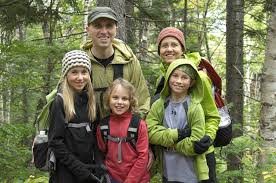
Today, walking for long distance travel,  on the other hand, has become rare. And this might explain why last month, when the Tougas family of New Richmond, Canada, announced their plans to walk more than two thousand miles, together, on the Appalachian Trail,  they saw it as a viable marketing opportunity to raise money for their project.

The Tougas family announced their planned family through-hike of the AT on Kickstarter.com.  They  received pledges of $19,109 (Canadian), surpassing their goal of $16,000. The family spokesperson and father, Damien Tougas, explains on his KickStarter site that the monies raised will go to fund production of a video series that sponsors will receive in installments, once a month. The money raised, he said, will not be used to pay for the hike itself. The family has already put aside funds for their 6 month sojourn, he explains.

Walking has always been a sure mode of human transportation. Early humans of course had no alternative. Hunting and gathering required walking and beasts of burden had presumably not yet become part of daily life.  Even Americans, thousands of years following hunter-gatherers, still walked alongside their covered wagons,  for upwards of six months.  400,000 or so people migrated, on foot, westward to  Oregon, Utah, New Mexico and California, between 1840 to almost 1870. Their wagons were so full of family belongings and food there was precious little room left for riders. But these hearty pioneers were perhaps among the last of the long-distance migratory walkers, at least in North America.

Human beings have slowly, but persistently, sought out alternatives to walking. Even several thousand years ago, Egyptian soldiers used horses to pull their chariots. Some Greek warriors rode into battle on the backs of elephants and trade routes in the Middle East have domesticated the camel.  In more recent times horses have either carried riders or pulled wagons and carriages.  The horseless carriage morphed into the car, and now motorized transportation has become ubiquitous.  Walking as a daily means of transportation has become a rarity, at least in western civilization.

Tougas family (fimby.tougas.net)

Tougas family (fimby.tougas.net)

And while the Tougas’ get great credit for their planned family adventure, we are left with the question, why is watching another family walk intrinsically interesting? Certainly there are challenges and risks with a long distance hike and even more so for the younger Tougas children.  The AT however,  is well marked, well traveled and fairly close to civilization along most of the route. Although  a 2,100 mile trek is big undertaking, and the trail is quite strenuous at times and weather is always a variable.

Nonetheless, I suggest that our societal de-evolution of long distance walking is the key to family Tougas’ ability to raise close to twenty thousand dollars from 267 people who are willing to pay to see that family walk. Almost like paying to watch an IMAX movie about rock climbers, or cliff divers or base jumpers. In 2014, traveling a long distance on foot is a novelty and considered an adventure, only for the intrepid among us. And I suspect that even if family Tougas said they were going to walk strictly along back-country roads from Georgia to Maine and stay in bed and breakfasts along the way, and not pitch their tent in the woods, they still would have been able to raise money for their trip.
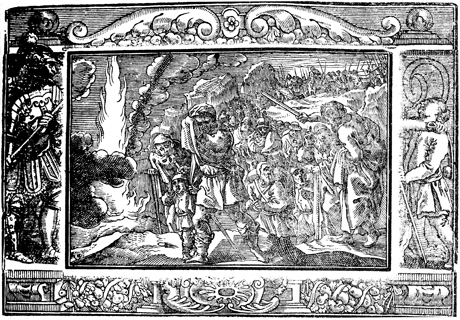
From Biblia Das Ist, Martin Luther (1486-1583), a depiction of the Exodus. Courtesy of the Digital Image Archive, Pitts Theology Library, Candler School of Theology, Emory University

From Biblia Das Ist, Martin Luther (1486-1583), a depiction of the Exodus. Courtesy of the Digital Image Archive, Pitts Theology Library, Candler School of Theology, Emory University

In one week the Jewish people mark the exodus of the Children of Israel out of Egypt, when they began their forty year sojourn toward the Promised Land. After hundreds of years of bitter enslavement the Israelites walked out of Egypt, away from their life of servitude, to follow Moses, a leader appointed by God. During four decades the Hebrew tribe walked from encampment to encampment in the Sinai peninsula, until they finally crossed the Jordan River to enter the city of Jericho in the land of Israel.

Next week, when Jewish families gather to commemorate that night about four thousand years ago when the Israelite  begin their long walk toward freedom, let us also remember that one of the most basic human functions, walking, is so simple and elegant. The long walk should not be considered a novelty,  since  the process of walking can transport us, physically and figuratively, toward a new beginning.

Howard E. Friedman


On the Trail: Really Smart Socks

published in Trail Walker Spring 2014, official publication of New York/New Jersey Trail Conference, nynjtc.org

By Howard E. Friedman DPM  Image

High tech companies keep trying to push their products onto the trail either in your backpack or on your wrist. Mapping apps for smart phones and ipads. Solar powered recharging stations so you can recharge your ipad and smart phone. But many hikers, backpackers and trail runners continue to eschew the idea of letting technology get between them and the trail. But this spring the newest high tech product for hikers will actually come between you and the trail – as long as you are wearing socks. Really smart socks.

 This spring a new high-tech sock will be available to runners and hikers that will record and project an image of exactly how your feet are striking the ground. Are you a heel striker, forefoot striker or mid-foot striker? Do you put all your pressure under your great toe but no pressure under your smallest toe? Understanding how the foot strikes the ground can be an important distinction especially for runners since many researchers suggest that mid-foot and forefoot strikers are less prone to injuries than heel strikers. (Walkers and hikers are normally heel strikers). The socks can also detect if the wearer’s gait has changed during a hike or run.

ImageCalled Sensoria, these socks will also record distance traveled, cadence (number of foot strikes per minute), number of steps taken, calories burned, as well as other metrics. A number of existing products can also tell you similar information, such as the Nike+Sportswatch. But no other device on the market geared for the athletic consumer can generate data and images of the pressure generated under your feet.

The Sensoria sock made of a washable, synthetic wicking fabric will be available this spring from Heapsylon LLC, a  Redmond, WA based technology company, Ceo Davide Vigiano said in a telephone interview. The company also manufactures a shirt and sports bra that use a sensor to record heart rate.

The sock incorporates three sensors, one each under the heel, near the big toe and near the small toe, which are less than 1 mm thick. To activate the sensors, the hiker or runner attaches an anklet to the sock via snaps. The  battery powered anklet contains an accelerometer and other technology which allow it to capture data from the sensors in the sock. The user can then see the data as it is being collected on his or her smart  phone or even Google glasses, with pressure reflected as either green, the lowest reading, or yellow or red, a high reading. Or the user could download the data from the anklet via Blue Tooth technology  or using a USB connection, after the hike to see a video strip of their foot strike history and other data, like distance traveled. Harvard evolutionary biologist Daniel Lieberman Ph.D, who has authored many studies on barefoot running and is the author of The Story of the Human Body (2013 Pantheon) is collaborating on the mobile application, according to Mr. Vigiano. The sock sensors do not have a GPS but can be paired with existing GPS units, Vigiano said.

Image

These smart socks are ideal for trail or road runners who not only want to know how far and fast they have traveled but also want to modify their gait, be notified if they have started suddenly pronating or supinating and want to try and minimize injury. Moreover, the sock could give a before and after look at exactly how an arch support or foot orthotic changes the pressure under the foot.

Howard E. Friedman
On the trail: Retreat and the edge effect

Tenafly Nature Center at Rt. 9 (H. Friedman)

Tenafly Nature Center at Rt. 9 (H. Friedman)

I finally turned back.

Perhaps my plan was ill advised from the start. To run and hike in two feet of snow without the aid of snow shoes or skis. Or even boots. Just La Sportive Wildcat trail shoes and a plastic bag I had slipped over each of my feet before I put my shoes on. But I really thought the snow would have been tamped down already by other hikers with their snow shoes or cross country skis or boots.

Apparently very few people had been out and the trail was covered with thick pillowy snow, softening in the warming temperatures. But on I ran, counting on my Kahtoola Microspikes to grab the ice and hard packed snow and prevent slipping. They were no match for today’s conditions. In some cases I crashed through the top layer of hard packed snow. But in other spots I post holed, my foot slipping into a cauldron of cold. After thirty minutes I finally accepted that I was neither trail running nor hiking, but rather slowly and inefficiently slogging my way uncomfortably through a forest blanketed in snow.

It was time to retreat, that moment when hope collides with reality.

Mountaineers must deal with the quandary of retreat. If a mountaineer advances to a summit when the odds are against her, she risks her life. Yet if she retreats she will have spent thousand of dollars and weeks or months on an unsuccessful expedition. Successful climbers, however, succeed in part because they know when to advance and when to retreat.

photo by Jake Norton/adventure.nationalgeographic.com

photo by Jake Norton/adventure.nationalgeographic.com

American mountaineer Ed Visteurs, the first U.S. climber to ascend all of the world’s 14 peaks over 8,000 meters (and without the use of supplemental oxygen), offered realistic advice about success in mountain climbing. “Getting to the top is optional. Getting down is mandatory”, he said. Each person who sets out on an adventure, be it large or small, must respect his own limits, his own edge of ability.

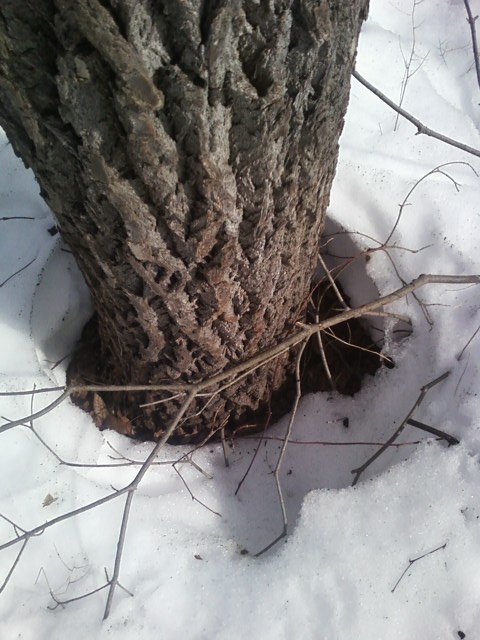
During my retreat I noticed that snow that had settled around the edge of the base of the trees was now melting away from those same trunks, leaving a ring of snow. And that ring forms a thin edge. The snow was disappearing gradually from around the trunks. The edge where the two had coexisted was the first spot to melt away.

Tenafly Nature Center 2014 (H. Friedman)

Tenafly Nature Center 2014 (H. Friedman)

Snow always begins its retreat at the edges, where it abuts a fencepost, or sidewalk or stone wall. The edge is a fragile place. Retreat for humans also occurs at the edge, the edge of ability or mental discipline. And when retreat comes, it starts with just one foot step, one step back. But that one step may be the difference between adventure and misadventure.  When you are standing on the edge, knowing whether to walk forward or back is one of life’s great challenges. But do not mistake turning back for defeat. Retreat is simply an opportunity to try another day.

Howard E. Friedman