Tenacity on the Trail

Catskill Waterfall, John Frederick Kensett (1816-1872), at Yale Museum of Art

Catskill Waterfall, John Frederick Kensett (1816-1872), at Yale Museum of Art

Humans aim to thrive.  Yet nature is oft satisfied with merely surviving. And at times, merely surviving is good enough. For example, some trees survive rooted only in a thin crevice of rock. And hikers and trail runners pushing through their day should take inspiration.

Gardeners strive to plant seeds and plants in the most fertile soil, and may even enrich the earth with compost or other fertilizer. And maple trees drop their seeds on the forest floor, rich with years of accumulated soil and decomposed leaf litter. Both gardener and maple tree aim to plant in a nutrient dense environment. Soil is the accumulation of lichens, mosses, fungi, animal and insect waste, decomposed leaves, twigs and fallen branches, a rich mix of nutrients ready to nourish the next seed that settles in its midst.

So it is shocking then to see that some trees are able to sprout from a rock without the benefit of a rich bed of soil. As the seed degrades and germinates, it must leach any and all available nourishment trapped alongside it in its rocky lair. And it must soak up precious drops of rainwater that find their way down the sides of the cold rock walls. Furthermore it must sprout with only the minimal amount of sunlight that makes its way deep into the dark crevasse.

Surprisingly, the sight of a tree emerging from a rock entombment is not so unusual in the forest. ‘Catskill Waterfall’, by Hudson River landscape painter John Frederick Kensett (1816-1872), seen above hanging in the Yale Art Museum, depicts a white birch seemingly emanating from a granite block, at the far right of his painting. And even today when driving through rocky terrain, one can often see saplings and trees growing almost magically right out of the crags that line our highways.
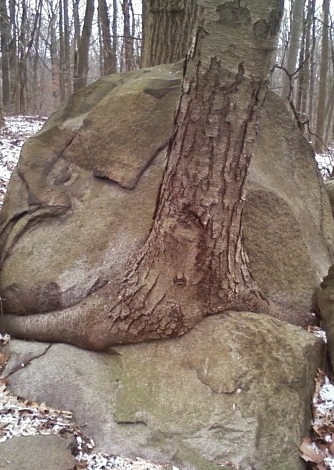
treeinrockTo a hiker or trail runner struggling on a hike or run, seeing a sapling or even a full grown tree swaying above its rocky foundation should give encouragement: to see life that has grown and persevered in adverse conditions. True, the tree growing out from a crack in a granite boulder may not be the tallest tree in the forest, but the tree has survived, and can help propagate its species. The tree can be a home to birds’ nests and provide refuge to insects galore which can burrow under its bark. But the tallest or the biggest tree it likely will never be.

The act of survival in the outdoors plays itself out again and again. Witness any of the birds resident through the winter. On a recent winter walk I was surprised to find myself within feet of a golden crowned kinglet, feeding among fir branches. This species, weighing less than a third of an ounce, is known to be able to survive even at temperatures of -40 F. The kinglet need not thrive on the coldest winter days, merely survive, to live so it can breed again in the spring. And so it is with the song sparrows, chickadees, nuthatches, titmice, cardinals, bluejays and downy woodpeckers one sees foraging, relentlessly, for their day’s nourishment throughout the winter.

Survive another day.

Such a lesson, while extreme for a recreational hiker or trail runner, is nevertheless a good one. The next mile which might seem to be insurmountable need not be covered in style. Breathlessness is okay. Sore muscles are okay. Walking and stopping are okay. Even thirst, at least for a short while, is okay. Know your limits, but persevere if possible.

The life force to survive is tenacious.

Thriving, however, may have to wait for another day.

Howard E. Friedman
Winter Ghosts on the Trail

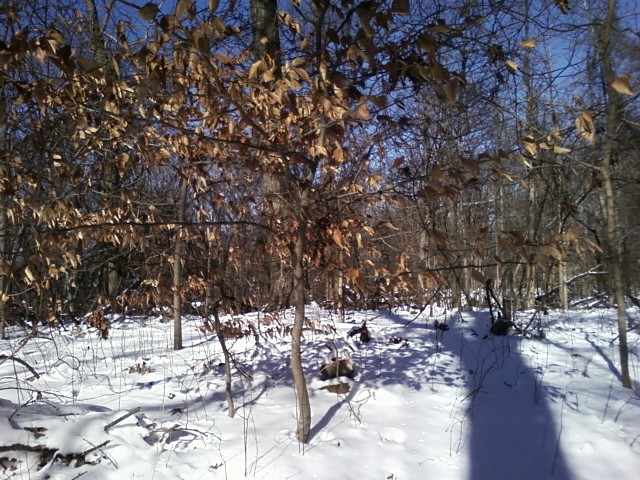
Beech tree in January

Beech tree in January

Wisps of last year linger even at the end of January. Almost all leaves dropped off  their branches months ago but the beech tree clings to last season. Even as it stands in a carpet of snow, its leaves rustle in a wind, one of the few sounds in the forest now. Though the leaves have lost their green color and are now only a ghost of their former selves, they summon up the images of the new leaves that will replace them and the millions of leaves that will appear on the trees that now stand bare in the dry winter air.

Needle bearing trees, pines, spruces, firs, hemlocks are covered in green year around, though even they lose needles from time to time. But they do not lose them all at once. And maples and birch trees lose their leaves in a continuous rain of colorful but dead and dying leaves in late autumn. Yet some beech trees hold on to their leaves throughout the winter in a process botanists call ‘marcescence’, a trait shared with oak trees. The tan wispy leaves that last throughout the winter  no longer participate in photosynthesis. Yet some scientists have postulated that these marcescent leaves serve to protect the new yet-to-bud leaves. And some have suggested that oaks and beeches are an intermediate type of tree on the evolutionary spectrum; occupying a space between the coniferous trees and the maples and birches. (Losing leaves in the fall can be a help to trees by limiting water loss and limit damage from severe cold, while holding on to needles year round may maximize photosynthesis).

Running through the snow-covered trails at Flat Rock Brook park in New Jersey, the leaves on the beech tree seemed incongruous viewed against a snow-filled backdrop. A leaf, after all, represents growth and fertility and hope and springtime. Yet the snow cover bespeaks a winter dormancy, a time of inactivity for forests and gardens. But seeing the ground covered with snow does not mean we cannot see what it hides.

My route took me over a brook crossing, one I had done many times before, rock hopping my way across. I knew the rocks were there but they were under a pile of snow and some hidden in thin ice. I looked down, but saw only mounds of snow and despite the snow cover, intuited my path.

Beech leaves have finally fallen.

Beech leaves have finally fallen.

Yet staring at the translucent leaves both on the trees and the ones that finally succumbed to their fate, I saw re-birth. Springtime. Looking at the snow covered trail and the snow on the ground to my right and left I saw, or at least wanted to see, spring wildflowers and grasses, buds on trees and nesting birds. I did see those things I think.

What can we see when we can’t see the real thing?

Educators, psychologists and others have written about the effects of watching television on developing minds.  What happens when everything is revealed? Do we dull our imagination? The advertising industry has certainly settled on ‘selling the sizzle and not the steak’. Leave something to the imagination.

And many researchers have written about our ability to imagine and fill in the visual gaps when we read. I did not find a study comparing our brain function while watching versus our brain activity when reading. But in ‘Your Brain on Fiction‘, a 2012 article in the New York Times, writer Anne Murphy Paul cites findings of neuroscientists who used MRIs to evaluate brain activity in people while they were  reading.The research shows that the written word on the page stimulates even non verbal areas of our brain. A word like “cinnamon” stimulates the olfactory portion of our brains. Fiction, it turns out, is good for our brains.

And last Sunday, running through the snow seeing ghost leaves dangling on the tree and no Joe Pye weed where it is supposed to grow, I would add: experiencing the naked forest in winter has the power to stimulate the springtime portion of our brains even while we enjoy the winter landscape.

0126141223

Winter light. What does your shadow say?

By by simonwakefield [CC-BY-2.0 (http://creativecommons.org/licenses/by/2.0)], via Wikimedia Commons

By by simonwakefield [CC-BY-2.0 (http://creativecommons.org/licenses/by/2.0)%5D, via Wikimedia Commons

Overland foot travel in winter requires extra care, like warm clothing. But there is one element even more critical,  that, unlike clothing, can not be added or subtracted easily at will.

Sunlight.

By liz west (Sundial) [CC-BY-2.0 (http://creativecommons.org/licenses/by/2.0)], via Wikimedia Commons

By liz west (Sundial) [CC-BY-2.0 (http://creativecommons.org/licenses/by/2.0)%5D, via Wikimedia Commons

True enough that hiking in the dark could be augmented with a bright headlamp. But there is no substitute for pervasive sunlight, the way it illuminates earth and sky. Regrettably, in the Winter, natural light is in short supply. Even on sunny Winter days, the radiance of the sun seems dim and insufficient. The sun can not bathe us in an intense bright  light from its low wintry perch no matter how much we strain to see.

Sundials have been in use for thousands of years, marking the sun’s transit across the sky. Once ancient people realized that our shadows shorten from morning until noon and than lengthen again toward evening, they could use that information to build reliable sun clocks, using a shadow to mark time. Sundials date back to ancient Egypt about 3,500 years ago and a reference to a sundial exists in the Book of Isaiah (38:8): “Behold, I will cause the shadow of the dial, which is gone down on the sun-dial of Ahaz, to return backward ten degrees.’ So the sun returned ten degrees, by which degrees it was gone down.”

Even Stonehenge is thought to be an ancient sun dial of sorts, not marking the hours of the day but marking rather the annual interconnected cycle of the sun and the earth, identifying both the shortest and longest days. And Stonehenge scholars believe that the midwinter solstice was more important to its worshippers than the summer solstice. Perhaps the reaffirmation of the sun’s travel across the sky was most appreciated in the depths of the dark winter days.

Sundials mark the passing of daylight, not by the sun’s light but by its shadow when the light hits the dial’s ‘gnomon’, the element that obstructs the light and casts the shadow.  Winter hikers are quite familiar with their shadow since the leaf cover that often shades the trail is absent, allowing light to filter its way down through the naked branches. Walk east in the early parts of the day and your shadow follows you, urging you along the way. Walk west and your shadow leads the way, pulling you along the trail,  the absence of light your personal guide.

You are your gnomon.

Photo source: Wikipedia, by Willy Leenders

Photo source: Wikipedia, by Willy Leenders

We know shadows from our early childhood. Shadow plays on the wall in nursery school. Picture books about frightened children cowering from their giant shadow. We know about shadows from language and literature. To Cast a Giant Shadow comes to mind. “Yeah though I walk through the valley of the shadow of death” is a more somber example from the book of Psalms.

Yet light is what we crave in the winter and even though sun beams reach the forest floor those rays of golden light still seem without their full luster. And it is our shadow that reminds us of both the presence of the sun and the absence of its light.

Now slowly approaching winter’s mid point the sun rises earlier and sets later and later if only by a few minutes at a time, increasing daylight by an additional two minutes each day by the end of January. While the sunlight has not yet fully awoken buds and bulbs from their sleep, we can see our way on wintry walks in the woods for longer and longer each passing day.  Just follow you shadow toward the light.

Springtime in the Winter, But No Promises

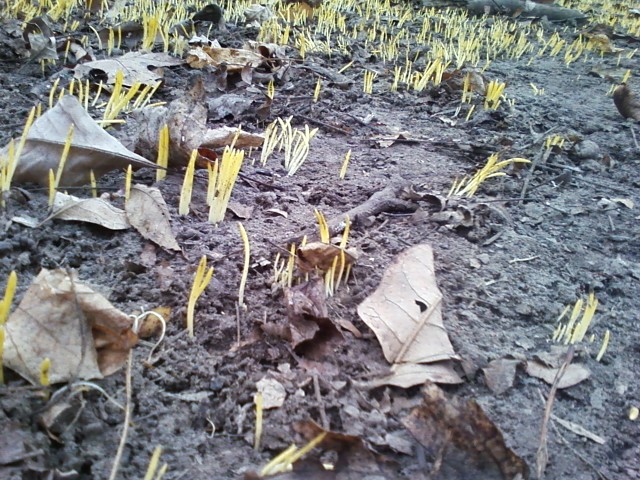
springshootsonwinterdayI passed right by them while crossing through a lightly wooded park on New Year’s day. The ground was frozen, the average temperature 28 F. Last spring’s fallen leaves still covered much of the hard earth, a threadbare blanket at best. And so it took me a moment to realize what I had just seen on this day early in Winter: Hundreds of green shoots jutting just above the cold dirt and thin layer of brittle dry leaves. They spread over an area almost a dozen feet in length

What were these nascent early risers?  Too early for me to tell, but this patch presaged a patch of robust wild plants. I doubled back when the incongruity of springtime growth on the first of January  dawned upon me. Bent over to get a closer look I thought about how nice this area would look in a few months time covered with dense vegetation.shootsandleaves

Earlier in the day I had visited a patient in a nursing home, a woman confined to bed, unable to walk due to advanced multiple sclerosis. Her room was nice enough with pictures of her family, holiday cards hanging and she was cheerful, happy to greet a new visitor. She had walked, like me, but not for more than two decades, yet she still smiled and offered warmth to a stranger.

Her ability to warmly embrace the moment regardless of her own physical limitations reminded me of another person I once visited in the hospital, a father who became a paraplegic after a car accident. Without the use of his arm or legs he cherished any function he could still perform on his own, such as breathing. A devout and learned man, he quoted to me, actually admonished me, with an interpretation of a sentence from the Book of Psalms: For every breath, I praise God.

Cherish what you perceive as inconsequential.

As I looked at the shoots I started to question my own assumptions, that saplings always grow into strapping trees, that young shoots always grow into verdant plants, that life follows an upward trajectory. Perhaps these unlucky shoots poked out too early and well, that’s it for them.  Their moment in the sunlight was their first and last stand. Indeed within four days they were once again covered by snow. Will they survive until Springtime?0105141541

Breathing hard, feeling sore in my legs, I had been running past the new shoots when I first spied them and I admit, I was happy for an excuse to stop running and rest. Yet I keep wondering, when will I finally be able to run this route effortlessly, without even wanting to stop, with nary a hint of tiredness in my body? Am I not destined to improve?

My answer was in front of me.

No guarantees. No promises.

Perhaps each footstep today is its own triumph to be celebrated while on the journey toward ‘better’.  I do not preach defeatism. Indeed, “better” is the currency of mankind: farther for a hiker, faster for a runner, higher for a climber.

Rather I offer that one should learn to revel even in the seemingly mundane moments along the way. One’s ultimate goal may or may not be reached.  But either way, at least the journey itself will bring joy.

Achilles Tendon Treatment Review

Protect Your Achilles Tendon

published in Trail Walker (NY/NJ Trail Conference) Winter 2014

Achilles, wounded. Depicted by Ernst Herter

Achilles, wounded. Depicted by Ernst Herter

By Howard E. Friedman DPM

Problems of the achilles tendon are often associated with runners but hikers are at risk for problems with this tendon too.  Hiking uphill for long periods of time is one risk factor for developing this condition.  And Achilles tendon disorders is one hikers should try hard to avoid. A painful achilles often requires three or more months of rehabilitation to heal enough to allow a hiker to resume hiking free of pain.

The achilles tendon is the largest tendon in the human body. A tendon connects a muscle to bone and the achilles tendon connects the powerful gastrocnemius muscle and smaller soleus muscle located in the calf behind the knee joint  to the back of the calcaneus, or heel bone. The tendon is several inches in length and is critical in lifting the heel   off of the ground when walking or running.

Achilles tendon problems are common among runners and  estimated to occur in 10-30% of male runners and even  5-8% in even well trained elite runners. No statistics exist for how many hikers develop this condition. Nonetheless, problems of the achilles often ail non athletes and often occur in people with one of many risk factors including having very flat feet or very high arch feet, or a diagnosis of obesity, diabetes or hypertension. In addition, a course of antibiotics in the Quinolone family, including Ciprofloxacin and Levaquin, can also cause tendon disorders. Overall achilles tendon issues occur in men more frequently than in women.

Hikers are at particular risk since walking up a steep incline especially with the extra weight of a back pack can cause excessive strain on the tendon. The tendon consists of millions of fibrils of the biochemical molecule collagen in addition to millions of tenocytes, or, tendon producing cells. Unlike other tissues in the human body which react to injury by producing inflammation, an influx of tissue repairing cells,  a damaged tendon degenerates with injury. No robust repair mechanism is programmed into the cells. Thus an injury to a tendon can be devastating.

For years doctors referred to achilles tendon injuries as “tendonitis”, meaning an inflammation. Now however, health professionals treating this injury call it a “tendinopathy” meaning a damaged tendon. This distinction is not very important because it has guided new and more effective treatments. The treatment used for an inflammation, “rest, ice, compression and elevation (RICE)”, can augment the treatment for a damaged achilles tendon but is not sufficient to repair the tendon.

Achilles tendinopathy can include damage to the lining of the tendon, called the paratenon, damage to the tendon itself via stretching or tearing of the tendon fibers, or in the worst case, result in a complete tear, or rupture, of the tendon. A complete rupture is usually the result of a hard landing on one foot, say, jumping down from a rocky ledge and landing on one foot. The injury creates immediate pain, often creates a popping or snapping sound and will result in significant difficulty walking. A complete tear is usually considered a surgical emergency.

But the less serious injuries are the more common types. Repetitive uphill walking and over stretching of the achilles tendon will stretch the fibers and result in a swollen section of tendon which is painful if squeezed in addition to painful when walking uphill or running. This type of injury which has a slow onset can result in a partial tear of the tendon. A partial tear has similar symptoms to a simple over stretching but the degree of swelling and pain are increased. A diagnostic ultrasound or more commonly an MRI can discern the extent of the injury.

May different treatments have been advocated over the years ranging from cortisone injections to general physical therapy to ankle braces and arch supports. But the past few years have validated one treatment as most effective: a program of eccentric stretching. This type of stretching can be done while standing on a step with the heels dangling off the step’s edge and slowly dropping the heels to stretch the tendon, holding that position and repeating. The exercise however is part of a multi week program which includes gradually increasing the force of the stretching. If done incorrectly the can condition can be exacerbated and therefore is best supervised by a health professional knowledgeable in the technique. In addition, using a lift in the heel portion of the shoe is often helpful as well.

What can the hiker or trail runner do to avoid this condition? When traveling uphill, reduce stride length to reduce the strain on the achilles tendon. Take smaller more frequent steps. And, use hiking poles for any sustained climb. And respond to any discomfort in the achilles tendon promptly. Icing the area can help reduce some of the accompanying soft tissue inflammation and local massage may help reduce the pain as well. Most important, however, is to correctly diagnose the extent of the injury and than, if appropriate, begin a program of eccentric stretching.

Running in the snow with Ozymandias

English: Footsteps on a bridleway My footsteps...

English: Footsteps on a bridleway My footsteps in the snow on a bridleway from Kinnersley to Earl’s Croome. (Photo credit: Wikipedia)

I ran this morning in 3-5 inches of snow, some fresh powder, some crusted hard pack. Stretches of my route are through a wooded section parallel to a road, crosses a soccer field and baseball diamond, continues along a grassy strip bordering some railroad tracks, and heads straight through undulating terrain amongst oaks and maples on a slope ten feet above the flat asphalt track of our town park. And so, I immediately noticed my own footprints from several days earlier when I ran this same route, in the first snow of the season. There were no other footprints anywhere nearby and I rarely see anyone run along these grassy paths.

I was pleased to become reacquainted with my run of a few days before, to see an actual trace of my earlier endeavor, to know that I had indeed left a mark. But than I saw the inevitable – my yesterdays footprints were fading fast. Covered in by new snow, filling up, the sharp edges of my trail shoe tread footprint crumbling. My own footprints were going the way of the statue of Ozymandias. His statue, memorializing his life, crumbled into the sand. My footprint was also vanishing into the surrounding snow, after only a few days.

So what, really? Ozymandias lived his life. His dissolving statue was merely a testament to the folly of his hubris. My footprints on the other hand were an unintended consequence of a run through the snow. Yet seeing that my path was now marked for all to see, filled me with hubris for my effort of slogging through miles of snow; “Look on my works…”  all ye passersby.

But the disappearing footprints were a quick reminder. The mark, if any, I leave from today’s run is indeed ephemeral. The run, the hike, the long walk lives on. No memorial is needed since the feeling of well-being and sense of accomplishment last long, long after even if I am the only one who knows.

Racing the Antelope…

Racing the Antelope cover


Racing the antelope seems to be a pure folly. Why even try to outrun an animal that can eclipse even the fastest human being alive. No contest. Yet, in suggesting this impossibility in the title of his 2001 book, professor of biology and ultra marathon runner Bernd Heinrich suggests that most people could indeed do what they think is impossible. Not to outrun an Antelope in a sprint, but to have the stamina to outrun most animals over a long distance. For Heinrich maintains, humans are designed to run. And we would do well to learn from many different species in the animal kingdom to help us understand the physiology needed to run fast and to run long.


Racing the Antelope concludes its final chapter remembering the author’s record setting 100 Km ultra marathon race which took place in Chicago in 1981 which he ran in 6:38:21, setting the official world record for that distance. And his success is all the more remarkable since Heinrich was already an accomplished biologist busy doing field work and publishing scientific papers. Yet specifically because of his analytic mind and intimate familiarity with the animal kingdom, Dr. Heinrich was in a position to bring a keen understanding of the science of running to bear on his own training. And train he did, running more than 100 miles a week in the lead up to his historic race.


The author takes us on a tour of animals familiar to us yet he dissects their lives in a way which should bring fascinating appreciation to anyone and especially someone who knows the physical pangs of exhaustion from a long run or hike. He begins describing how the hawk-moth cools its body despite almost non-stop activity during flight and feeding. The author than goes on to describe the problem of overheating among human athletes. Fortunately, Heinrich explains, humans have a superb method of cooling via sweating.

Bernd Heinrich

Bernd Heinrich (Photo credit: Sterling College)

The author goes on to describe the mind-boggling migratory routes of various bird species, including the white-rumped sandpiper which flies 2,900 miles non-stop during its migration. Heinrich uses these amazing feats to deconstruct just how a species endures a physically exhausting activity. He discusses caloric needs, the anatomy of muscle placement to maximize flight and a unique avian mechanism for delivering as much oxygen as possible with each breath.


Subsequent chapters peer into the world of frogs whose explosive strength in their hind legs shed light on the benefit of fast twitch muscle fibers over slow twitch. Unless of course you want to run for a long distance, like say, a 50 km race. In that case, a greater percentage of slow twitch fibers are beneficial. Remarkably, one can influence to some extent their own ratio of slow to fast twitch muscle fibers by the type of training one does he explains.  Shorter but quicker sprints will favor more fast twitch fibers. The author goes on to write about camels as well as running among early hominids. But the central chapter of the book is about the antelope.


Dr. Heinrich cites a scientific article from Nature magazine which declared the pronghorn antelope “the world’s premier ultra-running animal”. Indeed, the pronghorn has been timed at running 61 miles an hour. And while a cheetah can also reach high speeds, the pronghorn can sustain that rate far longer covering 7 miles in 10 minutes. What does the pronghorn have that we don’t? A combination of a high VO2 max, the ability to get the most work for the amount of oxygen available. Ultimately though the antelope couples this VO2 max with other unique adaptations, including a larger heart, lungs and windpipe, increased muscle mass and a higher concentration of hemoglobin in the muscle tissue to take up the available oxygen. “Pronghorns are just better at everything that affects sustained running speed”, Heinrich writes.


He goes on to explain aspects of the endurance of camels including their unique methods of dealing with intense heat despite often limited access to water. And the author touches on the basilisk lizard and even differences in running between dogs and cats before diving into his own preparation for his record setting ultra. Anyone training for or thinking about training for a race or hike or backpacking trip that will take him or her out of their comfort zone should be inspired by just how hard Professor Heinrich trained. Yet he neither romanticizes his training nor describes his feat as superhuman.


And that is the point of the book. We are, all of us, runners in our core. And we can run and, if properly motivated, run far. “The will to win means nothing without the will to prepare”, a quote Heinrich shares from Tanzanian marathon runner Juma Ikangaa, seems to aptly represent his core philosophy for all who dream to run farther than they have run before.


To Walk the World…

For walkers, trail runners, travelers and even armchair explorers, read about one man’s slow seven year walk retracing the route of human migration over millennia. Journalist Paul Slopek, partially funded by National Geographic, is making this journey and posting every several hundred miles with text, photos and even a short audio track of the sounds that surround him, wherever he may be, desert, town, market, or no where particular. In this article Slopek writes his first extended length article about this journey he began earlier this year, starting in Ethiopia. Now he has crossed the Red Sea and is walking north along the coast in Saudi Arabia.

Here are some of his opening thoughts in his National Geographic essay. (He can also be followed at outofedenwalk.com ):

“Each step we take is an arrested plunge, a collapse averted, a disaster braked. In this way, to walk becomes an act of faith. We perform it daily: a two-beat miracle—an iambic teetering, a holding on and letting go. For the next seven years I will plummet across the world.

I am on a journey. I am in pursuit of an idea, a story, a chimera, perhaps a folly. I am chasing ghosts. Starting in humanity’s birthplace in the Great Rift Valley of East Africa, I am retracing, on foot, the pathways of the ancestors who first discovered the Earth at least 60,000 years ago. This remains by far our greatest voyage. Not because it delivered us the planet. No. But because the early Homo sapiens who first roamed beyond the mother continent—these pioneer nomads numbered, in total, as few as a couple of hundred people—also bequeathed us the subtlest qualities we now associate with being fully human: complex language, abstract thinking, a compulsion to make art, a genius for technological innovation, and the continuum of today’s many races.”

Here is a link to the NG article:

via To Walk the World.

To be or not to be Barefoot. Is that the Question?

English: Barefoot hiking south of Penzberg, Ge...

English: Barefoot hiking south of Penzberg, Germany (Photo credit: Wikipedia)

Barefoot running and barefoot hiking have been discussed continuously since at least May 2009 when Chris McDougall’s book Born to Run was published and fueled nationwide interest in running very long distances barefooted, or, at least with only a flexible piece of rubber under one’s foot and nothing more. McDougall chronicled the ultra long distance runs of the Tarahumara Indian tribe of Mexico who’s members, men, women and children routinely logged long distance runs in a type of sandal.

And barefoot running received a further boost in 2010 when Harvard Evolutionary Biology professor Daniel Lieberman published an article in the respected science journal  Nature  about foot strike patterns in habitually barefoot runners compared to shod runners. In fact, Dr. Lieberman’s work was cited in McDougall’s book.

And since that time ‘barefoot’ has been a hundred million dollar word.

Every major shoe manufacturer and many less well known have marketed ‘barefoot’ running shoes, admittedly an oxymoron, Dr. Lieberman has noted. The shoe sole manufacturer Vibram introduced the iconic Vibram Five Fingers  a cross between a glove and a rubber soled moccasin. New Balance and others heavily marketed ‘minimalist’ shoes invoking themes suggestive of running barefoot.

And bloggers and newly minted experts cropped up overnight inveighing the virtues of the barefoot gospel. If it was good enough for Austrolapithicus, it must be good enough for us, was a general sentiment. Indeed, the modern running shoe as we know it only dates back to the 1970s (of the common era). And even according to anthropologists  who date shoe wearing among Homo Sapiens as far back as 40,000 or so years (Trinkhaus and Shang,  “Anatomical evidence for the antiquity of human footwear”, Journal of Archealogical Science 2008), ancient man’s shoes surely did not include motion controlling ethyl vinyl acetate heel cushions and a thermal polyurethane reinforced arch support.

And so authors Tam, et. al of the Department of Human Biology at the University of Cape Town rightly questioned many of the commonly accepted notions about barefooted running in their October 2013 article, “Barefoot running, an evaluation of current hypothesis, future research and clinical applications”, in the British Journal of Sports Medicine published first on-line.

A woman wears Vibram "Five Fingers" ...

A woman wears Vibram “Five Fingers” shoes. (Photo credit: Wikipedia)

Tam, et. al thoroughly review much of what is known about barefoot running, making their article an important one for someone new to the discussion about this ongoing phenomenon. Their central question remains, however,  Does running barefooted reduce the rate of injuries? And toward that end they quote Daniel Lieberman from his most recently published analysis on the topic. “How one runs is probably more important than what is on one’s feet, but what is on one’s feet may affect how one runs”, Lieberman writes near the beginning of a 2012 article.

However, what Lieberman writes at the end of his lucid, organized and thorough review of barefoot running is perhaps more cogent. In “What We Can Learn About Running From Barefoot Running: An Evolutionary Medical Perspective”, published in Exercise and Sport Sciences Review (April 2012), he writes: “My prediction – which I readily admit is nothing more than hypothesis that could be incorrect – is that shod runners with lower injury rates have a more barefoot style form…Likewise I predict that injury rates are higher among barefoot runners who either lack enough musculoskeletal strength in their calves and feet…or who still run as if they were shod with long strides and slow stride frequencies.”

It seems than that many questions about barefoot running remain outstanding. But some truths have been established. Lighter weight shoes do reduce the oxygen need of the runner with a one percent decreased need for every 100 gm decreased weight of the shoes. A mid foot or forefoot strike avoids the high pressure impacts of a heel strike. And shorter strides with a higher frequency cadence do seem to be correlated with a reduction in injuries.

So while one is vacillating about what shoes to buy, in the meanwhile run like a hunter gatherer may (or may not) have run: shorten your stride, land on the middle or front of your foot and increase the number of steps you take per minute. Unless of course you develop pain in your foot, leg, hip, back or elsewhere.  In that case, go back to whatever you were doing before!

It’s Crunch Time, Walkers…

Maple leaves fallen on a lawn.

Maple leaves fallen on a lawn. (Photo credit: Wikipedia)

Walking and running are solitary by design.

Walk out the door. Keep walking, alone with your thoughts. Continue running to the sound of breathing and footfalls on grass or dirt trails.

Rhythmic.

Quiet.

But last evening I experienced ‘crunch time’. I heard every step even as I looked ahead in the beam of my headlamp to see the leaf covered ground and occasional twigs. My path lead me through patches of oaks and maples, 40, 50, maybe 60 years old. Serrated leaves dried, curled, fragile, carpeted the ground beneath my feet. And while I did not always see them I heard them. This short trail run was a feast for the senses:

visual (shadowy outlines on the ground in the light beam tunneling though the dark);

tactile (sensing the change in the feel of the ground, now covered with leaves);

auditory (hearing crunches, crackles, snaps, as the soles of my shoes pulverized these leaves once green than brightly colored and now shades of brown).

For the hill walker, trail walker and hiker, ‘hearing’ the trail is a rite of Autumn no less than observing the leaves’ quietly change from monochrome to their festive polychrome array.

See it. Feel it on the ground.

And hear it as you walk and run.