Running in the snow with Ozymandias

English: Footsteps on a bridleway My footsteps...

English: Footsteps on a bridleway My footsteps in the snow on a bridleway from Kinnersley to Earl’s Croome. (Photo credit: Wikipedia)

I ran this morning in 3-5 inches of snow, some fresh powder, some crusted hard pack. Stretches of my route are through a wooded section parallel to a road, crosses a soccer field and baseball diamond, continues along a grassy strip bordering some railroad tracks, and heads straight through undulating terrain amongst oaks and maples on a slope ten feet above the flat asphalt track of our town park. And so, I immediately noticed my own footprints from several days earlier when I ran this same route, in the first snow of the season. There were no other footprints anywhere nearby and I rarely see anyone run along these grassy paths.

I was pleased to become reacquainted with my run of a few days before, to see an actual trace of my earlier endeavor, to know that I had indeed left a mark. But than I saw the inevitable – my yesterdays footprints were fading fast. Covered in by new snow, filling up, the sharp edges of my trail shoe tread footprint crumbling. My own footprints were going the way of the statue of Ozymandias. His statue, memorializing his life, crumbled into the sand. My footprint was also vanishing into the surrounding snow, after only a few days.

So what, really? Ozymandias lived his life. His dissolving statue was merely a testament to the folly of his hubris. My footprints on the other hand were an unintended consequence of a run through the snow. Yet seeing that my path was now marked for all to see, filled me with hubris for my effort of slogging through miles of snow; “Look on my works…”  all ye passersby.

But the disappearing footprints were a quick reminder. The mark, if any, I leave from today’s run is indeed ephemeral. The run, the hike, the long walk lives on. No memorial is needed since the feeling of well-being and sense of accomplishment last long, long after even if I am the only one who knows.

Racing the Antelope…

Racing the Antelope cover


Racing the antelope seems to be a pure folly. Why even try to outrun an animal that can eclipse even the fastest human being alive. No contest. Yet, in suggesting this impossibility in the title of his 2001 book, professor of biology and ultra marathon runner Bernd Heinrich suggests that most people could indeed do what they think is impossible. Not to outrun an Antelope in a sprint, but to have the stamina to outrun most animals over a long distance. For Heinrich maintains, humans are designed to run. And we would do well to learn from many different species in the animal kingdom to help us understand the physiology needed to run fast and to run long.


Racing the Antelope concludes its final chapter remembering the author’s record setting 100 Km ultra marathon race which took place in Chicago in 1981 which he ran in 6:38:21, setting the official world record for that distance. And his success is all the more remarkable since Heinrich was already an accomplished biologist busy doing field work and publishing scientific papers. Yet specifically because of his analytic mind and intimate familiarity with the animal kingdom, Dr. Heinrich was in a position to bring a keen understanding of the science of running to bear on his own training. And train he did, running more than 100 miles a week in the lead up to his historic race.


The author takes us on a tour of animals familiar to us yet he dissects their lives in a way which should bring fascinating appreciation to anyone and especially someone who knows the physical pangs of exhaustion from a long run or hike. He begins describing how the hawk-moth cools its body despite almost non-stop activity during flight and feeding. The author than goes on to describe the problem of overheating among human athletes. Fortunately, Heinrich explains, humans have a superb method of cooling via sweating.

Bernd Heinrich

Bernd Heinrich (Photo credit: Sterling College)

The author goes on to describe the mind-boggling migratory routes of various bird species, including the white-rumped sandpiper which flies 2,900 miles non-stop during its migration. Heinrich uses these amazing feats to deconstruct just how a species endures a physically exhausting activity. He discusses caloric needs, the anatomy of muscle placement to maximize flight and a unique avian mechanism for delivering as much oxygen as possible with each breath.


Subsequent chapters peer into the world of frogs whose explosive strength in their hind legs shed light on the benefit of fast twitch muscle fibers over slow twitch. Unless of course you want to run for a long distance, like say, a 50 km race. In that case, a greater percentage of slow twitch fibers are beneficial. Remarkably, one can influence to some extent their own ratio of slow to fast twitch muscle fibers by the type of training one does he explains.  Shorter but quicker sprints will favor more fast twitch fibers. The author goes on to write about camels as well as running among early hominids. But the central chapter of the book is about the antelope.


Dr. Heinrich cites a scientific article from Nature magazine which declared the pronghorn antelope “the world’s premier ultra-running animal”. Indeed, the pronghorn has been timed at running 61 miles an hour. And while a cheetah can also reach high speeds, the pronghorn can sustain that rate far longer covering 7 miles in 10 minutes. What does the pronghorn have that we don’t? A combination of a high VO2 max, the ability to get the most work for the amount of oxygen available. Ultimately though the antelope couples this VO2 max with other unique adaptations, including a larger heart, lungs and windpipe, increased muscle mass and a higher concentration of hemoglobin in the muscle tissue to take up the available oxygen. “Pronghorns are just better at everything that affects sustained running speed”, Heinrich writes.


He goes on to explain aspects of the endurance of camels including their unique methods of dealing with intense heat despite often limited access to water. And the author touches on the basilisk lizard and even differences in running between dogs and cats before diving into his own preparation for his record setting ultra. Anyone training for or thinking about training for a race or hike or backpacking trip that will take him or her out of their comfort zone should be inspired by just how hard Professor Heinrich trained. Yet he neither romanticizes his training nor describes his feat as superhuman.


And that is the point of the book. We are, all of us, runners in our core. And we can run and, if properly motivated, run far. “The will to win means nothing without the will to prepare”, a quote Heinrich shares from Tanzanian marathon runner Juma Ikangaa, seems to aptly represent his core philosophy for all who dream to run farther than they have run before.


To Walk the World…

For walkers, trail runners, travelers and even armchair explorers, read about one man’s slow seven year walk retracing the route of human migration over millennia. Journalist Paul Slopek, partially funded by National Geographic, is making this journey and posting every several hundred miles with text, photos and even a short audio track of the sounds that surround him, wherever he may be, desert, town, market, or no where particular. In this article Slopek writes his first extended length article about this journey he began earlier this year, starting in Ethiopia. Now he has crossed the Red Sea and is walking north along the coast in Saudi Arabia.

Here are some of his opening thoughts in his National Geographic essay. (He can also be followed at outofedenwalk.com ):

“Each step we take is an arrested plunge, a collapse averted, a disaster braked. In this way, to walk becomes an act of faith. We perform it daily: a two-beat miracle—an iambic teetering, a holding on and letting go. For the next seven years I will plummet across the world.

I am on a journey. I am in pursuit of an idea, a story, a chimera, perhaps a folly. I am chasing ghosts. Starting in humanity’s birthplace in the Great Rift Valley of East Africa, I am retracing, on foot, the pathways of the ancestors who first discovered the Earth at least 60,000 years ago. This remains by far our greatest voyage. Not because it delivered us the planet. No. But because the early Homo sapiens who first roamed beyond the mother continent—these pioneer nomads numbered, in total, as few as a couple of hundred people—also bequeathed us the subtlest qualities we now associate with being fully human: complex language, abstract thinking, a compulsion to make art, a genius for technological innovation, and the continuum of today’s many races.”

Here is a link to the NG article:

via To Walk the World.

To be or not to be Barefoot. Is that the Question?

English: Barefoot hiking south of Penzberg, Ge...

English: Barefoot hiking south of Penzberg, Germany (Photo credit: Wikipedia)

Barefoot running and barefoot hiking have been discussed continuously since at least May 2009 when Chris McDougall’s book Born to Run was published and fueled nationwide interest in running very long distances barefooted, or, at least with only a flexible piece of rubber under one’s foot and nothing more. McDougall chronicled the ultra long distance runs of the Tarahumara Indian tribe of Mexico who’s members, men, women and children routinely logged long distance runs in a type of sandal.

And barefoot running received a further boost in 2010 when Harvard Evolutionary Biology professor Daniel Lieberman published an article in the respected science journal  Nature  about foot strike patterns in habitually barefoot runners compared to shod runners. In fact, Dr. Lieberman’s work was cited in McDougall’s book.

And since that time ‘barefoot’ has been a hundred million dollar word.

Every major shoe manufacturer and many less well known have marketed ‘barefoot’ running shoes, admittedly an oxymoron, Dr. Lieberman has noted. The shoe sole manufacturer Vibram introduced the iconic Vibram Five Fingers  a cross between a glove and a rubber soled moccasin. New Balance and others heavily marketed ‘minimalist’ shoes invoking themes suggestive of running barefoot.

And bloggers and newly minted experts cropped up overnight inveighing the virtues of the barefoot gospel. If it was good enough for Austrolapithicus, it must be good enough for us, was a general sentiment. Indeed, the modern running shoe as we know it only dates back to the 1970s (of the common era). And even according to anthropologists  who date shoe wearing among Homo Sapiens as far back as 40,000 or so years (Trinkhaus and Shang,  “Anatomical evidence for the antiquity of human footwear”, Journal of Archealogical Science 2008), ancient man’s shoes surely did not include motion controlling ethyl vinyl acetate heel cushions and a thermal polyurethane reinforced arch support.

And so authors Tam, et. al of the Department of Human Biology at the University of Cape Town rightly questioned many of the commonly accepted notions about barefooted running in their October 2013 article, “Barefoot running, an evaluation of current hypothesis, future research and clinical applications”, in the British Journal of Sports Medicine published first on-line.

A woman wears Vibram "Five Fingers" ...

A woman wears Vibram “Five Fingers” shoes. (Photo credit: Wikipedia)

Tam, et. al thoroughly review much of what is known about barefoot running, making their article an important one for someone new to the discussion about this ongoing phenomenon. Their central question remains, however,  Does running barefooted reduce the rate of injuries? And toward that end they quote Daniel Lieberman from his most recently published analysis on the topic. “How one runs is probably more important than what is on one’s feet, but what is on one’s feet may affect how one runs”, Lieberman writes near the beginning of a 2012 article.

However, what Lieberman writes at the end of his lucid, organized and thorough review of barefoot running is perhaps more cogent. In “What We Can Learn About Running From Barefoot Running: An Evolutionary Medical Perspective”, published in Exercise and Sport Sciences Review (April 2012), he writes: “My prediction – which I readily admit is nothing more than hypothesis that could be incorrect – is that shod runners with lower injury rates have a more barefoot style form…Likewise I predict that injury rates are higher among barefoot runners who either lack enough musculoskeletal strength in their calves and feet…or who still run as if they were shod with long strides and slow stride frequencies.”

It seems than that many questions about barefoot running remain outstanding. But some truths have been established. Lighter weight shoes do reduce the oxygen need of the runner with a one percent decreased need for every 100 gm decreased weight of the shoes. A mid foot or forefoot strike avoids the high pressure impacts of a heel strike. And shorter strides with a higher frequency cadence do seem to be correlated with a reduction in injuries.

So while one is vacillating about what shoes to buy, in the meanwhile run like a hunter gatherer may (or may not) have run: shorten your stride, land on the middle or front of your foot and increase the number of steps you take per minute. Unless of course you develop pain in your foot, leg, hip, back or elsewhere.  In that case, go back to whatever you were doing before!

It’s Crunch Time, Walkers…

Maple leaves fallen on a lawn.

Maple leaves fallen on a lawn. (Photo credit: Wikipedia)

Walking and running are solitary by design.

Walk out the door. Keep walking, alone with your thoughts. Continue running to the sound of breathing and footfalls on grass or dirt trails.

Rhythmic.

Quiet.

But last evening I experienced ‘crunch time’. I heard every step even as I looked ahead in the beam of my headlamp to see the leaf covered ground and occasional twigs. My path lead me through patches of oaks and maples, 40, 50, maybe 60 years old. Serrated leaves dried, curled, fragile, carpeted the ground beneath my feet. And while I did not always see them I heard them. This short trail run was a feast for the senses:

visual (shadowy outlines on the ground in the light beam tunneling though the dark);

tactile (sensing the change in the feel of the ground, now covered with leaves);

auditory (hearing crunches, crackles, snaps, as the soles of my shoes pulverized these leaves once green than brightly colored and now shades of brown).

For the hill walker, trail walker and hiker, ‘hearing’ the trail is a rite of Autumn no less than observing the leaves’ quietly change from monochrome to their festive polychrome array.

See it. Feel it on the ground.

And hear it as you walk and run.

Walking in a fog…

Fog obscures.

The “fog of war” explains how otherwise  civil men can be driven to act so uncivil. Fog is the rationale. Not only soldiers but poets too have turned their eyes toward the “fog”. For them it is a comfortable literary trope. “Fear death – to feel the fog in my throat and the mist in my face” wrote Sir Robert Browning (1812-1889). And when people look out their window and see the fog, they sigh as if only sunlight can bring happiness.

Last Sunday I hiked a route with which I am quite familiar, a 4 mile trail through boulder fields, along and over brooks, past a cascading waterfall and around fallen trees in an east coast maple-beech-birch forest in northern New Jersey. The trail includes over 1000 feet in elevation change and half of that is a 500 foot ascent up a section with several vistas along the way. From each viewpoint the panorama gets better and better until at the top one can see 30 miles and easily make out the skyline of New York City.

On a clear day.

Fog on Carris Hill Oct. 2013

Fog on Carris Hill Oct. 2013

On a clear day people make their way up the strenuous section which is almost two miles from the trail head. On a clear day a hiker will see others along the way and at the top,  in small groups or large or alone with their dog.

On a foggy, damp day you see no one at the top and just one or two souls  who have turned around complaining about the absent views.

But I for one saw value that day in not seeing. I took comfort in my obstructed view of that which I knew was there yet could not see. And for the first time in my life I made no effort to look past the slate gray cloud which enveloped the summit, which colored the nearby lime green leaves into a drab olive hue and totally hid the canopy only a few dozen feet beyond. No skyline was to be seen no how.

I surrendered any attempt to see beyond my veiled misty curtain for I began to understand that the nature of nature is that it is always beautiful if not always comfortable. We are guests in a vast abode about which we have no say. Yes, I could have waited for a sunny day. But Sunday last the fog at my fingertips was my panorama, and it was good.

The still, small, voice…

When I finally stopped gasping for air I realized what I had done.

After plodding along for the past few years with no attention to speed I decided to see if I could run faster. I looked around and found many recommendations and decided to try interval training: Run a lap at normal speed than run the same lap faster. Repeat. And repeat again and again.

After panting I realized I was able to increase my speed by 20%, if only for a short period of time. I did not know what I had accomplished while I was running, only after I stopped.

The Jewish high holidays have concluded. The liturgy for the Jewish New Year, Rosh Hashanah, is filled with images of the majesterial as we proclaim God the Master of the Universe. We listen to the primal sound of a ram’s horn, the shofar, to punctuate the day. And in one stirring paragraph we describe the power of that sound upon our hearts. But that sentence is mysteriously juxtaposed to the most enigmatic phrase of the day. The sound of the shofar will be sounded, the prayer states, and a “still, thin sound will be heard”.

That phrase comes from the book of Kings 1, chapter 19 and concludes a section about Elijah the prophet who had reestablished God’s honor before crowds of idol worshippers, including Israelites who had strayed from their belief in God. Tired from his battle for truth Elijah beseeched God to end his life. God responded by sending an angel who led Elijah on a 40 day journey to a cave from where he witnessed a sound so loud it crushed rock, caused a devastating earthquake and a great fire.

“God is not there” we are told after each cataclysmic event. Elijah did not find God in the maelstrom. But than a “still, small voice” appeared and there is where Elijah reconnected to his Maker. Immediately afterward we read Elijah leaves his cave and re-enters the world, appointing a king for this nation and for that one. He begins to re-build the world. 19th and 20th century naturalist writers have borrowed this phrase as well and often refer to the “still, small voice” they hear in the forests and the fields.

And I thought of this scene finally standing upright after bracing myself on my knees doubled over, oxygen deprived, the lactic acid burn starting to ebb. We don’t know what we have accomplished in the midst of the thing, in the middle of a run, or long hike. Or in the midst of raising our children. Indeed, physiologists believe that endurance is increased not during the quickened pace while running but rather in the moments right afterward when the the cardiovascular system adjusts to the new challenge.

It is only in the calm moments that follow our accomplishments that we, like Elijah, can realize the truth of our lives, and the work we have done and the work we have yet to accomplish.

The Power of New Shoes?

Of course new shoes can make your feet feel better. But can they really help your soul?

I ran a trail yesterday I have run many times before. I did not see the Great Blue Heron I once saw there feeding not 15 feet away. Nor did I see the Northern Oriole building its dangling hollowed ball  shaped nest I’ve seen before nor the spring irises lining the trail here and there. Yet I felt newly exhilarated despite the sameness of the scenery. What was different?

Not much. Just my shoes.

New shoes.

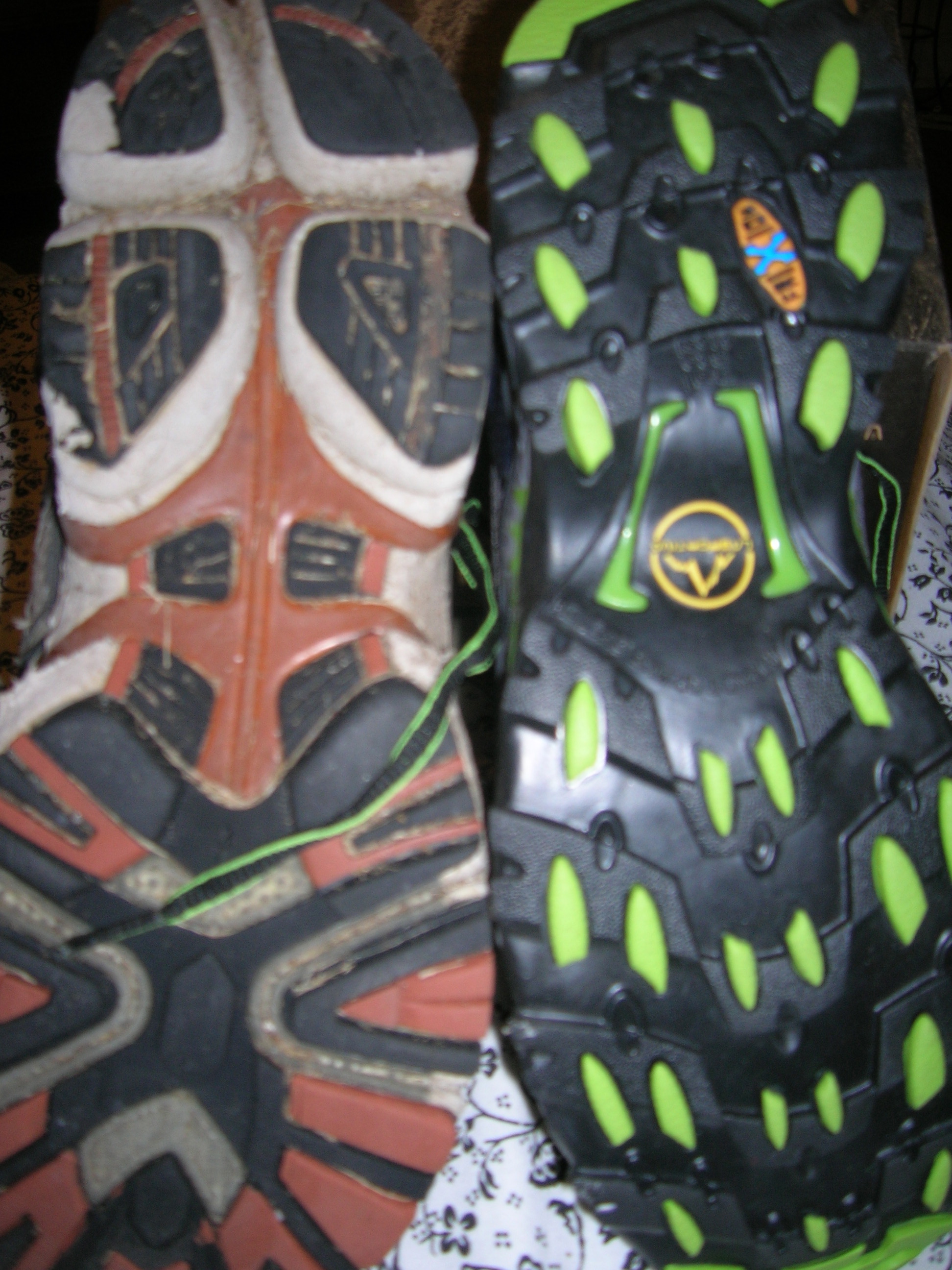
The old (Asics Trail Sensor circa 2009) and the new (La Sportiva Wildcat circa 2013)

The old (Asics Trail Sensor circa 2009) and the new (La Sportiva Wildcat circa 2013)

New shoes I had researched and pondered, read reviews about and weighed pros and cons before arriving at my decision. I looked for them in stores and ultimately ordered on the web. Even guessed right on the European size.

I am loyal to my shoes. Not the brand specifically but actually to the shoes. I do not part ways with them easily. I wear them until they are frayed. Until chunks of rubber are missing from the sole. Until I am pretty sure the mid sole layer has lost its cushioning. Yet, I have seen pictures of the poorest of the poor running around or carrying water in tattered shoes, or no shoes and I know even at their worst my old shoes are quite adequate.  And so I relinquish them reluctantly and don new shoes undeservedly.

But I am attached to old shoes for quite another reason too. We have traveled together for so long. The rubber rand covering the front of the shoes is peeling. The lining around the heel has worn completely away after thousands and thousands of steps on streets and sidewalks and grassy fields and trails criss crossing county and state parks, as my shoes and I have hiked our way together across rocks in a fast flowing brook or run across a wooden bridge while looking upstream at  riffles of frothy white water. They were with me when I ran a trail race and badly sprained my ankle and they were with me the following year when I redeemed myself on the same course.

Old sole, new sole.

Old sole, new sole.

I look at the worn sole but don’t see shoes worn out. Rather I see miles walked, hiked, run.

Yet the trail does seem more fresh and alive and spirited with my new shoes, a feeling which I attribute to more than better cushioning and less fraying. I am inspired by the possibilities of the new, real or imagined. The shiny sole of my new shoes with their special features to provide traction on uneven terrain beckons the deep forest trail. And I will even take inspiration from the picture on the shoe box, of men I know not, running toward towering mountains I know not where in a place I will likely never be.

Photo on the cover of the La Sportiva Wildcat shoes

Photo on the cover of the La Sportiva Wildcat shoes

(Old shoes: Asics Trail Sensor. New shoes: La Sportiva Wildcat)

Walking with the wisdom of the crowd…

My son and I set out to explore a rock climbing crag nearby, recently approved by the municipal land owners and sanctioned for climbing. The area is an otherwise unused strip of land, long with several undulations of granite cliffs no more than 100 feet tall with several smaller rock formations at its base. The most prominent feature of this wooded land however is a series of towering power lines. The land is actually a power company right of way for high capacity electrical lines. Indeed, if you listen carefully it is possible to hear a faint crackling of electricity traveling through the lines at the top of the steel super structures which stand guard on otherwise undeveloped woodlands.  images

No formal trails lead to the rocks but faint foot paths have stomped down tall grasses. In some areas a dirt path has emerged but no blazes mark the trail. Leave the parking lot, look for a faint trail and walk. Look for a stream and cross by a  fallen log the instructions explain. Pick up a trail on the other side, faint as it is. Finally crossing a dirt road one sees an official sign at the informal entrance to this newly opened rock climbing area.

514744213_1c0dcc8046

Neither my son nor I are real climbers. We have climbed in indoor climbing gyms which simulate some of the athletic moves needed for outdoor climbing on real rock slabs. And we have climbed once in the famous Shawungunk climbing area in New Paltz, NY under the supervision of a watchful and well trained guide. So we were just scoping out this new venue to see if we and the rocks made a good match.

By the time we started hiking into the woods we did not have too much time to explore but did have enough time enough to spot a flock of goldfinches dressed in their bright summery ellow and black plumage flying in and around some low brush.

imgresOn the way back we lost the trail, with no supplies, lights or even water. We were never more than half mile or so from the car but with dusk approaching the thought of stumbling around in the dark in an unfamiliar woods was unappealing. While we lost the main trail, faint as it was, we picked up several other ‘herd’ paths – that is, trails going this way and that left by the footfalls of previous hikers. On some summits a herd path usually leads to a great view, or short cut to the trail’s continuation. The herd path deviates from the main blazed path, placed purposefully by the trail maintainer. White rectangles 2 inches wide and 3 inches long mark the entire 2,160 miles of the Appalachian Trail.

Herd wisdom, or the wisdom of the crowd, has been around for eons. Thompson’s Gazelle‘s use the wisdom of the crowd to turn tail and bolt in the opposite directions from a prowling lion. Schools of fish do the same. And now a days humans ‘crowd source’ using the collective information gathering skills of hundreds to pull resources together to yield new information hitherto not easily knowable.

But walking in the woods in the waning light, pushing away boughs of thorn bushes obstructing the faint herd paths we had little choice but to follow the foot steps of walkers before us, and hope that their intentions in walking this ground were our intentions, that they were going, or coming, from the direction we sought. It felt comforting to embrace the wisdom of the footsteps of the crowd which indeed led us back to where we started.

Mount Sharp: The Galaxy’s Newest Hike

Hike your local glen or glade. Hear the sounds of cascading brooks. Take a few days for a rim to rim hike of the Grand Canyon, or circumnavigate Mt. Rainier‘s 93 mile Wonderland Trail. Perhaps be lucky enough to trek to Mt. Everest base camp, traversing the foothills of the Himalayas.

Mount Sharp, seen from Mars rover Curiosity. NASA/JPL photo.

Mount Sharp, seen from Mars rover Curiosity. NASA/JPL photo.

Now, start dreaming about Mount Sharp, the most exotic new hike most of us will never do. But, thanks to NASA’s Jet Propulsion Laboratory we can follow Curiosity the Mars rover as it begins its approach toward this 18,000 foot mountain.

NASA/JPL comparison of Mount Sharp to high Earth peaks.

NASA/JPL comparison of Mount Sharp to high Earth peaks.

Despite the lack of water falls, the sound of birdsong or the smell of fresh pine needles, Mount Sharp has one thing no other hike this side of the Milky Way can boast: It has never seen the the imprint of a human footstep. For even if you hike to the coolest trek on our planet, you will likely not be alone. You may even find an empty plastic water bottle lying in the forest duff or see the remnants of a campfire from the weeks before.

Contemplate finding complete solitude on virgin ground. Absorb majestic views never seen before, except by a camera on a  rover. But take your own water, as you will find none  on the red planet and take your best down coat, mittens and booties to help  survive nighttime temperatures of -100F. Oh, and take oxygen too. Perhaps the  hike on the nearby forest trail I’ve been to a dozen times might do just fine.

Curiosity rover tracks point toward Mt. Sharp. NASA/JPL photo.

Curiosity rover tracks point toward Mt. Sharp. NASA/JPL photo.